
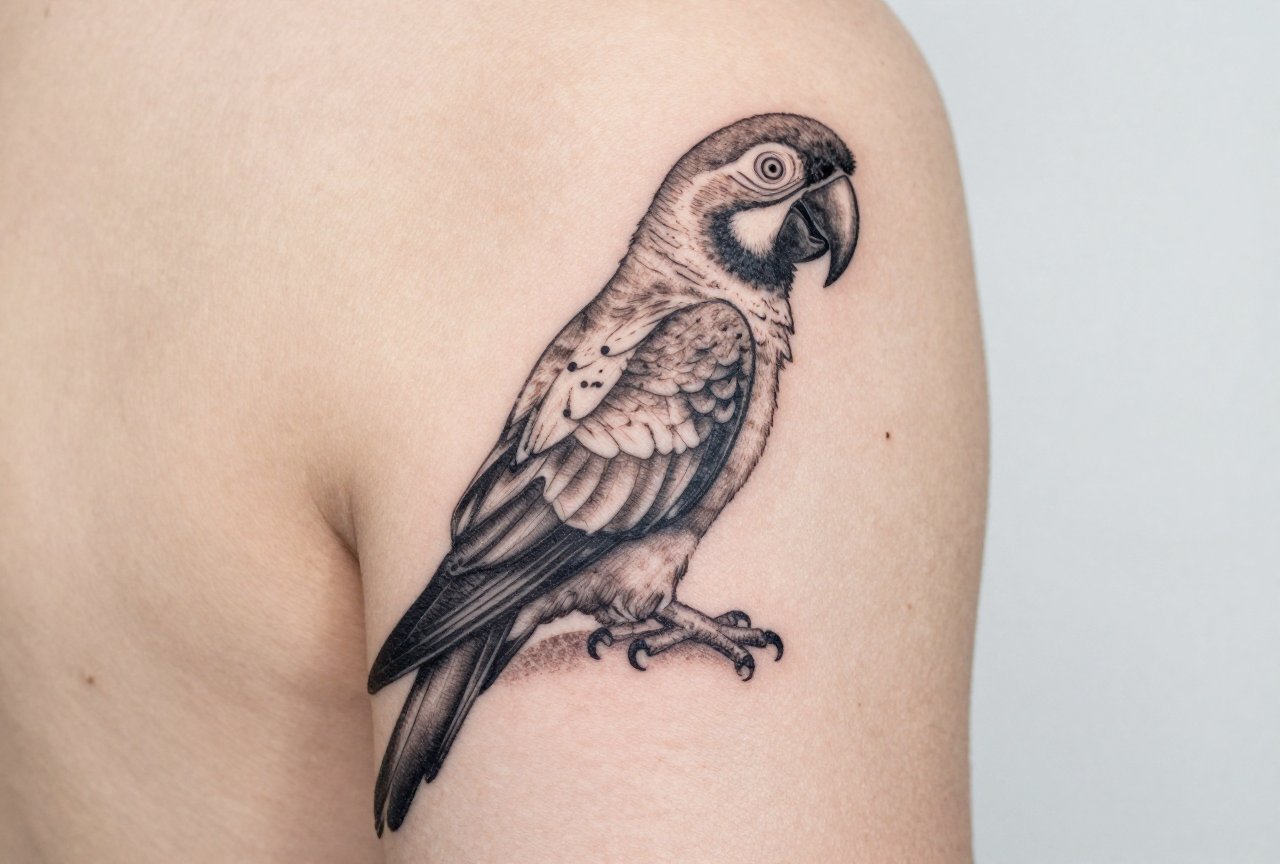
A parrot tattoo usually means voice, freedom, and living out loud. People get them to mark finding their own words after silence, or to celebrate someone colorful who won’t be caged. I’ve tattooed parrots on throats, ribs, shoulders, every placement tells a slightly different story about why that person walked in.
Symbolism & History
Parrots have carried weight across cultures for centuries. Sailors got them first, literally brought them back from voyages, then started wearing them on skin. That maritime connection stuck: travel, adventure, the exotic, the story you bring home. I’ve had clients whose grandfathers were Navy men, getting a parrot to honor that lineage without the usual anchor cliché.
Voice and Communication
This is the big one. Parrots speak. They mimic, sure, but they also learn context, timing, emotional tone. A parrot tattoo often marks someone who finally found their voice, left a bad relationship, came out, started speaking up in rooms where they used to stay quiet. I did one on a singer’s forearm after she recovered from vocal surgery. The bird’s beak was open, mid-squawk. She wanted that moment captured, not a pretty bird sitting still.
Freedom vs. The Cage
There’s tension in parrot symbolism. They’re wild birds that live in cages. People play with that duality, broken cage bars, an open door, feathers drifting through. I’ve seen this resonate hard with folks who grew up in restrictive homes or religions. One guy got a scarlet macaw bursting through a cage on his back piece. The cage was his family’s church, he told me. The bird was him at thirty-five, finally gone.
- Travel and wanderlust, especially maritime or tropical
- Communication, finding or reclaiming your voice
- Color and vibrancy, refusing to fade into background
- Intelligence and mimicry, sometimes trickster energy
- The cage/freedom tension, escaping constraint
Common Variations & Styles
Not all parrots read the same. The species matters, the style matters more. I’ve watched trends shift over fifteen years in shops, what clients bring in, what Pinterest shows them, what we actually recommend.
Macaws and Cockatoos
Macaws hit different. They’re huge, loud, primary colors that don’t exist in nature elsewhere. That scale translates to tattoos needing real estate, thigh, back, outer arm. I try to talk people out of tiny macaws. The color packing is dense, the detail gets muddy under an inch. Cockatoos read softer, more emotional. That crest up or down changes the whole feeling. I’ve done cockatoos with crests flat for clients marking depression periods, crests raised for recovery.
Traditional and Neo-Traditional
Sailor Jerry parrots are classics, bold lines, limited palette, often with a banner or dagger. They age beautifully. The heavy black holds, the simple color fields don’t blur into each other. Neo-traditional gives more room for jewel tones, ornamental backgrounds, but still keeps enough line weight to last. I steer clients toward these styles if they want longevity over Instagram impact. Watercolor parrots look stunning fresh. I’ve watched them fade to bruise-colored smears in five years. The yellows and light greens go first, always.
- Traditional: Bold lines, limited colors, ages best, maritime heritage
- Neo-traditional: Expanded palette, ornamental elements, still holds up
- Realistic: Requires large scale, expert color packing, high maintenance
- Watercolor: Stunning fresh, unpredictable aging, not for commitment-phobes
- Minimalist/line: Focus on silhouette or single feather, subtle meaning
Best Placements
Where you put it changes how people read it, and how it lives on your body.
Throat and neck placements are bold, literally about voice, can’t be hidden. I’ve done three throat parrots, all on performers or public speakers. The pain is real; we schedule longer sessions, more breaks. Ribs work for personal pieces, something you show selectively. The canvas is long and curved, suits a parrot’s body shape. Color saturation struggles here though, thin skin, lots of movement, healing gets tricky. I warn clients: rib tattoos often need touch-ups.
Shoulder cap and outer arm are workhorses. Easy to show, easy to cover, enough flat area for detail without the rib distortion. Forearm reads conversational, people see it, ask about it. I’ve had clients say that’s exactly what they want, the parrot as conversation starter. Ankle and foot? Small parrots look like generic birds. I decline those requests now unless it’s a single feather or stylized silhouette.
- Throat/neck: Maximum visibility, voice symbolism, high pain commitment
- Shoulder/outer arm: Balanced visibility, good detail real estate, ages well
- Ribs: Personal, private, anatomical challenges for color
- Forearm: Social, conversational, moderate pain
- Back piece: Epic scale, full species accuracy, major time investment
Who Chooses This Tattoo / Personal Meanings
After years in the chair, patterns emerge. Not stereotypes, just human tendencies I notice.
Performers gravitate here: musicians, actors, drag artists. The parrot’s theatricality matches their own. I’ve tattooed parrots on a burlesque dancer’s hip, a slam poet’s chest, a podcast host’s forearm. Each one talked about voice, presence, refusing to be background noise.
People in recovery choose parrots too. The “finding your voice” narrative fits addiction, eating disorders, abusive relationships. One woman got a grey parrot, specifically an African grey, the talking breed, after leaving a marriage where she wasn’t allowed opinions. She researched species for months. That specificity matters; it makes the tattoo hers, not a generic symbol.
Travelers sometimes, though they more often pick compasses or maps. The parrot traveler tends to be the immersive kind, lived in Costa Rica, worked on a boat, something embodied. Not the passport-stamp collector. I can usually tell which within five minutes of talking.
Commemorative Parrots
Pet memorials happen. Parrots live decades; they outlive dogs, sometimes relationships. I tattooed a blue-and-gold macaw on a man’s calf after his thirty-year companion died. He cried in the chair, not quietly. We stopped twice. That’s shop reality, sometimes the tattoo is grief processing, not decoration. I keep tissues in my station, not just for wiping ink.
Similar Symbols
Clients often compare parrots to other birds. Here’s how I talk them through it.
Phoenix is rebirth, fire, dramatic transformation. Parrot is more about ongoing voice, daily aliveness. Ravens and crows carry shadow, mystery, intelligence without warmth. Parrots are social, almost comedic. Eagles are power, nationalism, masculine archetype. Parrots subvert that, colorful, talkative, not predatory.
Lyres or microphones voice too, but literally. Parrot adds the animal, the wild, the refusal to be fully tamed. I had a songwriter choose between parrot and microphone; she went parrot because “the microphone is the tool, the parrot is the creature using it.” That distinction stuck with me.
- Phoenix: Rebirth, dramatic transformation, fire
- Raven/crow: Mystery, shadow, solitary intelligence
- Eagle: Power, dominance, traditional masculinity
- Lyres/microphones: Voice as craft, tool, performance
- Parrot: Voice as identity, social connection, untamed color
Final Thoughts
A parrot tattoo works when the person connects to something specific, species, story, moment of finding voice. It fails when it’s just “pretty bird.” I’ve watched both. The best ones come from clients who’ve thought about why this animal, why now, why this placement. The worst come from Pinterest boards with no personal anchor.
Color aging is real. Talk to your artist about how those bright greens and yellows will settle. Ask about touch-up plans. A good parrot tattoo at five years should still read as parrot, not faded tropical smear. I’ve done cover-ups on enough failed watercolors to be evangelical about this.
What I love about parrot tattoos is the conversation they start. In my chair, people tell stories. The parrot brings out voice, appropriately. That’s the magic, getting the symbol you actually needed, not the one you thought looked cool.
Frequently Asked Questions
Do parrot tattoos fade faster than other color tattoos?
Yellows and light greens fade quickest, especially in watercolor styles. Traditional and neo-traditional hold better because of heavier black outlines. I always warn clients that bright parrot colors will need touch-ups in five to seven years.
What’s the most painful placement for a parrot tattoo?
Throat and ribs hurt most, throat because the skin is thin and sensitive, ribs because of constant movement and proximity to bone. Shoulder and outer arm are much more manageable for long color sessions.
Can a small parrot tattoo still look detailed?
Under two inches, parrots lose species specificity and start looking like generic birds. I recommend minimum three inches for recognizable detail, or going minimalist with just a silhouette or single feather.
Is there a difference in meaning between a talking parrot species and a non-talking one?
Absolutely. African greys and Amazons emphasize communication and voice. Macaws and cockatoos lean more toward visual vibrancy and emotional expression. Clients who research species usually have deeper personal connections to the specific bird they choose.
Related Tattoo Meanings
- Gun Look Like Tattoo Meaning: Power, Rebellion Raw Identity
- Aces Tattoo Meaning: Luck, Rebellion, and Going Solo
- Matt Rife Wrist Tattoo Meaning: What It Says Why It Matters
- Explore more









