
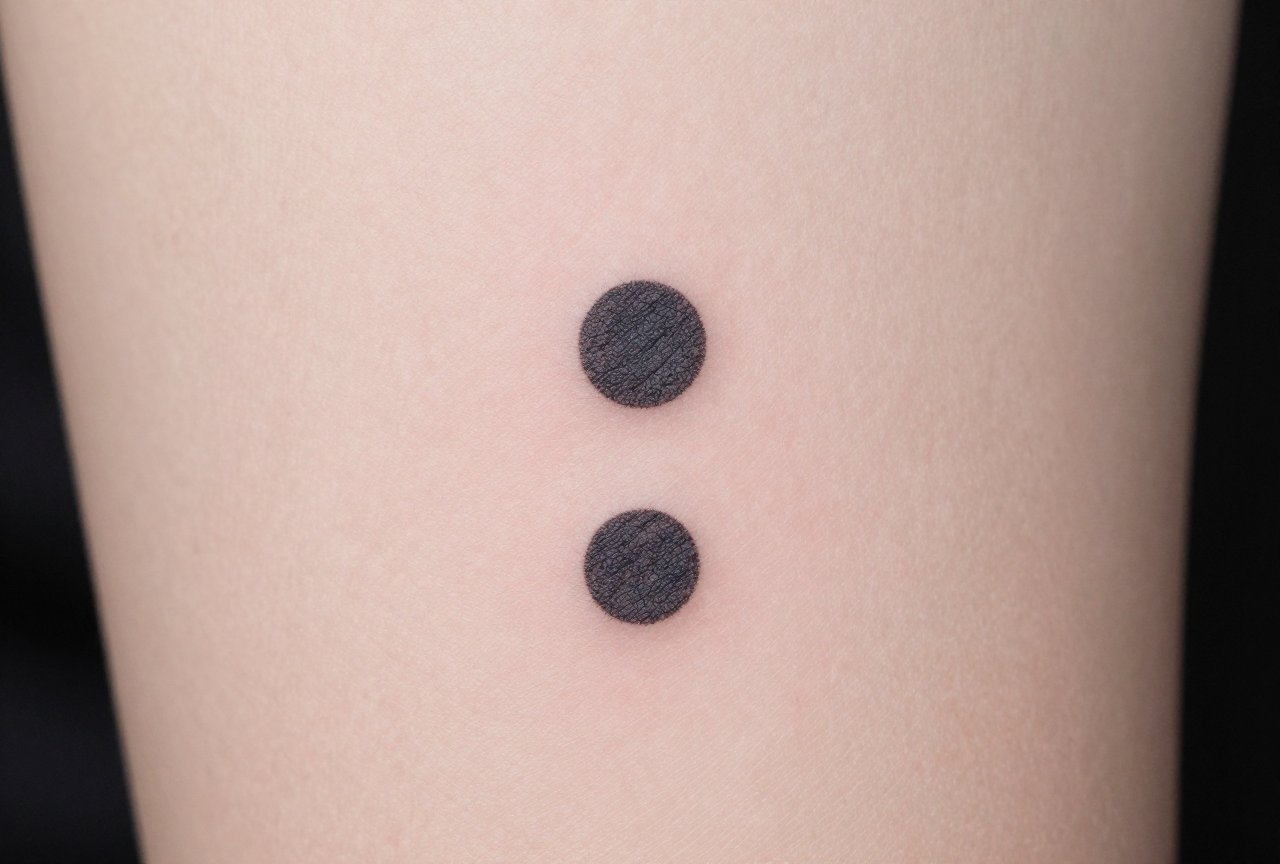
Two dots tattoo meaning shifts depending on who you ask and what they need it to say. it’s punctuation made permanent, a pause, an ellipsis, a colon, or simply two points marking something left unsaid. I’ve tattooed these tiny marks on fingers, behind ears, on ribs where they hide from everyone except the person who chose them. The meaning is almost never universal; it’s intimate, coded, sometimes deliberately vague.
Symbolism & History
The beauty of two dots is their refusal to pin down. Unlike a cross or a lotus, they don’t arrive with a borrowed cultural weight. They’re closer to a secret language, and that’s exactly why people keep asking for them in my chair.
Punctuation & The Unfinished
Most commonly, two dots read as an ellipsis, something trailing off, unresolved, continuing beyond what the eye can see. I’ve had clients tell me it marks a story they can’t finish yet. A grief they haven’t processed. A relationship that ended mid-sentence. The skin becomes the page where the pause lives. One woman, voice steady but hands shaking, said it was for her brother’s sentence cut short. She placed them on her left wrist, where she’d see them typing, where the pause would remind her.
Others read two dots as a colon: what follows, what’s next, the promise of something to be named. I’ve heard it called “the before”, two points waiting for the rest of the statement to arrive.
Minimalism as Resistance
The two dots tattoo exploded alongside the broader minimalist movement, but it carries something older. Prison tattoo culture used simple dot patterns as coded communication. Three dots in a triangle meant “mi vida loca.” Two dots had quieter associations, sometimes marking time served, sometimes a more personal tally. I always ask clients if they know this history. Most don’t. Some care, some don’t. The information belongs to them either way.
- Ellipsis: the unsaid, the ongoing, the interrupted
- Colon: what comes next, potential energy
- Binary: 0 and 1, duality, on/off, presence/absence
- Prison coding: historical association with time served or personal count
- Pure geometry: two points defining a line, direction, relationship
Common Variations & Styles
Two dots sounds simple until you’re the one trying to make them survive five years of sun and cell phone friction. I’ve seen beautiful disasters and boring perfection. The difference is usually in the details clients don’t think to ask about.
Hand-Poked vs. Machine
Hand-poked two dots carry a specific softness, a slight irregularity that reads as organic. Machine work can get cleaner, sharper, but “clean” on day one often means “blown out” by year three. I hand-poke a lot of these, especially on fingers and faces. The needle depth is everything. Too shallow and it falls out in two weeks. Too deep and you’ve got two permanent bruise-looking smears instead of dots. I tell clients: these will age like a watercolor or like a stamp, and the technique decides which.
Size, Spacing & Color
The gap between dots matters. Close together, they read as a single mark, a pause. Further apart, they become two separate events, two people, two moments. I’ve done them touching, creating a tiny figure-eight infinity. I’ve done them two inches apart on a collarbone, framing nothing, making the skin between them feel charged.
Color is rare but potent. Black dominates. I’ve done one red, one black, blood and ink, two states of being. I’ve done UV-reactive dots that only show under club lights, which sounds cool until you remember UV ink has a patchy reputation and most of us won’t guarantee it.
- Standard black, 2-3mm diameter: classic, readable, ages best
- Hand-poked with sewing needle or professional needle: softer edges, more organic
- Stipple texture around dots: adds depth, risks muddying over time
- Vertical or horizontal orientation: changes the emotional read completely
Best Placements
Where you put two dots changes their grammar. I’ve learned this from watching clients touch them unconsciously, from seeing which placements they cover and which they flash.
Fingers and hands are the most requested. They’re visible, declarative, slightly dangerous in professional contexts. The skin here sheds fast, moves constantly, takes abuse. I warn everyone: finger dots need touch-ups. Plan for it. The between-finger placement, that webbing, is especially brutal, thick skin, lots of movement, high fall-out rate. I’ve seen perfect dots vanish in six months.
Behind the ear offers concealment with easy revelation. Hair down, they’re private. Hair up, they’re a statement. The skin here is thin, takes ink well, heals relatively clean. I’ve done dozens here, usually on people who want the choice of visibility.
Ribs, hip bones, sternum, these are for the wearer alone. They hurt more, being near bone and thin skin, but the privacy is the point. One client said her rib dots were her “breath marks,” placed where her lungs expand, reminding her to keep going.
Face, under the eye, beside the eye, temple. I’ve done fewer of these. They read differently, carry more weight. The face doesn’t hide anything. I spend extra consultation time here, make sure the person knows what they’re choosing in terms of social read, not just personal meaning.
Who Chooses This Tattoo / Personal Meanings
After fifteen years, I can tell you the “type” doesn’t exist. I’ve tattooed two dots on a seventy-year-old retired professor and a nineteen-year-old SoundCloud rapper. The through-line is need, not demographic. Something specific wants marking, and the minimal form feels right.
Grief & Continuation
This is the most common story I hear, and I never ask directly. People offer it. Two dots for someone who died mid-sentence. For a life that should have kept going. The ellipsis as elegy. I’ve cried in my station twice, both times with this variation. The smallness of the tattoo against the size of the loss is the point. It doesn’t try to contain the grief. It marks that the grief continues.
Transitions & Thresholds
Divorce, sobriety, coming out, leaving a religion, starting over in a new city. The colon reading dominates here. Two dots as doorway. I’ve heard “to be continued” more than once. One guy got them after leaving his law firm to become a carpenter, placed on the hand that now holds a chisel. The dots face him while he works.
Relationships & Duality
Two people. Two dots. Simple math. I’ve done matching sets on couples, on siblings, on friends who’ve outlasted every romantic relationship. The spacing is intentional, close but distinct, related but separate. I’ve also done them as self-reminders: the two sides of a person, the public and private, the before and after.
Similar Symbols
Clients often arrive considering alternatives. I walk them through the differences so they don’t regret the minimalism later.
Three dots (ellipsis or triangle): More established in specific subcultures. The triangle of three dots carries gang and prison associations that can complicate a simple personal meaning. The horizontal three dots is standard punctuation, less ambiguous than two.
Semicolon: The mental health awareness symbol, more specific, more publicly coded. If you want that conversation, it’s clearer. If you want privacy, two dots keep it yours.
Ampersand: Connection, continuation, the “and” of ongoing story. More decorative, more legible as language. Less mysterious.
Single dot: The period. Finality. I’ve done these too, usually for people who want something even more stark, more closed. The single dot is harder to read as intentional, it can look like a freckle, a blemish, a mistake. Two dots declare themselves as design.
Final Thoughts
Two dots tattoo meaning lives in the gap between the marks and the skin, between what you say and what you don’t. I’ve watched this tiny design carry more weight than full sleeves, precisely because it asks the viewer to fill in the blank. The best ones I’ve done were for people who understood that the tattoo wouldn’t explain itself. They’d need to carry the explanation, or choose not to offer one.
If you’re considering this, think about the space between your dots as much as the dots themselves. That space is where your meaning lives. Find an artist who does small work well, who knows how to make pigment stay in skin that wants to reject it, who won’t rush something that takes patience to do right. And be ready for the question you’ll get a hundred times: “What do those two dots mean?” The answer is yours to give or withhold. That’s actually the point.
Frequently Asked Questions
Do two dots tattoos fade faster than other small tattoos?
They can, especially on fingers and hands where skin regenerates quickly. The minimal ink means less margin for error, slight fading makes them disappear rather than just soften. Plan for a touch-up, and choose placement with this reality in mind.
How much should I expect to pay for two dots?
Most shops have a minimum charge regardless of size, typically $50-$150 depending on city and artist. Some artists charge less for hand-poked work, others more for the specialized skill. Don’t expect it free because it’s small, precision at tiny scale is harder, not easier.
Can two dots be covered up or removed easily if I change my mind?
Removal is actually easier than with dense blackwork since there’s less pigment. Cover-ups are simple too, two dots become eyes, seeds, part of a constellation, or get integrated into a larger design. Their minimalism is forgiving in both directions.
Will people assume my two dots tattoo has a specific meaning I don’t intend?
Most people won’t recognize any fixed meaning since there isn’t one universally. The prison association is obscure enough that few outside tattoo culture know it. If asked, you’re free to offer your meaning or simply say “it’s personal”, most will respect that.
Related Tattoo Meanings
- Two Face Tattoo Meaning: Duality, Conflict Inner Truth
- Weeping Willow Tattoo Meaning: Grief, Resilience Deep Roots
- Parrot Tattoo Meaning: Symbolism, Styles What Artists Notice
- Explore more









