
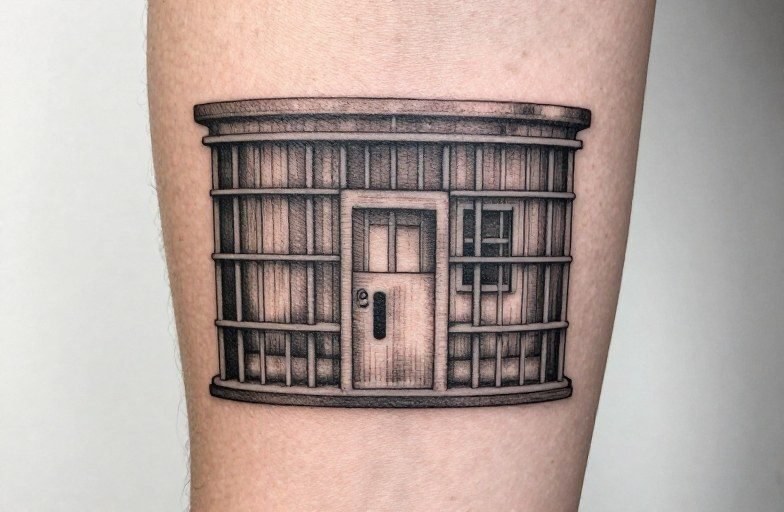
Jailhouse tattoos, also called prison tattoos or joint tattoos, are markings made under incarceration using improvised tools and limited ink. They signal time served, gang affiliation, personal survival, or status within the prison hierarchy. Outside prison walls, people sometimes choose these designs for their raw aesthetic, their connection to resilience, or as a nod to specific artists and movements that emerged from confinement.
Symbolism & History
The origins of jailhouse tattooing are often linked to sailors and soldiers in the 19th and early 20th centuries, who sometimes marked themselves while detained or in military prisons. Some trace it to Depression-era chain gangs and federal penitentiaries where men with time and little else created entire visual languages from guitar strings, melted chess pieces, and ballpoint pen ink.
The Visual Language of Survival
Inside, a tattoo is rarely decorative. Placement, imagery, and completion all carry weight. A teardrop under the eye might indicate a killing, a loss, or time served, definitions shift by region and era. Spider webs on elbows or necks commonly mark time inside, with the number of rings or concentric circles sometimes corresponding to years. Three dots in a triangle (mi vida loca) often signal gang life or a general “crazy life” philosophy, though specific gangs claim variations.
- Clock with no hands: “Doing time”, time moves differently inside, or time has stopped for the wearer.
- Five-point crown: Often linked to Latin Kings, though the specific design elements (points, colors, accompanying text) determine actual affiliation.
- Playing cards: The suits carry specific meanings, spades for thieves, hearts for lovers or family, clubs for criminals of violence, diamonds for informants or those who cooperate.
- Barbed wire: Years served, with each barb sometimes representing a specific sentence length.
Regional Variations
California prison art, particularly Chicano black-and-grey fine-line work, heavily influenced modern street tattooing. Russian prison tattoos developed an even more elaborate system, with orthodox church domes on shoulders indicating rank, stars on knees meaning “I kneel to no one,” and cats signaling thieves in law. These systems don’t translate cleanly, wearing Russian prison imagery without the lived experience is widely considered dangerous and disrespectful.
Common Variations & Styles
Authentic jailhouse work has a distinct look: bold black lines, limited shading, sometimes blown out or uneven from hand-poked application. Modern tattooers who specialize in this aesthetic often replicate the visual language while using professional equipment.
Hand-Poked vs. Machine Replication
True hand-poked jailhouse tattoos are made by repeatedly jabbing ink into skin with a sharp point, sewing needles, paper clips, sharpened guitar strings. The result is a specific texture: slightly raised lines, variable saturation, sometimes scarred or keloided healing. Machine work that mimics this style uses single needles and careful voltage control to achieve similar line quality without the same trauma.
Styles that borrow from prison aesthetics include:
- Chicano black-and-grey: Soft shading, religious imagery, payasa (clown girl) faces, fine-line script.
- Ignorant style: Purposefully crude, anti-technical work that embraces the rawness of amateur tattooing.
- Traditional bold: Thick black outlines, limited color palette, simple readable imagery.
Script and Lettering
Prison tattoo script tends toward specific fonts: Old English for territory and gang affiliation, cursive for names of loved ones or memorials, simple block letters for slogans or codes. Lettering ages predictably, fine script spreads and blurs over decades, while bold block letters remain readable longer. This matters when choosing placement; hand and finger tattoos fade fastest due to constant use and sun exposure.
Best Placements
Placement in jailhouse tattooing was never arbitrary. Visible locations meant status you couldn’t hide; hidden spots meant information shared only with those who needed to know.
- Face and neck: The most committed placement. Teardrops, crosses, initials, and symbols here are immediately legible to other inmates and, later, to employers and strangers. These fade unevenly due to skin movement and sun exposure.
- Hands and knuckles: Common for letters (one per finger), symbols, or short words. “HOLD FAST” and “LOVE HATE” have sailor origins but were adopted in prison. Hand skin regenerates quickly; these require regular touch-ups to maintain.
- Elbows and knees: Spider webs, stars, and other “joint” markers. These spots hurt significantly due to bone proximity and thin skin, which historically demonstrated toughness.
- Chest and back: Larger canvases for religious imagery, names, or narrative scenes. Better aging than extremities, with more room for detail that won’t blur together over time.
Modern wearers choosing prison-style imagery should consider that face and hand tattoos still carry heavy professional and social consequences, regardless of personal intent. The ink doesn’t explain itself.
Who Chooses This Tattoo / Personal Meanings
People outside prison get jailhouse-style tattoos for several distinct reasons, and the meaning shifts accordingly.
Connection to Subculture or Aesthetic
Some are drawn to the raw visual language, bold lines, limited palettes, anti-preciousness. This overlaps with punk, hardcore, and certain streetwear aesthetics. The choice is stylistic, not experiential.
Family or Personal History
Others have incarcerated parents, siblings, or partners and choose these markings to maintain connection or process trauma. A father’s prison tattoo replicated by his child carries different weight than the same image chosen for fashion.
Resilience and Survival Narratives
Some wearers have their own incarceration history and continue to mark themselves with the visual language they developed inside. Others who’ve survived different forms of institutionalization, foster care, psychiatric facilities, military service, sometimes adopt prison imagery as broader metaphor for surviving controlled environments.
The critical distinction: wearing imagery tied to specific gang affiliation, rank, or criminal achievement without the corresponding experience can provoke genuine danger in certain contexts. Research thoroughly. Ask your tattooer. When in doubt, choose generalized imagery over specific coded symbols.
Similar Symbols
Several tattoo traditions overlap with jailhouse work and are sometimes confused or deliberately blended.
- Sailor Jerry / traditional naval tattoos: Shared imagery includes swallows (distance traveled), anchors (stability), and “HOLD FAST.” Naval and prison tattooing historically influenced each other in port cities and military brigs.
- Russian criminal tattoos: Far more codified than American prison work, with specific images mandatory for specific crimes and ranks. The orthodox imagery and star systems are often copied aesthetically without understanding their hierarchical function.
- Chicano fine-line art: Emerged from East Los Angeles barrio and prison culture, then entered mainstream tattooing through artists like Freddy Negrete. Religious imagery, payasas, and ornate script remain signature elements.
- Ignorant and DIY tattooing: Contemporary movements that embrace amateur technique, crude drawing, and rejection of polish. Shares the anti-establishment ethos but lacks the specific survival context of prison work.
Final Thoughts
Jailhouse tattoos carry weight that outlasts their making. The imagery developed in confinement as communication, status, and psychological survival tool. Today, that same imagery circulates in mainstream tattooing, sometimes stripped of context, sometimes worn with full knowledge of its history.
If you’re considering this style, do the research specific to the imagery you want. Understand that placement, design details, and regional variations all carry meanings you may not intend to signal. Choose a tattooer who knows the difference between aesthetic reference and coded communication. The best prison-style tattoos honor the tradition without pretending to lived experience that isn’t yours, respecting the source while making something honestly your own.
Frequently Asked Questions
Can I get a jailhouse-style tattoo without having been to prison?
Yes, but choose carefully. General imagery like bold lines, script, or certain religious icons are widely available. Avoid specific gang symbols, rank markers, or coded imagery tied to actual prison hierarchies, as these can provoke dangerous misunderstandings.
Do hand-poked tattoos heal differently than machine tattoos?
Hand-poked work often heals with slightly more texture or scarring due to inconsistent depth and trauma. They may also fade faster or blow out more readily. Professional machine work replicating the style typically heals cleaner while maintaining similar visual results.
Why do some prison tattoos look blurry or blown out?
Improvised needles, inconsistent depth, and low-quality ink all contribute to blowout, ink spreading in fat layers beneath the intended line. This is common in actual jailhouse work. Some modern wearers deliberately seek this effect; others want the style without the technical flaws.
Are face tattoos always associated with prison culture?
No. Face tattooing appears across many cultures and subcultures, from Polynesian traditions to modern SoundCloud rap aesthetics. However, specific placements like teardrops or certain script styles remain strongly linked to incarceration and gang affiliation in North American contexts.
Related Tattoo Meanings
- MS-13 Tattoos and Meanings: A Shop-Level Guide
- Japanese Temple Tattoo Meaning: Symbolism, Styles Placement
- Johnny Silverhand Tattoo Meaning: Cyberpunk Rebellion Inked
- Explore more









