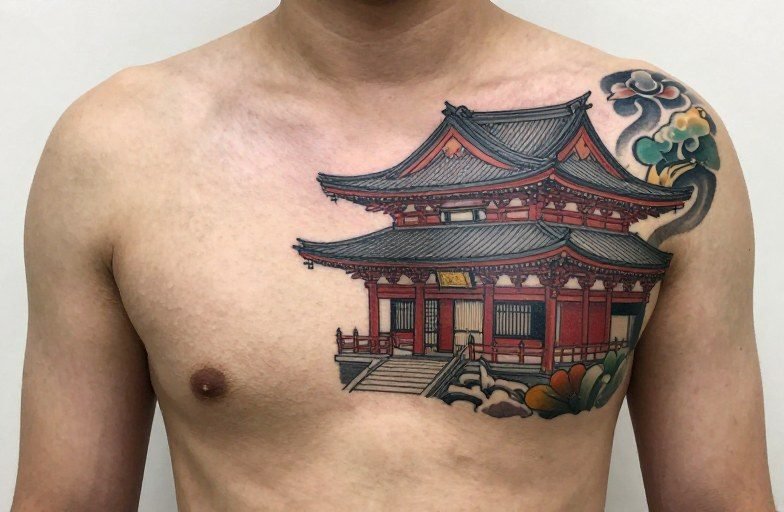
A Japanese temple tattoo typically represents spiritual shelter, personal transformation, and the boundary between the mundane and the sacred. The imagery draws from Buddhist and Shinto architecture, pagodas, torii gates, and temple complexes, each carrying distinct symbolic weight depending on what elements the artist includes and how they’re composed.
Symbolism & History
The Temple as Refuge
In Japanese visual culture, the temple (tera or jiin) has long signified a place removed from ordinary life. Tattoo compositions often exploit this by framing the temple amid natural obstacles, mist, steep paths, dense forest, emphasizing that reaching sanctuary requires effort. The torii gate, frequently paired with temple imagery, marks a literal threshold; in tattoo work, it commonly represents a personal transition or commitment to a new path.
Buddhist temple architecture itself carries coded meaning. The five-story pagoda (gorintō) corresponds to the five elements of Buddhist cosmology, earth, water, fire, wind, and void, stacked in ascending order. A tattoo featuring this structure can function as a personal mandala, though artists vary in how explicitly they render these elemental associations. Some clients request cracked or weathered pagodas to suggest endurance through difficulty; others want pristine, idealized versions representing aspirational goals.
Historical Context for Tattoo Collectors
Religious imagery in Japanese tattooing (irezumi) carries complex baggage. During the Edo period, tattooing was often linked to punishment and outcast status, yet simultaneously developed elaborate pictorial traditions borrowing from ukiyo-e woodblock prints. Temples and sacred landscapes appeared in these prints as settings for narrative scenes, pilgrims, travelers, monks, rather than as isolated devotional images. This narrative tradition persists: a Japanese temple tattoo today usually works best as part of a larger scene rather than a standalone architectural study, though minimalist exceptions exist.
- Torii gates: transition, commitment, entering sacred space
- Five-story pagoda: elemental balance, spiritual ascent
- Stone lanterns (tōrō): guidance, memory, illumination
- Weathered wood and moss: time, persistence, natural reclamation
- Mountains behind temples: aspiration, isolation, the hermit’s path
Common Variations & Styles
Traditional Japanese (Irezumi)
Full-back or bodysuit compositions in this style treat the temple as one element within a sweeping landscape. Backgrounds feature bold, flat color fields, deep teals, blood reds, heavy black, with the temple rendered in architectural detail against simplified natural forms. Line work tends toward thick, confident outlines with minimal tapering. Temples in this style rarely stand alone; they’re paired with cherry blossoms, pines, dragons, or figures to create narrative depth.
Black and Gray Realism
Contemporary Western adaptations often isolate temple architecture for photorealistic treatment. Here, the focus shifts to texture: moss on stone, grain in aged wood, the particular quality of light through temple eaves. This approach demands larger scale to resolve detail, typically upper arm, thigh, or back panel. Without color to separate planes, artists rely heavily on atmospheric perspective and careful value control to push the temple back into mist or pull it forward as focal point.
Minimalist and Linework
Reduced to essential rooflines and gate silhouettes, temple imagery suits smaller placements and faster sessions. The challenge becomes recognition: too minimal and the structure reads generic; just enough detail and it becomes unmistakably Japanese. Single-needle or fine-line artists often incorporate negative space to suggest the temple emerging from or dissolving into skin.
- Traditional irezumi: narrative context, bold color, large scale
- Black and gray realism: textural detail, atmospheric depth, medium to large
- Minimalist linework: symbolic reduction, smaller scale, faster healing
- Neo-Japanese: blended Western/Japanese techniques, experimental color
Best Placements
Scale and composition dictate placement more than with many tattoo subjects. A temple’s vertical emphasis, rising roofs, stacked stories, needs height to read properly. Horizontal compression destroys architectural dignity.
The upper back between scapulas offers natural vertical space and a relatively flat canvas for detailed roofwork. Thighs, outer or front, provide excellent height for pagoda compositions and tolerate the longer sessions required for architectural precision. The outer upper arm works for simplified temple gates or single structures, though full pagodas feel cramped below mid-bicep. Forearms and calves force horizontal adaptation, temples viewed from angle, or gates flanked by vertical elements like pines to fake height.
Ribcage placement is technically possible but punishing for both artist and collector. The floating, irregular surface makes straight architectural lines genuinely difficult; only experienced specialists should attempt temple work here. Chest pieces work when the temple is positioned off-center, entering from collarbone or sternum edge, rather than centered like a brooch.
Who Chooses This Tattoo & Personal Meanings
People drawn to temple imagery often share certain qualities without forming a single demographic. There’s typically some experience of seeking, religious conversion, recovery, geographic relocation, career abandonment, something that makes the threshold metaphor personally resonant. The tattoo functions as marker rather than cause: it commemorates a passage already made, not one anticipated.
Some collectors come from Japanese heritage and treat the temple as cultural connection, though this isn’t required for the imagery to work. Others have traveled extensively in Japan and want permanent record of specific sites, Kiyomizu-dera’s stage, Senso-ji’s gate, remote mountain temples of the Kii peninsula. These pieces sometimes incorporate particular seasonal details (autumn maples, winter snow) tied to when they visited.
The meaning that actually persists in the skin, years later, tends to simplify. Complex personal narratives fade; the visual fact of sanctuary, of deliberate structure amid natural chaos, remains. That’s the real durability of this imagery.
Similar Symbols
Collectors considering temple work often weigh related imagery. Understanding distinctions helps clarify intent.
- Shinto shrines (jinja): more nature-focused, less architecturally elaborate, torii gates without temple buildings
- Cherry blossoms alone: transient beauty without the shelter/transition dimension
- Buddhist deity figures (Fudo, Kannon): direct spiritual presence rather than architectural setting
- Chinese pagodas: related architecture but different cultural associations, often confused in Western tattooing
- Tibetan prayer wheels and stupas: Himalayan Buddhist context, distinct visual vocabulary
Japanese temple imagery specifically offers something these alternatives don’t: the built environment as mediator between human effort and natural or divine order. It’s architecture doing spiritual work, which appeals to people who value craft, patience, and tangible process.
Final Thoughts
A Japanese temple tattoo succeeds when the architecture feels inhabited by intention rather than empty picturesque reference. The best pieces give sense of approach, path, gate, building, beyond, rather than treating the temple as decorative object. Work with artists who understand spatial composition, not just Japanese iconography. Ask to see how they handle rooflines, how they age materials, whether their temples feel weathered by time or frozen in idealized stasis. Your own relationship to the imagery, seeking, having found, maintaining, should determine which version gets built in your skin.
Frequently Asked Questions
Does a Japanese temple tattoo need to be large to look good?
Not necessarily, but architectural detail demands minimum scale. A simple torii gate or temple silhouette can work at 3-4 inches, while a five-story pagoda with realistic texture needs significantly more room to resolve properly.
Can I combine a temple with non-Japanese elements?
Technically yes, though visual coherence requires care. Western artists sometimes blend temple imagery with geometric frames or watercolor backgrounds successfully; mixing with unrelated cultural symbols tends to look unintentional rather than eclectic.
How does black and gray temple work age compared to color?
Black and gray temples age predictably, fine detail in rooflines softens over 5-10 years, but structural readability persists. Traditional color backgrounds hold contrast longer but require more maintenance; faded color temples can look muddy where gray work merely softens.
Is temple imagery appropriate if I’m not Buddhist or Japanese?
Appreciation and appropriation differ in execution. Avoid specific deity pairings or sacred text you don’t understand; architectural forms and landscape settings carry broader cultural circulation and raise fewer concerns when rendered respectfully.
Related Tattoo Meanings
- Johnny Silverhand Tattoo Meaning: Cyberpunk Rebellion Inked
- Jörmungandr Tattoo Meaning: Norse World-Serpent Symbolism
- Kaizen Tattoo Meaning: Continuous Growth in Ink
- Explore more