
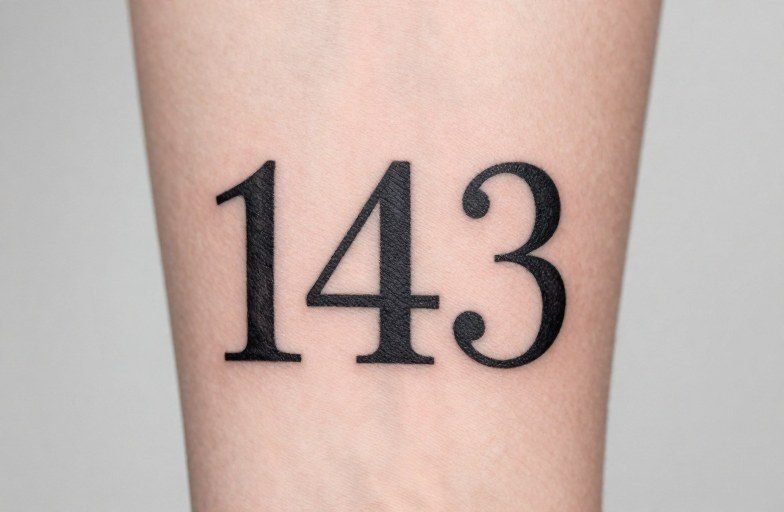
The 143 tattoo translates the phrase “I love you” into numbers: one letter in “I,” four in “love,” three in “you.” This code originated in pager and early text-message culture, and it has persisted as a quiet, private shorthand between people who want to carry affection without broadcasting it in plain language.
Symbolism & History
Where the Code Came From
The 143 sequence is often linked to early telecommunications. Some trace it to pager slang in the 1990s, when character limits made brevity essential. Others note its use in telegraph and even lighthouse signal contexts, though these origins are less documented. What matters for tattoo purposes is that the code became widely understood shorthand for affection across American pop culture, appearing in songs, social media, and personal correspondence. It functions as a secret visible to those in the know and innocuous to everyone else.
What It Represents Now
Today the 143 tattoo carries several overlapping meanings. The most common is romantic love, anniversaries, long-distance relationships, or partners who met during the text-message era. It also serves as memorial ink for lost family members, with the numbers standing in for words someone can no longer hear spoken aloud. Some wear it as self-love or friendship code, particularly among people who shared the reference during formative years. The ambiguity is part of the appeal; you control who knows what it means.
Common Variations & Styles
Typography Choices
The simplest 143 tattoos use clean numerals in a single weight. Sans-serif fonts dominate for legibility at small sizes, think Helvetica, Futura, or custom geometric lettering. Serif fonts add a vintage feel, sometimes paired with decorative elements. Script or handwritten styles soften the mathematical quality, though they sacrifice some of the code-like anonymity that makes the concept work. Bold, uniform strokes hold up better over time than hairline details.
Visual Additions
- Minimalist: Bare numbers, no embellishment. Usually black ink, small scale.
- With hearts or pulses: A small electrocardiogram line replacing the “1,” or a heart symbol tucked nearby. Risk: the heart makes the meaning obvious, defeating the coded purpose.
- Clock or time references: 1:43 as a time stamp, sometimes with “AM” or “PM” added. Works for significant moments, birth, death, first meeting.
- Coordinates or dates paired: Numbers stacked with latitude/longitude or a date in matching typography. Keeps the code central while adding personal context.
- Color accents: Red ink for the “4” or gradient fills. Color fades faster than black; expect more frequent touch-ups.
Negative Space and Placement Tricks
Some artists render 143 inside larger images, hidden in the stripes of a lighthouse beam, the leaves of a plant, or the fur pattern of a pet portrait. This requires working with an artist comfortable with integrated text. The numbers must remain readable or the concept fails; too hidden and it becomes meaningless abstraction.
Best Placements
Small number tattoos age predictably based on location and skin behavior. Here is how common placements perform:
- Inner wrist: Highly visible, easy to read. Skin here moves frequently and sees sun exposure; lines may blur slightly within five to seven years. Touch-ups likely.
- Side of the finger: Trendy and discreet. Fingers shed ink rapidly due to constant use and regeneration. Expect significant fading within two to three years; many require annual refreshment.
- Behind the ear: Concealable, decent ink retention. Small area limits size; numbers must be simple and bold. Hair products and friction from glasses or headphones affect longevity.
- Ribcage or sternum: Private, larger canvas possible. Painful placement due to thin skin over bone. Heals well if protected from bra straps and sleeping pressure during recovery.
- Inner bicep: Protected from sun, minimal daily friction. Good longevity for fine lines. Muscle growth or weight fluctuation can distort spacing over years.
- Ankle or foot: Popular for couple tattoos. Poor ink retention; feet regenerate skin rapidly and shoes cause constant abrasion. Fades fastest of any common placement.
For 143 specifically, the inner wrist and inner bicep offer the best balance of visibility, privacy control, and technical durability. The numbers read clearly at conversation distance without demanding attention.
Who Chooses This Tattoo / Personal Meanings
Romantic and Partnership Contexts
Couples getting matching 143 tattoos typically choose identical placement and style, sometimes with one partner wearing 143 and the other responding with 831, “8 letters, 3 words, 1 meaning,” another numerical love code. The risk with matching tattoos is obvious; the 143 at least retains independent meaning if the relationship ends. Some choose it as a wedding anniversary marker, inking the date alongside the numbers.
Family and Memorial Uses
Parents use 143 for children, particularly after loss. The code allows public acknowledgment without exposing grief to casual observers. Siblings sometimes share it as a private language from childhood. In memorial contexts, the numbers often pair with birth dates, death dates, or small symbolic imagery, feathers, birds, or objects specific to the person remembered.
Self-Directed and Friendship Meanings
Solo wearers often choose 143 as self-love ink, a reminder of their own worth. The coded format suits people uncomfortable with explicit sentimental statements. Friend groups from the 1990s and early 2000s sometimes adopt it as generational shorthand, marking shared adolescence defined by pagers and early cell phones. The tattoo becomes identity marker rather than message to a specific recipient.
Similar Symbols
People considering 143 often compare it to these alternatives:
- 831: The response code, “8 letters, 3 words, 1 meaning.” Less universally recognized than 143; works best as a paired set rather than standalone.
- Infinity symbol: Broader meaning, overused to the point of cliché. 143 offers specificity and cultural reference that infinity lacks.
- Initials or names: Direct and legible to everyone. 143 provides privacy and works across relationship changes without requiring cover-up.
- Roman numerals for dates: Visually similar, purely chronological. 143 adds the linguistic layer that dates cannot replicate.
- Coordinates: Location-specific, meaningful only with explanation. 143 carries built-in cultural recognition for those familiar with the code.
The 143 occupies a middle ground: more private than a name, more specific than an infinity loop, more durable in meaning than a date that might accumulate negative associations.
Final Thoughts
The 143 tattoo succeeds because it compresses significant emotional weight into three small characters. Its technical execution is straightforward, any competent artist can render clean numbers, but the decision of style, placement, and accompanying elements determines whether it reads as thoughtful or generic. Black ink, simple sans-serif typography, and protected placement like the inner bicep or wrist will give you the longest-lasting, most legible result. The code itself does the emotional work; the tattoo’s job is to present it clearly and endure.
Frequently Asked Questions
Does 143 always mean I love you in a tattoo?
In American tattoo culture, 143 consistently encodes “I love you” through letter counting. Context around the numbers, hearts, names, dates, can shift emphasis, but the core meaning remains stable.
Will a small 143 tattoo blur or become unreadable?
Small number tattoos risk blurring if placed on high-friction areas like fingers or feet, or if rendered with extremely thin lines. Bold strokes at moderate size on the wrist or bicep typically remain legible for years.
Is 143 considered a matching tattoo or can it stand alone?
It works both ways. Many wear it solo as self-love or memorial ink. Matching sets with 831 exist but are not required for the meaning to function.
What font works best for a 143 tattoo?
Clean sans-serif fonts with consistent stroke weight perform best at small sizes. Avoid overly decorative scripts that reduce legibility or thin lines that will fade into indistinct marks.
Related Tattoo Meanings
- Seraphim Tattoo Meaning
- 508 Tattoo Meaning for Guys: Symbolism, Styles Placement
- Adam Levine Head Tattoo Meaning: Butterfly, Rose Cloud Ink
- Explore more









