
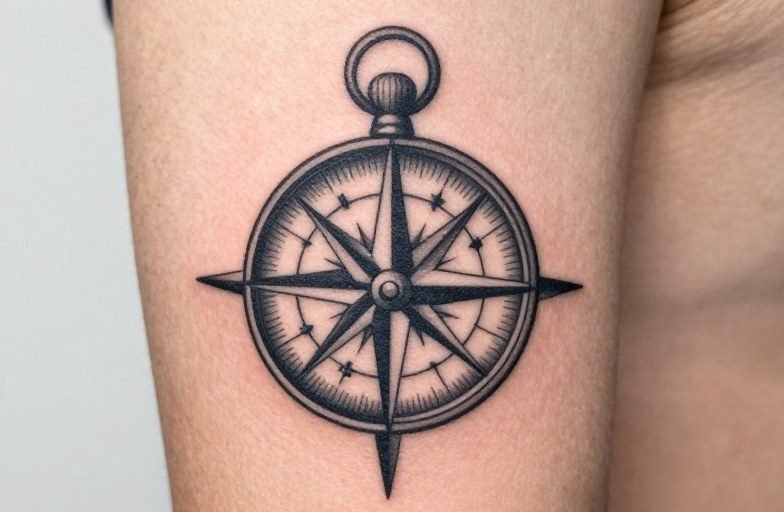
A realistic compass tattoo reproduces the instrument with photographic accuracy: glass glare, brass patina, needle tilt, and engraved degree markings. Unlike traditional or neo-traditional compass designs that simplify and stylize, this approach demands the artist render three-dimensional objects on a two-dimensional surface, accounting for skin movement, light falloff, and how ink settles over time. The result sits somewhere between technical illustration and portrait work, with the compass treated as a subject worthy of the same scrutiny usually reserved for faces or wildlife.
Origins & History
The compass as tattoo imagery carries maritime roots, often linked to sailors who marked their bodies with navigation symbols as both practical reference and talisman. Some trace it to 19th-century British and American naval traditions, where the instrument represented literal survival, finding port in fog, correcting course in open water. The realistic rendering of these compasses, however, is a much later development.
Photorealism in tattooing emerged in the 1990s and early 2000s as equipment improved, coil machines capable of softer saturation, rotary machines with consistent needle depth, and pigments engineered for smoother blending. Before this, compass tattoos were almost exclusively bold-line, limited-color designs. The realistic compass became feasible only when artists could reliably produce the subtle greys of aged metal, the transparent quality of glass, and the fine parallel lines of engraved numerals.
From Sailor Jerry to Hyperrealism
The evolution tracks broader tattoo technology. Early electric tattooing favored bold, simple shapes because skin diffusion and coarse needles punished fine detail. As needle groupings shrank and artists developed “single needle” techniques, the compass transformed from a symbolic icon into a technical challenge, could you make the needle actually appear to float? Could the glass dome show reflected light? This shift from symbol to object is what distinguishes realistic compass work from its predecessors.
Key Characteristics & Motifs
Realistic compass tattoos share specific visual priorities that separate them from stylized alternatives. The artist must solve several technical problems simultaneously.
- Dimensional accuracy: The compass face reads as a circle in perspective, not a flat disc. Ellipse construction must be precise, any wobble in the outer rim destroys the illusion.
- Material differentiation: Glass, brass, steel, and paper each require distinct rendering approaches. Glass gets bright highlights and subtle blue-grey shadows; brass develops warm ochre and green patina; paper yellows and shows fiber texture.
- Needle suspension: The compass needle must appear to float above the printed card, achieved through careful shadow placement and highlight separation.
- Engraved detail: Degree markings, cardinal letters, and maker’s names are rendered in fine line work, often requiring needle groupings of 3 or 5 for consistency.
- Environmental context: Many designs incorporate maps, ropes, or navigational charts beneath or behind the compass, requiring the artist to manage multiple focal depths.
Common Motif Pairings
Standalone compass pieces exist, but most realistic designs integrate supporting elements. Antique maps with visible coastlines and latitude lines provide context and texture. Rope or chain wrapped around the compass body adds organic contrast to mechanical precision. Some designs incorporate the compass as part of a larger navigational tableau, sextant, chronometer, and spyglass arranged in still-life composition. Others fracture the instrument, showing exploded views of internal magnets and gimbals.
Color vs Black and Grey
The choice between color and black and grey fundamentally changes the tattoo’s character and longevity.
Black and grey realistic compass work dominates the style. The limited palette suits metallic subjects, steel and aged brass translate naturally into greyscale values. Without color, the artist focuses entirely on value range and edge quality. This approach ages more predictably; black ink holds its saturation longer than most pigments, and grey washes fade into softer versions of themselves rather than shifting hue. A well-executed black and grey compass will still read clearly at fifteen years, though lighter greys may need reinforcement.
Color realistic compasses demand more technical control. The artist must mix greens for verdigris, warm ochres for brass, cool blues for steel reflections, and subtle reds or blacks for needle tips. Color saturation in realistic work is typically muted, garish primaries destroy the illusion of aged metal. The risk lies in longevity: yellows and light greens are notorious for fading or migrating, and the fine color transitions that sell the realism can blur into indistinct mud as skin changes. Color pieces require larger scale to maintain detail integrity over time, and more frequent touch-ups are almost guaranteed.
Best Placements
Realistic compass tattoos need sufficient flat area to preserve the circular geometry and fine detail. Curved surfaces distort the illusion; the compass face must read as level, not wrapped around a cylinder.
- Upper outer arm (deltoid to mid-bicep): Flat plane, moderate visibility, good for medium-scale pieces (4-6 inches diameter). Skin here moves relatively little, preserving fine lines.
- Thigh (front or outer): Large, stable canvas. Ideal for compasses integrated with map backgrounds or multiple instruments. Allows 8+ inch scale for maximum detail.
- Chest, upper pectoral: Flat when standing, though pectoral flex can distort the circle during movement. Best for designs that incorporate the compass into larger chest pieces rather than isolated circles.
- Forearm (inner or outer): Highly visible, but the narrower width constrains scale. Works for smaller, simpler compasses without extensive background. The radius bone edge can distort the lower portion of the design.
- Back (upper, between scapulae): Stable, flat when standing straight. Excellent for symmetrical compositions. Difficult to self-view, which matters for some collectors.
Hands, feet, neck, and ribs present problems: too much movement, too little flat area, or skin that heals unpredictably. Fine engraved numerals and hairline highlights simply don’t survive in these zones.
Who It Suits
The realistic compass appeals to specific collecting temperaments. It rewards patience, these pieces take longer than stylized alternatives, and the collector must sit still through extensive grey-wash building and fine-line detail. It suits those drawn to technical precision over symbolic abstraction; the meaning is carried in the object’s craftsmanship, not in simplified iconography.
The subject matter resonates with actual travelers, sailors, pilots, and military personnel, but also with those who value the metaphor of direction without wanting it rendered obviously. The realistic treatment keeps the symbolism subtle, the compass is simply presented as a beautiful, functional object, not a decorated symbol.
Collectors with existing traditional or neo-traditional work should consider whether realistic pieces will harmonize. The style jump can work if planned (realistic objects as focal points amid traditional surrounding work), but isolated realistic pieces among bold traditional tattoos often look visually disconnected.
Modern Variations
Contemporary artists have pushed the realistic compass in several directions, expanding the core vocabulary without abandoning its technical foundations.
Deconstructed and Exploded Views
Some designs show the compass disassembled, magnetized needle separated from gimbal mount, glass dome lifted, base plate removed. This reveals internal mechanics and creates dynamic asymmetry. The challenge increases: the artist must render each component’s material (steel pivot, jeweled bearing, liquid-damped housing) with equal conviction, and the composition must read as intentional disassembly, not accidental breakage.
Integrated Landscape
Double-exposure or composite techniques place topographic maps or coastal photography inside the compass face, replacing the standard printed card. The compass becomes a window. This requires the artist to manage two distinct realistic vocabularies, mechanical precision and organic landscape, within one coherent image. Scale demands increase; the internal image must hold detail at very small size.
Biomechanical Hybrids
Less common but technically impressive, some artists merge compass elements with mechanical or organic machinery, gears visible beneath glass, bone structure supporting brass housings. This borrows from H.R. Giger-influenced biomech traditions but applies realistic rendering rather than illustrative stylization.
Choosing an Artist
Realistic compass work requires specific demonstrable skills. Review portfolios for:
- Photorealistic metal rendering, look for actual metallic objects, not just grey shapes. The artist should show understanding of specular highlight, diffuse reflection, and patina variation.
- Ellipse consistency across multiple pieces. Any wobble in circular objects indicates weak foundational drawing.
- Fine line stability in healed work, not just fresh photos. Ask to see healed results if possible; fresh tattoos always look sharper.
- Glass or transparent material rendering. Water droplets, crystal, or actual glass objects in the portfolio indicate the artist understands refractive and reflective behavior.
Geographic proximity matters less than specialization. Realistic specialists often travel for guest spots, and many collectors fly to specific artists. Budget realistically: these pieces take longer than traditional equivalents. A detailed 5-inch compass with map background might require 8-12 hours across multiple sessions. The investment is in the artist’s problem-solving, every material, every reflection, every engraved letter represents a discrete technical decision.
Final Thoughts
A realistic compass tattoo succeeds when the object appears to have weight, history, and function. The collector isn’t wearing a symbol of navigation; they’re wearing navigation itself, rendered with the respect given to any finely made tool. The style demands more from both artist and canvas, more time, more precision, more maintenance over decades, but returns that investment in a piece that resists stylistic dating and retains its legibility as craft rather than fashion.
The compass has been tattooed for centuries. The realistic treatment is newer, but the underlying impulse persists: marking the body with instruments of finding the way. The difference is in the fidelity. Where a sailor’s bold black compass declared affiliation, the realistic compass declares close looking, the collector and artist both agreeing that the object itself, rendered truly, carries sufficient weight.
Frequently Asked Questions
How small can a realistic compass tattoo be before detail is lost?
Most realistic compasses need at least 3-4 inches in diameter to preserve readable numerals and needle definition. Below that scale, engraved details blur together and the glass dome effect becomes impossible. For compasses with integrated map backgrounds, 5-6 inches is safer.
Do realistic compass tattoos age worse than traditional compass designs?
They age differently, not necessarily worse. Fine grey-wash and subtle highlights fade first, leaving the bolder structure. A well-designed realistic compass has enough underlying black value to remain readable even as subtlety softens. Touch-ups every 5-8 years maintain the full effect.
Can a realistic compass be covered up or modified later?
Cover-ups are challenging due to the circular composition and dense black areas. The shape reads strongly and resists transformation into other subjects. Laser fading before cover-up is often necessary. Plan for the long term rather than assuming future modification.
Why do some realistic compasses look flat while others look truly three-dimensional?
The difference lies in value range and shadow logic. Flat compasses use mid-greys uniformly; dimensional ones push to near-white highlights and near-black shadows with consistent light source. The needle must cast a believable shadow, and the glass dome must show both reflection and transmitted light. These effects require deliberate planning, not just good shading technique.
Related Style Guides
- Realistic Deer Skull Tattoos: Complete Style Guide
- Realistic Jewelry Tattoos: Complete Style Guide
- Realistic Raccoon Tattoos: Complete Style Guide
- Explore more









