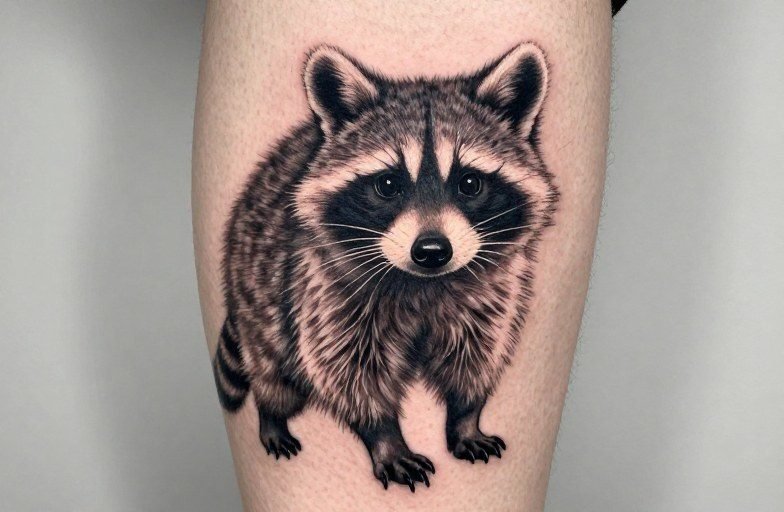
A realistic raccoon tattoo captures the animal’s distinctive masked face, dense fur texture, and clever expression with photographic accuracy. Unlike stylized or cartoon versions, this approach demands mastery of fine detail, subtle gradation, and anatomical precision. The best pieces make the animal look like it could step off your skin, whiskers catching light, eyes reflecting depth, that characteristic bandit posture rendered in ink.
Origins & History
Wildlife Realism in Tattooing
Photorealistic animal tattoos gained serious traction during the 1990s and early 2000s as tattoo machines, needles, and pigments improved dramatically. Before that, most animal tattoos leaned bold and graphic, think Sailor Jerry panthers or traditional wolves. The shift toward realism coincided with artists studying fine art techniques, airbrush methods, and even taxidermy reference to understand how fur lays over muscle and bone.
Raccoons specifically started appearing more frequently in the 2010s as clients moved beyond the obvious predator choices, lions, wolves, bears, toward animals with personality and regional connection. The raccoon’s urban adaptability gives it particular resonance for city dwellers who see themselves in its resourceful, slightly scrappy nature.
Cultural Associations
The raccoon carries layered symbolism across North American cultures. In Indigenous traditions of the eastern woodlands, the raccoon often appears as a trickster figure, clever and persistent. Contemporary associations lean into the “trash panda” meme culture and the animal’s reputation for nocturnal mischief. Some trace the raccoon’s appeal to its duality, wild yet thriving in human spaces, cute but capable of real damage. A realistic rendering lets you engage with that complexity rather than flattening it into a symbol.
Key Characteristics & Motifs
What separates a convincing realistic raccoon from a mediocre one comes down to specific technical choices:
- The mask: The black facial markings aren’t solid blocks. Quality work shows the gradient where fur transitions from silver-tipped guard hairs to the darker undercoat, with individual hairs breaking the edge softness
- Ringed tail: The alternating bands require careful value control, too stark and it looks graphic; too soft and the pattern disappears. The tail’s cylindrical form must read through the markings
- Eye shine: Raccoons have tapetum lucidum (reflective eye tissue). Many artists add a subtle catchlight or nocturnal glow effect, especially effective in color work
- Fur directionality: On the face, fur radiates outward from the eyes and nose. On the body, it follows the spine’s contour. Wrong direction breaks realism instantly
- Paw detail: Those dexterous front feet with their almost human-like fingers are a signature element, when visible, they need proper anatomical structure
Common compositions include the raccoon emerging from darkness (dramatic lighting from one side), a three-quarter portrait showing the mask’s asymmetry, or the animal in a naturalistic pose, washing food, climbing, or peering over a surface.
Color vs Black and Grey
Black and Grey Realism
This dominates the realistic raccoon space for good reason. The animal’s natural palette, charcoal, silver, warm brown undertones, translates beautifully through black ink diluted to grey washes. The mask reads as deep value rather than pure black, and the salt-and-pepper body fur achieves that texture through whip shading and stipple techniques.
Black and grey ages more predictably on most skin tones. The risk of muddiness in the mid-tones is lower than with color, and touch-ups stay simpler. The main challenge: achieving warmth. Without careful brown-grey mixing, the animal can look cold and dead. Skilled artists add subtle warmth to the eye area and ear interiors to bring life back.
Color Realism
Full color raccoon tattoos work when the artist understands that “realistic” doesn’t mean “saturated.” The actual animal’s colors are muted, browns that lean toward olive, greys with lavender undertones in certain light, black that carries blue or brown casts. Over-saturated orange and pure black look like a sports mascot.
Color allows for environmental storytelling: autumn leaves, moonlight on wet pavement, the green glow of a dumpster interior. These contextual elements must share the same light source or the piece falls apart. Color also demands more sessions and more maintenance; the lighter pigments (those subtle greys and warm browns) fade faster than the deep mask blacks.
Best Placements
The raccoon’s proportions suit certain body areas better than others. A full-body raccoon needs vertical or horizontal space to show that distinctive tail; a portrait focuses on the face and works in tighter formats.
- Outer thigh: Flat, large canvas for full-body compositions. The muscle movement is minimal, preserving detail. Easy to show or conceal
- Upper arm/shoulder: Classic for three-quarter portraits. The deltoid curve echoes the animal’s rounded back when positioned well
- Forearm: Best for smaller portraits or the raccoon peeking over an edge. The visibility means you’ll see it constantly, make sure the expression holds up
- Ribcage: Painful and tricky to heal, but the vertical space suits a climbing pose. The body’s natural taper can frame the composition
- Calf: Good for medium full-body pieces. The muscle’s teardrop shape can complement or fight the composition depending on pose
Avoid spots with heavy distortion, inner bicep, stomach, sides of torso, unless the design accounts for stretch. The mask’s symmetry is unforgiving; shift it slightly and the expression changes from curious to deranged.
Who It Suits
There’s no demographic lock here. The raccoon appeals to night-shift workers, urban foragers, people who pride themselves on making do with what’s available. It suits those who want an animal tattoo that isn’t aggressively masculine or obviously spiritual. The “trash panda” identity resonates with folks who find dignity in scrappiness, who see beauty in overlooked creatures.
Skin tone matters for technique, not suitability. On darker skin, the silver fur tones need adjustment, pure white highlights won’t read, so artists build luminosity through negative space and warm undertones. The mask’s darkness actually holds well across tones since it’s achieved through dense black rather than grey wash.
Modern Variations
Double Exposure & Composite Imagery
Some designs merge the raccoon’s silhouette with forest scenes, city skylines, or nocturnal environments inside the body contour. This requires a tattooist who understands both realism and graphic design, two disciplines that don’t always overlap. The interior scene must match the exterior lighting or the effect collapses.
Neo-Traditional Hybrids
A newer trend keeps the realistic face and fur but frames it with decorative elements, botanical borders, ornamental patterns, or jewel-like color blocks. The contrast between organic realism and structured geometry creates visual tension. This works best when the decorative elements don’t compete for detail attention; let the raccoon remain the focal point.
Micro-Realism
Small, highly detailed raccoon portraits, sometimes just the face at two inches across, have gained popularity. This pushes needle grouping and ink saturation to their limits. The risk: fine lines blur within a few years, and the mask’s darkness can spread into surrounding fur. Not every artist who claims micro-realism actually delivers longevity.
Choosing an Artist
Realistic animal work is a specialty, not a general competency. Look for:
- A portfolio with multiple healed photos of fur-bearing animals, not just fresh work
- Evidence of understanding light source consistency, does the shading on the body match the highlight in the eye?
- Clean edges in the mask that still show fur texture breaking through; too sharp looks graphic, too soft looks muddy
- Willingness to work from multiple reference photos rather than copying a single image
- Experience with your specific skin tone if you have concerns about how greys or colors will settle
Ask to see a raccoon specifically if possible. The facial structure is distinct from dogs, foxes, or cats, artists who’ve rendered one successfully understand the short muzzle, the rounded ears, the particular eye placement. A generic “wildlife” portfolio might not translate.
Budget for quality. Realism takes time, multiple sessions for larger pieces, careful layering that can’t be rushed. The cheapest option usually means the fastest execution, and speed kills detail.
Final Thoughts
A realistic raccoon tattoo done well stops people mid-conversation. The animal’s familiar yet unexpected presence, rendered with technical precision, creates that double-take moment every collector wants. The key is respecting the subject, this isn’t a cartoon, not a mascot, but a specific creature with particular textures and expressions. Find an artist who treats it with that specificity, give them the time and reference material they need, and you’ll wear something that genuinely earns its realism.
Frequently Asked Questions
How long does a realistic raccoon tattoo take to complete?
A palm-sized portrait runs 3-4 hours. Full-body pieces with environment typically need 8-12 hours across two or three sessions. Micro-realism work might finish in 2-3 hours but requires exceptional precision that not all artists offer.
Will the black mask blur or spread over time?
Dense black can experience slight blowout, especially on thin skin or if overworked. A skilled artist controls needle depth and uses multiple passes rather than saturating in one go. Proper aftercare during healing prevents the worst spreading.
Can a realistic raccoon tattoo be covered up later if I change my mind?
The heavy black in the mask and eyes makes full coverage challenging. Laser lightening is usually necessary first. Placement on areas with existing coverage options (thigh over hip, upper arm over shoulder) provides more flexibility than hands or neck.
What reference photos work best for my artist?
Bring multiple angles of the same individual animal if possible, plus images showing the specific expression or pose you want. Wildlife photography sites and ethical animal sanctuaries with photo permissions are better sources than random internet images, which may be too low-resolution for detail work.
Related Style Guides
- Traditional Name Tattoo Ideas: Style Guide
- Traditional Ship Flash Tattoos: Style Guide
- Traditional Tattoo Stars: Complete Style Guide
- Explore more