A scorpion tattoo carries weight. The symbol can mean protection, danger, survival, intensity, sexuality, or the refusal to let someone cross your boundaries. What matters is which meaning you lead with, and how the design makes that feeling visible to someone who has never heard your story.
What the symbol actually carries
The scorpion has been a tattoo image for decades across multiple traditions, though pinning exact origins to specific shops or years is difficult. In Russian prison tattooing, the scorpion often marked a soldier or someone with combat experience, though meanings shifted between institutions and time periods. In Mexican and Chicano tattoo culture, the scorpion connects to desert survival, resilience, and sometimes specific regional identity. In North African and Middle Eastern imagery, it often appears as protection against harm, a reading that travels through Mediterranean and eventually Western tattooing.
I mention these not to give you a borrowed identity, but to show that the symbol arrives with history already attached. You cannot fully control what strangers read into it. You can only decide whether their reading overlaps with yours.
The biological reality also shapes the symbol’s power. Scorpions are not aggressive hunters of humans. They sting when cornered, when threatened, when the boundary is crossed. That defensive posture is what most people actually want: not the predator, but the creature that refuses to be prey.
Choosing your meaning
Defense and boundaries
If you want the tattoo to say keep your distance, the design should feel contained rather than explosive. The tail curved back toward the body, not striking outward, reads as guarded strength. Placement matters here: ribs, sternum, inner arm, back of arm, or hip keep the message private until you choose to reveal it. These placements also hurt more, which for some people is part of the commitment.
Survival and resilience
For survival, the scorpion often pairs with desert imagery: sparse plant life, cracked earth, sun-bleached bone. But restraint is key. One extra symbol can support the meaning. Three or four become a collage with no center. Fine line work can work here if the scale is realistic; a scorpion the size of a quarter will lose leg definition within a few years.
Intensity and desire
The sexual reading of the scorpion comes partly from the Scorpio zodiac association, partly from the creature’s dangerous allure. If this is your angle, consider how much you want that reading to be immediately legible. A scorpion paired with a rose or a specific flower is readable. A scorpion alone with particular line quality, maybe softer weight or curved tail, can suggest the same thing without being explicit. The choice depends on your comfort with conversation.
Memorial or personal marking
Some people choose the scorpion after a loss, a fight, or a period of isolation. In these cases, the symbol often works best with minimal addition: a date, a set of coordinates, a small directional marker. The simpler the design, the more room the meaning has to breathe.
Design decisions that matter
Silhouette first
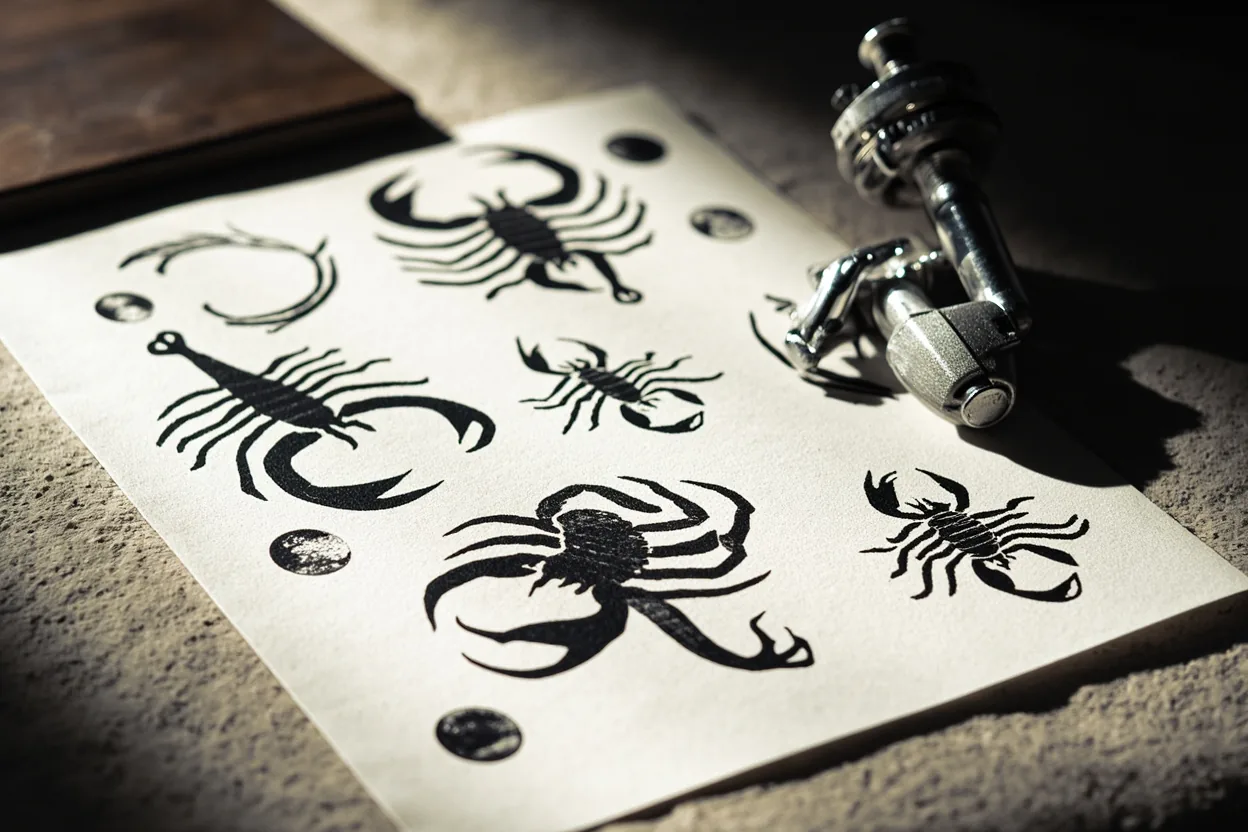
A scorpion must read instantly. If someone has to lean in or ask what the image is, the design has failed. Start with the overall shape: the curved tail, the pincers, the segmented body. These three elements must survive at the intended size from a normal viewing distance. Everything else is secondary.
Style and aging
Traditional American scorpion designs hold up well because bold outlines and limited color keep the shape clear. Blackwork and illustrative styles also age reliably if the contrast is strong enough. Fine line can work, but the legs need spacing. A traditional scorpion with six visible legs reads as a scorpion. A fine line version with twelve hair-thin legs becomes a grey blur after five years.
Dotwork and stippled shading can add texture, but they require a larger canvas. On a small piece, dots become indistinguishable from blowout or fading.
Size and placement
The stinger and claws are the first details to degrade. If you go too small, both become unreadable scar tissue within a few years. Size up at least twenty percent from your first instinct, especially for finger-adjacent or wrist placements.
Visible placements, forearm, wrist, neck, hand-adjacent, invite questions. Be honest with yourself about whether you want to explain the tattoo to strangers regularly. Private placements, ribs, hip, sternum, upper back, keep the meaning yours. They also tend to hurt more and heal slower due to movement and friction.
Color and contrast
Black and grey scorpions dominate for good reason. The symbol relies on shape, not color story. If you want color, limit it to one accent: a red stinger tip, a specific flower, a small background element. Multiple colors compete with the silhouette rather than supporting it.
Working with an artist
Bring references for mood, not for copying. A skilled artist needs to know what feeling you want, not which Instagram post you screenshotted. Describe the meaning that should lead: defensive, sensual, memorial, or something else entirely. That description should influence line weight, angle, negative space, and whether the tail curves toward or away from the body.
Ask for two versions: one stripped to essentials, one with atmosphere. For long-term wear, the simpler version usually wins. The atmospheric version photographs better on day one but ages faster. The choice is yours, but make it knowing the tradeoff.
Before you approve the stencil, see it at actual size on your body. A design that balances on a screen can feel wrong once it sits on real skin with real curves and movement. Trust your gut if something feels off. Adjusting the angle or scale takes minutes. Living with a poorly placed tattoo takes years.
Specific combinations that work
Scorpion and desert rose: survival with specific regional or personal connection. Keep the rose small and positioned so the scorpion remains dominant.
Scorpion and dagger: danger, combat, protection. The dagger should not compete with the tail curve. Parallel or crossing angles work better than identical diagonals.
Scorpion and moon: cycles, hidden threat, nocturnal identity. The moon phase can be specific if the date matters.
Scorpion and script: only if the text is brief and the lettering style matches the image weight. A heavy blackwork scorpion with thin cursive rarely harmonizes.
Scorpion alone: often the strongest choice. The symbol is already loaded. Adding decoration sometimes dilutes rather than deepens.
What to remember
The scorpion is a common tattoo. That is not a reason to avoid it, but it is a reason to be deliberate. The difference between a generic scorpion and a personal one usually comes down to a single decision: the angle of the tail, the choice of placement, the absence of one expected element, the presence of one unexpected detail.
Do not chase originality for its own sake. Chase clarity. A tattoo that clearly means something to you, even if the meaning is private, will always read better than a tattoo that tries to mean everything to everyone.
Finally, respect the biological reality that shaped the symbol. The scorpion does not attack unprovoked. It survives. It waits. It defends its ground. If that matches your story, the tattoo will hold.
Frequently Asked Questions
Is a scorpion tattoo a good first tattoo?
It can be, if the design is not too small and the placement matches your comfort with visibility. First tattoos often tempt people toward tiny, hidden pieces, but a scorpion needs enough size to keep the legs and stinger readable. Ask for a stencil at actual size and live with it for a day before committing.
What style ages best for a scorpion?
Clean outlines with strong contrast age most reliably. Traditional, blackwork, and illustrative styles hold their shape. Fine line can work but needs realistic scale and enough spacing between legs. Avoid cramming too many details into a small space.
Does a scorpion tattoo always mean danger or aggression?
No. The defensive reading is more common and more accurate to the animal’s behavior. Many people choose the scorpion for boundaries, survival, or personal resilience rather than threat. The meaning depends on your design choices and what you tell people, if you tell them anything.
How much should I expect to pay?
Prices vary widely by city, artist experience, and design complexity. A small, simple scorpion might start around $150 to $250 in smaller markets. Larger, detailed pieces by established artists can run $400 to $800 or more. The priority should be finding an artist whose scorpion work you respect, not finding the lowest price.
Should I add other symbols to my scorpion tattoo?
One supporting element can strengthen the meaning. Two or three usually weaken it. If you want a flower, a moon, or script, choose the one that matters most and let the scorpion dominate. The symbol is already visually busy; extra decoration competes for attention.