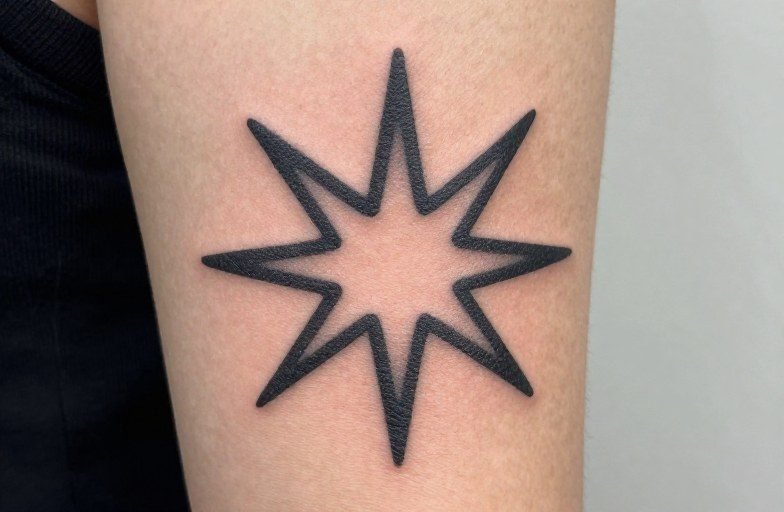
Traditional star tattoos sit at the intersection of maritime history and pure graphic punch. Five points, thick black outlines, limited color palettes, and enough negative space to keep them readable from across a room. They’re some of the oldest flash designs in the books, and they remain staples because they work. No gimmicks, no fine-line fragility, just solid, honest tattooing that ages on your terms.
Origins & History
Nautical Roots
The five-point star, particularly the nautical star, is often linked to sailors navigating by the night sky. Some trace it to 19th-century maritime culture, where a star tattoo marked a seafaring milestone or served as a talisman for finding home. The compass rose and star frequently appeared together in early flash sheets. Whether those sailors believed in literal guidance or simply wore their trade on their skin, the motif stuck.
From Flash Sheets to Mainstream
By the early-to-mid 20th century, stars anchored countless flash sets from artists like Sailor Jerry and Bert Grimm. They were quick to execute, easy to customize with banners or names, and universally understood. That accessibility made them crossover hits, bikers, soldiers, and civilians all wore versions without diluting the style. The design’s survival isn’t about nostalgia; it’s about structural integrity. A traditional star doesn’t need context to read as a tattoo.
Key Characteristics & Motifs
Traditional star tattoos follow specific rules that separate them from geometric or realistic star renderings. Here’s what defines the style:
- Five points, not six or more: The classic nautical star has five symmetrical points. Six-pointed stars (hexagrams) carry different cultural and religious weight and aren’t interchangeable in this style.
- Thick black outlines: Usually 7-9RL or equivalent, built to hold as the tattoo settles. The outline is the skeleton; everything else hangs on it.
- Limited color fills: Red, yellow, green, and blue dominate. Each point might carry a different color, or the star splits into two tones down the center.
- Drop shadows or simple shading: A grey wash or second color behind the star creates depth without softening the edges. No smooth gradients, just hard shifts.
- Negative space highlights: Often a small un-inked dot or wedge near the center, mimicking light reflection and keeping the star from going flat.
Common pairings include banners with names or dates, rope or chain borders, and small complementary motifs like swallows, daggers, or roses. The star rarely stands completely alone in classic flash, though solo stars work fine for smaller placements.
Color vs Black and Grey
Traditional Color
Bold red and black nautical stars are the most recognized combination. Color in traditional work isn’t about realism, it’s about contrast and longevity. Saturated pigments (especially reds and dark blues) hold better over decades than softer tones. A color star will fade, but the structure remains obvious because the black outline does the heavy lifting.
Black and Grey Adaptations
Black and grey traditional stars trade color fill for solid black points with grey wash shading. These read tougher, lean more biker or prison-adjacent aesthetically, and suit people who want the graphic punch without the carnival brightness. The same rules apply: thick outline, hard edges, no soft blending. Grey wash can suggest dimension, but it shouldn’t mimic photographic light.
Healing reality: color stars often look patchy at week two as the top layer of red or yellow settles. Black and grey versions can appear more consistent through healing, but both need the same aftercare discipline. No soaking, no sun, no picking.
Best Placements
Traditional stars adapt to nearly any body real estate, but certain placements honor the style’s history and practical strengths:
- Hands and knuckles: Small stars here are classic, though finger skin sheds ink faster than most areas. Expect touch-ups. The visibility is high, the statement is blunt.
- Forearms: Outer forearm gives maximum visibility and flat skin for clean lines. Inner forearm works but sees more movement and moisture.
- Chest, near shoulders: Historical sailor territory. Larger stars with banners or companion pieces fit well. Skin here stays relatively stable with age.
- Behind the ear or neck: Small, quick, but high on the pain scale and prone to fading from sun exposure and hair products.
- Thighs and calves: Flat planes, good for larger multi-star pieces or stars integrated into bigger traditional compositions.
One practical note: stars on joints (elbows, knees) distort with movement. A traditional star’s symmetry makes that distortion obvious. Artists usually place them slightly off the pivot point to preserve the shape.
Who It Suits
This isn’t about personality matching, it’s about skin behavior and lifestyle honesty. Traditional stars suit people who want visibility and low maintenance. The bold lines forgive minor sun damage and aging better than fine-line alternatives. If you work in environments where visible tattoos create friction, a hand or neck star demands commitment. If you want something that reads as “tattoo” from ten feet away without explanation, this delivers.
The style also works for collectors building traditional sleeves or patches. A star fills gaps between larger pieces, balances color distribution, and connects disparate motifs. It’s utilitarian and beautiful in equal measure.
Modern Variations
Neo-Traditional Stars
Neo-traditional work keeps the bold outline but introduces more complex shading, jewel tones, and ornamental detail. Stars might gain dimensional beveling, surrounding filigree, or integration with animals rendered in softer gradients. The core shape stays recognizable, but the execution gets flashier.
Contemporary Twists
Some artists now play with imperfect hand-poked stars, distressed textures, or deliberate asymmetry. These flirt with other styles, ignorant, folk, even abstract, while nodding to traditional roots. Quality varies wildly. The best maintain the star’s instant readability; the worst dissolve into trendy mush that won’t hold.
Choosing an Artist
Not every artist who does “traditional” does it well. Look for:
- Consistent line weight: Outlines should be uniform, not wobbling between thick and thin. Traditional demands confidence.
- Solid saturation in their healed photos: Fresh work looks bold on everyone. Check their portfolio for one-year-healed pieces. Faded but structured means they built it right.
- Flash availability: Artists who draw and sell flash sheets usually understand traditional conventions more deeply than those who only take custom requests.
- Specific star examples: Even a simple star reveals an artist’s understanding of point symmetry, negative space placement, and color balance.
Ask about their machine setup. Traditional stars typically run on coils for that signature punchy line, though skilled rotary users can replicate the effect. The tool matters less than the hand holding it, but traditional specialists often have strong preferences worth respecting.
Final Thoughts
Traditional star tattoos endure because they solve problems. They’re small enough for spontaneity, bold enough to last, and loaded with enough history to feel weighty without requiring a dissertation. The best ones don’t reinvent, they execute. Clean points, honest black, colors that earn their place. If you’re filling a gap in a sleeve or getting your first piece, a traditional star done right is never a mistake. It just is, the way good tattoos should.
Frequently Asked Questions
Do traditional star tattoos have to be nautical stars?
No. The five-point star with split colors is the nautical variant, but solid color stars, black and grey versions, and stars paired with banners or other motifs all qualify as traditional. The style is defined by execution, not just the nautical color split.
How well do star tattoos hold up on fingers and hands?
Hand and finger skin regenerates faster and sheds ink more aggressively than most areas. Expect significant fading within a few years and plan for touch-ups. The bold outlines of traditional style help, but no hand tattoo stays crisp forever.
Can a traditional star cover up an older tattoo?
Small stars rarely cover anything substantial due to their size and negative space. For larger cover-ups, artists often build a star into a bigger traditional piece, adding banners, roses, or background fills to obscure the old work.
What’s the typical price range for a simple traditional star?
Shop minimums usually apply, so a palm-sized star often runs $80-$150 depending on location and artist tier. Larger pieces with banners or multiple stars scale accordingly. You’re paying for the spot and the sterilization setup, not just the ten minutes of tattooing.
Related Style Guides
- Tribal Sagittarius Tattoos: Complete Style Guide
- 500 Tattoo Designs for Ladies: Real Shop Inspiration
- Avatar Tattoo Designs: Ink Worthy of Pandora
- Explore more