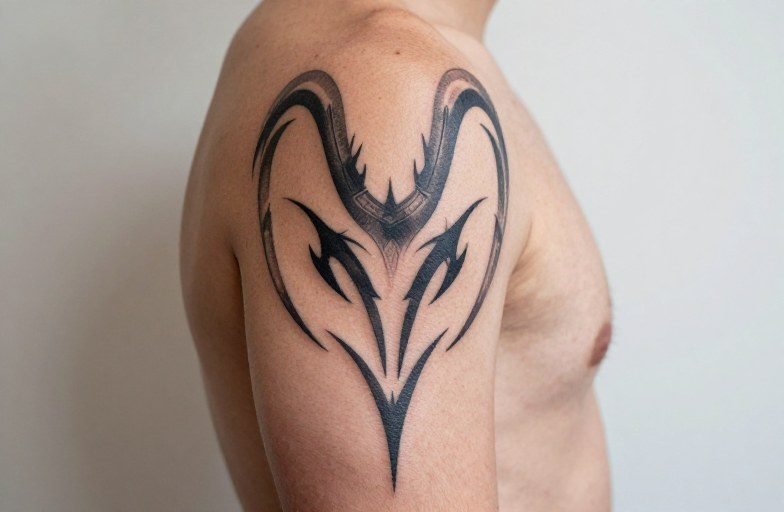
Tribal Sagittarius tattoos fuse the zodiac’s archer symbolism with the bold, graphic language of tribal tattooing, heavy black lines, geometric patterns, and flowing negative space. The challenge is making the centaur’s form or the arrow’s trajectory readable through abstracted shapes without losing the astrological reference entirely. Done well, the result carries weight and movement; done poorly, it becomes a blob of black ink that reads as neither tribal nor Sagittarius.
Origins & History
The tribal tattoo style as most people know it emerged from a 1990s fusion of Polynesian, Maori, and Samoan tattoo traditions filtered through Western interpretation. Those Pacific Islander roots used specific patterns to denote genealogy, rank, and protection, meanings that don’t directly transfer to zodiac imagery. The Sagittarius symbol itself, the archer, traces back to Babylonian astronomy and later Greek mythology, where the centaur Chiron represented wisdom and the hunt.
When these two streams merged in tattoo culture, the result was often a flattening of both traditions. Contemporary artists working in this space have moved toward more thoughtful integration, respecting the visual power of tribal linework while finding authentic ways to render the archer form.
What “Tribal” Actually Means Here
In this context, “tribal” refers to a specific visual vocabulary rather than cultural affiliation:
- Graduated line weights, thick black bands tapering to needle-fine points
- Curved and angular geometric patterns that follow muscle flow
- Heavy use of negative space to create contrast and readability
- Symmetrical or mirrored compositions, especially for back pieces
- Abstracted organic forms rather than literal illustration
The style is sometimes called “neo-tribal” or “blackwork tribal” to distinguish it from traditional cultural practices. Some trace the zodiac-tribal crossover to Southern California flash art of the early 1990s, though no single origin point is documented.
Key Characteristics & Motifs
The Sagittarius offers three main visual anchors: the archer, the arrow, and the centaur. In tribal translation, each presents different design problems.
The Archer Figure
Abstracting a humanoid form with bow drawn requires careful attention to proportion. The torso and bow arm often become sweeping curved bands, while the drawing arm and arrow resolve into sharper angles. The negative space between bow and body becomes critical, too narrow, and it closes up over time; too wide, and the figure falls apart visually. Most successful designs elongate the figure, stretching it across the body’s natural lines rather than compressing it into a badge-like shape.
The Arrow and Bow
The arrow offers cleaner tribal translation. A single arrow can carry the full Sagittarius reference with minimal detail, the fletching rendered as geometric flares, the shaft as a straight or slightly curved band. Bow shapes work as framing elements, arced lines that echo the arrow’s trajectory. Many designs pair the arrow with the Sagittarius glyph (the cross with upward arrow) worked into the fletching or tip.
The Centaur
The horse-human hybrid is the hardest to abstract successfully. Most tribal interpretations reduce the form to a single flowing silhouette, the human torso merging into equine curves without clear anatomical separation. This works best at larger scales where the transition has room to breathe. Small centaur tribals often read as indeterminate animals.
Color vs Black and Grey
Traditional tribal is saturated black. Period. The style depends on maximum contrast between inked skin and bare skin, and any color dilutes that impact.
That said, some contemporary variations introduce limited color:
- Deep red accents in arrow fletching or the Sagittarius glyph, referencing fire (Sagittarius is a fire sign)
- Dark blue or purple as background wash behind black linework, creating depth without breaking the tribal read
- White ink highlights on healed blackwork, adding texture but requiring touch-ups as white fades faster
Black and grey shading has no place in classic tribal. The style’s power comes from flat, unmodulated black. Greywash creates a muddy, uncertain quality that contradicts the graphic clarity that makes tribal work. If you want tonal variation, consider a different style entirely, perhaps illustrative blackwork or neo-traditional.
Best Placements
Tribal Sagittarius designs need space for their lines to flow and their negative space to remain distinct. Certain placements naturally accommodate this.
Shoulder to bicep: The classic tribal placement. The deltoid’s curve accepts arched bow shapes or the archer’s torso, with the design extending down the outer arm. Muscle movement animates the design slightly, intentional in traditional tribal, where placement followed body structure.
Upper back, centered or offset: Large centaur or archer compositions work here, symmetrical pieces spanning the shoulder blades or single figures aligned to one side. The broad canvas allows graduated line weights that would blur on smaller areas.
Outer thigh: Increasingly popular for larger pieces. The muscle’s length suits elongated arrow designs or full archer figures. Less sun exposure than arms means slower fading.
Calf and shin: Vertical arrow designs follow the bone’s line. The calf’s curve can carry bow shapes that wrap slightly. Be aware that shin and ankle tribal often ages poorly, thin lines spread, and the area sees constant friction from socks and boots.
Chest: The arrow pointing outward over the heart has obvious symbolic resonance, but chest skin moves and stretches significantly. Large pieces here require future touch-up planning.
Avoid: hands, feet, fingers, behind the ear. The skin’s texture and movement in these areas destroys fine tribal detail within months.
Who It Suits
Beyond zodiac affiliation, this style demands certain commitments. The heavy blackwork is permanent in a way finer styles aren’t, laser removal is more difficult and less complete on saturated black. Cover-ups require significantly larger, darker designs.
The aesthetic reads masculine in cultural association, though that constraint has loosened. What matters more is body type: tribal’s bold lines complement muscular definition, creating interplay between ink and anatomy. On very thin limbs, heavy black bands can appear to float rather than integrate. On larger bodies, the design needs sufficient scale, small tribals get lost.
Skin tone affects outcome. On darker skin, black ink reads as deep blue-black rather than pure black; the contrast is still present but different. Experienced artists adjust line weight slightly heavier to maintain visibility. On very fair skin, black stays true but sun exposure causes faster fading to grey, SPF becomes maintenance.
Modern Variations
The style has evolved beyond its 1990s form in several directions worth considering.
Pattern-based tribal: Rather than figurative archer or arrow, the Sagittarius glyph becomes a repeating geometric element within larger Polynesian-inspired pattern work. This reads as more culturally respectful when done with understanding of source patterns, though it requires an artist with genuine knowledge of those traditions.
Neo-tribal fusion: Combining tribal’s black bands with illustrative elements, perhaps a realistically rendered arrowhead emerging from abstract fletching, or a partial archer face within geometric framing. This hybrid demands technical range from the artist.
Blackwork ornamental: Abandoning the zodiac reference almost entirely except for subtle glyph integration within large-scale ornamental blackwork. The Sagittarius becomes private, embedded in pattern rather than displayed.
Choosing an Artist
This is where most tribal Sagittarius tattoos fail. The style looks simple, how hard can thick black lines be?, but requires precise technical control.
Look for:
- Consistent line weight in their healed portfolio, not just fresh photos. Fresh tribal always looks sharper; healed work reveals blowouts and uneven saturation
- Experience with large-scale blackwork specifically, not just occasional tribal pieces among varied styles
- Understanding of how designs flow with body movement, ask them to explain why they’d adjust a design for your specific placement
- Willingness to draw custom rather than applying flash. Sagittarius tribal from generic flash sheets is immediately recognizable as generic
Red flags: portfolios showing only fresh work, lines that waver in thickness without intention, designs that ignore body contour entirely, artists who dismiss questions about how the black will age.
Expect to pay for the time this requires. Heavy black saturation takes longer than equivalent-sized greywork, multiple passes, slower work to avoid overworking skin. A substantial shoulder-to-bicep piece might run 4-6 hours minimum.
Final Thoughts
A tribal Sagittarius tattoo works when the style’s visual language and the zodiac’s symbolism genuinely intersect, not when one is pasted onto the other. The best pieces let the arrow’s trajectory follow the body’s natural lines, let the black bands emphasize rather than obscure anatomy, and remain readable as both tribal design and astrological reference decades later when the lines have softened and the black settled into skin.
The commitment is real: this is not a style that fades gracefully into subtlety. It stays bold, or it becomes a blurred reminder of boldness past. Choose accordingly, and choose an artist who respects both what tribal blackwork does and what the archer represents.
Frequently Asked Questions
Will a tribal Sagittarius tattoo look dated in ten years?
The 1990s tribal revival has aged poorly in some cases, but contemporary neo-tribal with thoughtful custom design holds up better than flash-derived pieces. Focus on clean geometry and personal meaning rather than trend-following.
Can I add color to a black tribal Sagittarius later?
Adding color over saturated black is extremely limited, black dominates everything. If you want color integration, plan it from the start as accent work, not afterthought.
How much should a full shoulder tribal Sagittarius cost?
Custom blackwork of this scale typically runs $800-1500 depending on artist rate and location, with established specialists charging more. The time investment is substantial due to saturation technique.
Is it cultural appropriation to get a tribal zodiac tattoo?
The 1990s “tribal” style is already a Western abstraction distant from specific cultural practices, but directly copying Polynesian patterns without understanding remains problematic. Work with artists who create original geometric language rather than appropriating sacred motifs.
Related Style Guides
- Awesome Tattoo Ideas for Women
- Create Your Own Tattoo Design Free
- Pict Tattoo Designs: Ancient Ink Ideas
- Explore more