
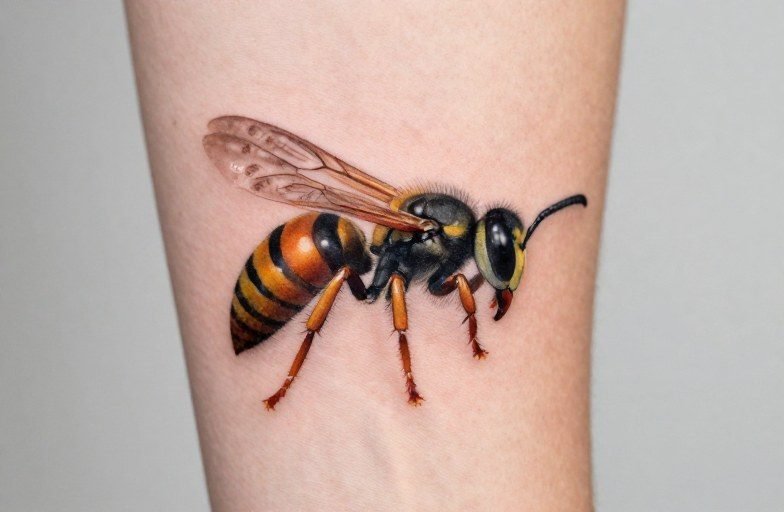
A wasp tattoo typically signals resilience, territorial defense, and sharp self-preservation. Unlike the communal honeybee, the wasp stands alone, solitary, aggressive when threatened, uninterested in being domesticated. People drawn to this image usually want to broadcast something harder-edged than sweetness: survival instinct, personal boundaries, or the willingness to sting back.
Symbolism & History
The wasp’s symbolic weight stretches across cultures, though specific meanings shift with context. Understanding these layers helps explain why someone might choose this particular insect over flashier alternatives.
Ancient and Cultural Roots
In Mesoamerican traditions, wasps often carried warrior associations, fast, painful, impossible to ignore. Japanese folklore sometimes linked hornets to relentless determination; the giant Asian hornet specifically embodies a kind of fearsome persistence that doesn’t retreat. European heraldry occasionally used the wasp to represent industriousness with an edge, a worker who defends rather than serves. These connections are often linked to martial values or protective household spirits, though the exact lineage varies by region and era.
Some trace the wasp’s modern tattoo popularity to punk and hardcore music aesthetics, where the insect’s stripped-down aggression matched the scene’s visual language. The imagery spread through album art, patches, and eventually skin. That subcultural residue still clings to the design, it’s rarely read as gentle or decorative.
Core Meanings Today
- Protection and boundaries: Wasps don’t attack unprovoked, but they respond disproportionately to threat. The tattoo often marks someone who gives warnings once.
- Resilience without softness: Unlike butterflies or bees, wasps don’t pollinate your garden or symbolize transformation. They endure, build, defend.
- Social isolation or independence: Many wasp species are solitary. The image appeals to people who don’t identify with colony-minded creatures.
- Precision and efficiency: Wasps are hunters, not gatherers. The tattoo can signal strategic thinking, surgical response to problems.
Common Variations & Styles
The wasp’s anatomy, narrow waist, veined wings, segmented abdomen, lends itself to several artistic approaches. Your choice of style dramatically changes how the tattoo reads.
Traditional and Neo-Traditional
American traditional wasp tattoos favor bold black outlines, limited color palettes (yellow, black, red accents), and strong readable shapes. The insect usually faces forward or in profile, wings spread to show the full silhouette. Neo-traditional work keeps the bold lines but adds more detail in the wings, more color gradation, sometimes decorative elements like daggers or banners. These versions read as classic, unambiguous, street-tough.
Realistic and Black-and-Grey
Photorealistic wasps require serious technical skill. The challenge is the exoskeleton’s shine, the transparency of wings, the hair-like textures on the thorax. Done well, these tattoos look like specimens pinned to skin, unsettling, scientific, slightly morbid. Black-and-grey realism ages more gracefully than color in small sizes, but the fine detail in wings can blur over time if placed on high-movement areas.
Minimalist and Geometric
Some designs reduce the wasp to its essential geometry: the pinched waist, the triangular head, the V-shaped wing pattern. Single-needle work can create delicate, almost architectural versions. These read more cerebral, less aggressive, designer rather than street. Geometric breakdowns of the wasp body, with hexagons replacing natural segments, nod to both the insect’s nest-building and contemporary tattoo trends.
Stylized and Illustrative
Japanese-influenced wasp tattoos sometimes scale the insect up to monstrous size, wrapping it around limbs with peonies or wind bars. Trash polka styles fracture the image with red splatter and mechanical elements. Watercolor backgrounds behind a solid wasp silhouette create contrast between structure and chaos. Each variation shifts the meaning slightly, more horror, more elegance, more aggression.
Best Placements
Wasps work almost anywhere, but certain placements amplify specific meanings. The insect’s directional posture matters: facing inward versus outward, ascending versus descending, changes the psychological effect.
- Neck or throat: High visibility, impossible to hide. Signals that the symbolism is central to identity, not private. The wasp’s stinger pointing toward the jaw adds confrontational energy.
- Hands and knuckles: Traditional placement for symbols of self-defense. Small wasp designs here age poorly due to constant movement and sun exposure, but the commitment itself communicates something.
- Forearm: Versatile for medium-sized pieces. Inner forearm allows detail; outer forearm shows the world. The wasp’s long body fits the forearm’s vertical space naturally.
- Ribcage or torso: Larger compositions, often combined with nest imagery or flowers. Painful placement that suggests the meaning is held close, literally protected by the body’s core.
- Behind the ear or on the temple: Small, wasp-as-whisper. The narrow waist fits these compact spaces. Reads as personal warning rather than public declaration.
Line-heavy wasp tattoos with minimal shading hold up better on fingers, feet, and other high-wear areas. Heavy black saturation in the abdomen can blur into a solid blob over five to ten years if the skin sees constant friction.
Who Chooses This Tattoo / Personal Meanings
There’s no single demographic. The wasp attracts people who reject the more commonly tattooed pollinators, bees for community, butterflies for change. The choice often marks a specific life phase: exiting a damaging relationship, recovering from violence, establishing professional or personal boundaries after being too accommodating.
Gendered Readings and Reclaiming
Women choosing wasp tattoos sometimes explicitly reject the pressure to be “sweet” or nurturing. The wasp becomes an anti-mandate, a refusal of likability. Men may use the image to signal protective capacity rather than aggression, defender of family, not random brawler. These are tendencies, not rules. The tattoo’s meaning compresses or expands based on the individual’s context.
Commemorative and Memorial Uses
Less common, but present: wasps marking survival of attack, assault, or systemic harm. The stinger becomes emblematic of fought-back, not given-in. Nest imagery sometimes accompanies these, suggesting rebuilt home or chosen family after dispersal. The memorial wasp tends toward realism rather than traditional styling, as if documenting an actual creature rather than adopting a symbol.
Similar Symbols
People considering wasp tattoos often weigh related imagery. Understanding the distinctions helps clarify whether the wasp is the right choice.
- Bee: Colony, cooperation, productivity. Softer, more socially acceptable, often linked to specific causes (environmentalism, Manchester’s worker bee). Choose the wasp if you want to emphasize defense over contribution.
- Hornet: Larger, more dangerous cousin. Some tattooers use the terms interchangeably, but hornet-specific designs tend toward sheer scale and threat. The wasp keeps some proportion, some restraint.
- Spider: Patience, trap-setting, creative destruction. The wasp acts; the spider waits. Different temporal relationship to violence.
- Scorpion: Desert, night, individual lethality. More explicitly dangerous, less industrious. The wasp maintains some connection to work and construction; scorpions don’t build.
- Snake: Transformation, cyclic renewal, venom. More ancient, more mythologically loaded. The wasp feels contemporary, almost urban.
Some designs combine wasp with other elements, nest and honeycomb hybrids, wasp-and-skull compositions, wasps emerging from mouths or eyes. These push toward horror imagery, losing the specific symbolic precision of the wasp alone.
Final Thoughts
The wasp tattoo occupies a narrow band in tattoo symbolism: too aggressive for mainstream decoration, too specific to be a generic “tough” marker. It works best for people who actually identify with the creature’s behavioral reality, solitary builders, disproportionate defenders, survivors who don’t need to be loved. If you’re drawn to the image, spend time with the species’ actual biology. Watch how paper wasps construct nests, how solitary species hunt, how the colony defends. The tattoo gains weight when it connects to observed truth rather than borrowed attitude. Choose a tattooer who understands insect anatomy; the narrow waist and wing venation are easy to flatten into generic bug-ness. Get the waist right, the segmentation precise, and the wasp will carry its meaning for decades.
Frequently Asked Questions
Does a wasp tattoo always mean something aggressive?
Not necessarily. The core meaning is protection and boundaries, defense rather than unprovoked attack. Many people choose it after learning to stand up for themselves, not because they want to seem threatening. Context and placement shape how aggressive it reads.
How well does a detailed wasp tattoo age over time?
Fine wing details and thin abdominal lines tend to blur after several years, especially on high-movement areas like hands or wrists. Bold traditional styles with thicker outlines age more reliably. Black-and-grey realism holds up better than heavy yellow saturation, which can fade to muddy green.
What’s the difference between a wasp and hornet tattoo?
Tattooers often use the terms interchangeably, but hornet designs usually emphasize larger scale and more menacing proportions. True wasp tattoos keep the narrower waist and more compact body. Symbolically, hornets lean harder into pure threat; wasps retain some nuance of construction and territorial defense.
Is the wasp tattoo connected to any specific music or subculture?
The imagery has roots in punk, hardcore, and certain metal scenes, where the wasp’s stripped-down aggression fit the aesthetic. That association still lingers, though the tattoo has broadened beyond any single scene. Today it attracts anyone drawn to its specific symbolism rather than subcultural membership.
Related Tattoo Meanings
- Bumblebee Tattoo Meaning: Community, Resilience Joy
- Whale Tail Tattoo Meaning: Symbolism, Styles Placement
- Blown Out Tattoo Look Like Meaning: Ink Spread Its Symbolism
- Explore more









