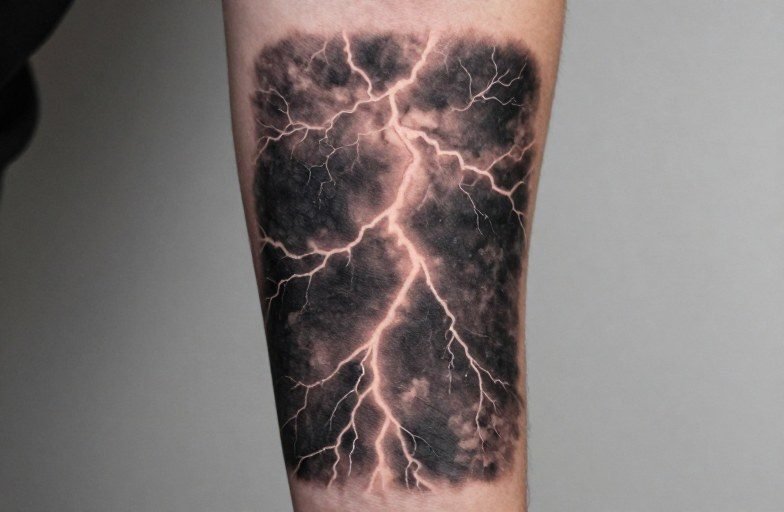
A thunder tattoo primarily symbolizes raw power, sudden transformation, and nature’s uncontrollable force. Unlike lightning, which represents speed and illumination, thunder carries the weight of consequence, the sound that follows the strike, the rumble that announces change has already occurred. People choose this symbol to mark personal upheavals, claim inner strength, or acknowledge life’s unpredictable, destructive beauty.
How It Ages on Skin
Thunder imagery presents specific challenges for long-term clarity. The jagged, irregular lines that define thunderbolt shapes blur faster than rounded, solid forms. Over five to ten years, fine interior detail, crosshatching, stippling, or tiny cloud wisps, tends to muddy into gray smears. Bold outer contours hold their shape far better.
Placement and Line Weight
High-movement areas like ribs, inner biceps, and calves accelerate distortion. Thunder tattoos on the outer thigh, upper back, or outer forearm age more predictably because skin stretches less dramatically there. For linework, 9-11 needle groupings create durable outlines; single-needle detail should be reserved for larger pieces where it can breathe.
Shading and Texture Longevity
Heavy black fill in thunderclouds stays readable for decades, but smooth gradients often settle unevenly. Whip-shaded edges or textured dotwork maintain visual interest longer than airbrush-style fades. If your design includes rain or secondary elements, consider separating them with negative space rather than relying on subtle tone shifts that disappear as skin changes.
Similar & Related Symbols
Thunder rarely travels alone in tattoo culture. Understanding adjacent symbols helps clarify what you’re actually communicating, and helps you avoid unintentionally copying common combinations.
Lightning vs. Thunder
- Lightning tattoos emphasize speed, revelation, divine message, or “strike first” energy
- Thunder tattoos emphasize aftermath, authority, the weight of presence, or “leave an impression”
- Combined, they suggest cause and effect, or power both immediate and lingering
Cloud and Storm Pairings
Traditional Japanese thunder gods (Raijin) carry drums that create thunder, often rendered with dramatic cloud spirals. Norse Thor’s hammer (Mjölnir) generates thunder and pairs naturally with thunder imagery. Native American thunderbirds combine avian and storm elements, though this symbol requires careful research to avoid appropriation. Plain storm clouds without cultural figures offer safer territory for thunder-focused designs.
Design Tips & Pairings
Effective thunder tattoos leverage contrast. The subject itself is chaotic, so composition needs intentional structure to avoid visual noise.
Composition Strategies
Framing thunderbolts with geometric borders, circles, triangles, or hexagons, creates tension between order and chaos. This works particularly well on chest pieces and upper arms where the geometry can follow muscle structure. Alternatively, letting thunder emerge from partial cloud coverage, with the bolt breaking a clean horizon line, suggests revelation or interruption.
Text pairings demand restraint. One word, maybe two, in a strong serif or brutalist sans-serif. Script fonts fight the angular energy of thunder imagery and typically date faster. If you want lettering, place it separate from the bolt itself, not wrapped through it.
Scale Considerations
Small thunder tattoos (under three inches) succeed as simple icons, single bolt, minimal cloud suggestion. Medium pieces (4-8 inches) can develop atmospheric depth with layered clouds and distant rain. Large work (full back, thigh sleeve, chest panel) allows narrative elements: figures reacting, landscapes transformed, sequential moments of storm approach and departure.
Color vs Black and Grey
Color theory changes thunder’s emotional register significantly. Your choice should reflect what aspect of the symbol matters most to you.
Black and grey thunder reads as solemn, timeless, slightly ominous. It connects to documentary storm photography, woodcut illustrations, and historical military insignia. The limited palette forces attention to shape and negative space. Healing is straightforward; there’s no color to shift or fall out unevenly.
Color introduces specific associations. Deep purples and electric blues suggest supernatural or psychedelic thunder. Blood-red bolts against black clouds create aggressive, almost violent energy. Yellow and white highlights on bolts can read as comic-book or pop-art, which some clients want but others find cheapens the symbol. Realistic storm color, blue-grays, muted greens, bruised purples, requires skilled color packing and will need refresh sessions sooner than black and grey.
One effective compromise: black and grey base with limited color accent on the bolt itself, drawing the eye without overwhelming the composition.
Personal & Modern Meanings
Contemporary thunder tattoos often detach from traditional mythology entirely. The symbol functions as personal shorthand for specific life experiences.
Transformation and Trauma
Survivors of sudden loss, accidents, or abrupt life changes sometimes choose thunder to mark the moment everything shifted. Unlike phoenix imagery, which promises rebirth, thunder acknowledges that some events don’t resolve cleanly, they rumble and reverberate. The tattoo becomes acknowledgment rather than redemption narrative.
Professional and Creative Identity
Musicians, particularly in heavy genres, use thunder to signal volume and impact. Athletes in contact sports sometimes adopt it for intimidation or to represent explosive power. These applications work best when personalized, specific equipment, jersey numbers, or instrument silhouettes integrated with the bolt rather than generic clip-art thunder.
Religious & Spiritual Angles
Thunder occupies charged territory across belief systems, often linked to divine voice or judgment.
Abrahamic Traditions
Biblical thunder frequently accompanies divine presence, Mount Sinai, theophanies, prophetic visions. Some Christian wearers interpret thunder tattoos as reverence for God’s overwhelming power, though others avoid it to prevent associations with wrath rather than love. The symbol requires theological nuance that many tattoo collectors don’t consider until after the fact.
Eastern and Indigenous Frameworks
Raijin in Shinto and the thunderbird in various North American traditions represent thunder as animate, personified force. Direct copying of these figures by outsiders raises serious cultural concerns. Abstracted thunder elements, suggested cloud forms, non-figurative bolts, can reference these traditions respectfully without appropriation. Research and consultation with practitioners matters here; a quick Pinterest search doesn’t constitute due diligence.
Final Word
Thunder tattoos carry genuine weight when chosen deliberately. The symbol’s power comes from its duality, immediate and lingering, destructive and necessary, heard before it’s understood. If you’re drawn to it, interrogate whether you want the flash of lightning or the rumble that follows, if you’re marking a moment or claiming a permanent quality. Your answer determines whether the design sustains meaning or becomes another forgotten bolt in the endless storm of trendy imagery.
Work with an artist who understands atmospheric rendering, who can build cloud depth without muddying values, who knows when to stop adding detail. The best thunder tattoos feel inevitable, like weather, you don’t question why they’re there, only that they belong.
Frequently Asked Questions
Does a thunder tattoo need to include lightning, or can it stand alone?
Thunder can absolutely stand alone, though many designs combine both for visual impact. Pure thunder imagery focuses on sound and atmosphere, clouds, vibration lines, or abstract energy, rather than the visible bolt. This creates a more subtle, less immediately recognizable symbol that rewards closer attention.
What’s the difference between a thunder tattoo and a lightning bolt tattoo?
Lightning emphasizes speed, sudden insight, or striking first, think flash, electricity, immediate action. Thunder emphasizes consequence, lasting presence, and the weight of power. The same bolt shape can read differently depending on surrounding elements: clouds and rumble lines push toward thunder; isolated, angular presentation reads as lightning.
Are thunder tattoos culturally appropriative if I’m not from a tradition that uses them?
Abstract thunder and storm imagery exists across virtually all cultures and carries low appropriation risk. Specific figures, Raijin, thunderbirds, Thor, require careful handling. Avoid direct copying of sacred figures; instead, research the visual language of your chosen tradition and work with artists who understand its boundaries. When uncertain, stick to non-figurative storm elements.
How much should I expect to pay for a quality thunder tattoo?
Small, simple bolt designs run $150-300 at reputable shops. Medium pieces with atmospheric detail typically cost $400-800. Large, complex storm scenes or full-chest panels reach $1,500-3,000+ depending on artist reputation and location. Thunder imagery demands solid black packing and clean linework, skills worth paying for rather than hunting bargain rates.
Related Tattoo Meanings
- Tornado Tattoo Meaning: Power, Chaos Transformation
- Two Lightning Bolt Tattoo Meaning: Reddit Symbolism Explained
- Mjolnir Tattoo Meaning: Thor s Hammer Symbolism Style Guide
- Explore more