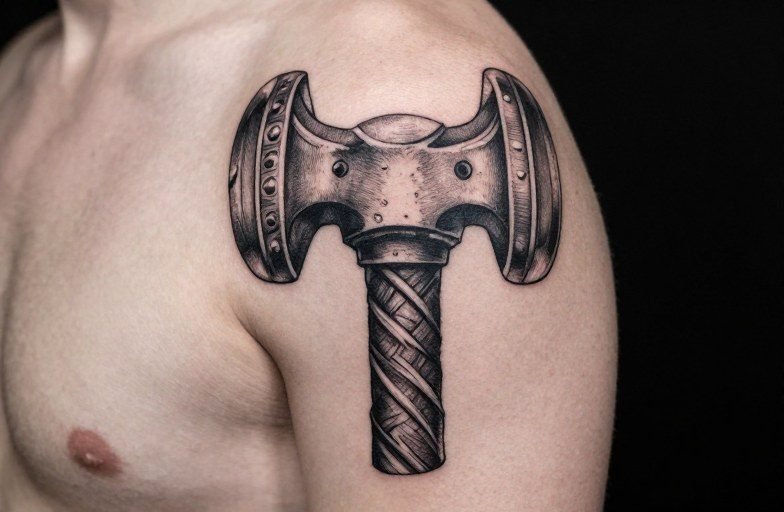
Mjolnir, Thor’s hammer in Norse mythology, functions as a protective amulet, a weapon of cosmic order, and a badge of cultural identity. As a tattoo, it draws people who want something weightier than generic toughness: connection to ancestral roots, defiance against erasure, or simply the raw visual power of a forged object. The symbol’s meaning shifts noticeably depending on whether you wear the archaeological pendant style or a battle-worn weapon from modern pop culture.
Symbolism & History
Archaeological Roots
Small Mjolnir pendants, often linked to Viking Age Scandinavia, appear frequently in burial finds. These weren’t mere decoration. Worn against the body, they served apotropaic functions, meaning they were believed to turn away harm. The hammer’s shape in these artifacts is distinctive: short handle, broad head, sometimes with a loop for suspension. Some trace it to the broader Germanic thunder-weapon tradition, though the Norse material is the most visually recognizable. For tattoo collectors today, choosing this archaeological form signals deliberate engagement with historical practice rather than cinematic fantasy.
Modern Reclamation & Identity
During the 20th century, Mjolnir underwent complicated appropriation by various nationalist movements. This history means the symbol carries political weight that many wearers actively work against. Modern pagan and heathen reconstructionist communities have spent decades reclaiming Mjolnir as a religious identifier, similar to how others might wear a cross or Star of David. The tattoo thus becomes a declaration of faith, a counter-signal against racist co-optation, or both simultaneously. Understanding this tension isn’t optional, it’s part of the symbol’s living meaning.
- Protective function: historically worn as amulet, now inked as permanent shield
- Cultural continuity: connecting to Scandinavian, Germanic, or broader Northern European heritage
- Religious identity: Ásatrú and heathen practitioners using it as devotional marker
- Anti-fascist reclamation: explicitly distancing from white supremacist misuse
Common Variations & Styles
The Pendant Form
Replicating actual archaeological finds makes for compact, immediately recognizable tattoos. These work exceptionally well at smaller sizes, two to three inches, because the original objects were themselves portable. Line weight matters enormously here. Too thin, and the detail collapses within a few years as ink spreads in the dermis. Too bold, and you lose the delicate proportions that make these pendants distinctive. Black and grey dominates, though some collectors add subtle bronze or silver tones through muted color packing.
The Weaponized Hammer
Contemporary illustrative and neo-traditional approaches often depict Mjolnir as an active weapon: cracked lightning, splintered wood, battle damage. These pieces demand more real estate. The hammer head becomes a stage for texture work, pitted iron, worn leather wrapping, runic inscriptions. Shading here separates mediocre from excellent. Smooth whip shading on metal surfaces contrasts against rougher texture in stone or wood backgrounds. Lightning bolts, when included, require careful planning; they age poorly if too thin or too saturated, turning into muddy blue-green blurs within five years.
- Archaeological replica: precise line work, small scale, historical accuracy
- Neo-traditional: bold outlines, limited color palette, stylized lightning
- Blackwork/dotwork: geometric interpretations, sometimes incorporating bindrunes
- Realistic/illustrative: weathered metal, dynamic composition, environmental storytelling
- Biomechanical: hammer emerging from or replacing bone/tissue
Best Placements
Forearms and calves function as natural display spaces for Mjolnir’s vertical orientation. The pendant form especially suits the inner forearm, where the slight curve of the muscle follows the hammer’s hanging position. Chest pieces allow for the weaponized interpretation, with the hammer head centered over the sternum and handle extending toward the stomach, literally over the heart, which carries obvious symbolic weight.
Hands and fingers present problems. The small scale forces simplification that loses recognizable detail, and these areas fade fastest due to constant use and sun exposure. Neck placement, particularly the side or back, works for committed collectors but carries professional visibility concerns that the symbol’s sometimes-political associations amplify.
Thigh and back of arm (tricep area) offer excellent compromise: large enough for detail, easy to conceal, stable skin that ages ink relatively well. The hammer’s symmetry makes it forgiving for placement; unlike asymmetrical designs, minor positioning errors are less visually disruptive.
Who Chooses This Tattoo & Personal Meanings
Heritage & Ancestry
Scandinavian-Americans and others with documented or suspected Northern European ancestry often select Mjolnir as tangible connection to pre-Christian roots. This isn’t necessarily religious, many wearers maintain other faiths or none. The tattoo functions as genealogical marker, a way of carrying something specific rather than melting-pot generality. The choice of historical versus pop-cultural rendering usually indicates how serious this ancestral connection is.
Strength & Protection Narratives
Some collectors come to Mjolnir after trauma, illness, or significant life transition. The hammer’s mythological function, defending gods and humans against chaotic forces, translates into personal symbolism without requiring ancestral claim. This meaning operates independently of Norse religious practice. The permanence of tattooing matters here: unlike a pendant that can be removed, the inked hammer becomes inseparable from the body it protects.
Subcultural Affiliation
Metal music communities, particularly black and Viking metal scenes, have long used Mjolnir as identifier. Tattooing it signals participation in these communities, sometimes with irony, sometimes with genuine spiritual commitment. The distinction between aesthetic affiliation and belief matters for how the tattoo is rendered, ironic wearers often choose more stylized, less archaeologically faithful versions.
Similar Symbols
Valknut and Vegvísir frequently appear alongside or instead of Mjolnir, though their meanings diverge. The Valknut, three interlocking triangles, associates with Odin and the slain, carrying death-related symbolism that some find too heavy for casual wear. Vegvísir, the “Viking compass,” actually dates to much later Icelandic magical practice and functions as wayfinding symbol rather than protective weapon. Both lack Mjolnir’s specific defensive connotations and its complicated modern political history.
Runic inscriptions often accompany Mjolnir tattoos, but require careful research. Individual runes carry specific meanings; combining them without understanding creates nonsense or unintended messages. The Elder Futhark runes most commonly used are historically appropriate for Viking Age Mjolnir, while Anglo-Saxon or medieval runic systems would be anachronistic. Professional rune translators exist, and consulting one before committing to permanent ink is standard practice among serious practitioners.
Other thunder-weapon symbols, Indra’s vajra, Zeus’s thunderbolt, the Slavic Perun’s axe, offer comparative mythology for collectors drawn to the archetype rather than specifically Norse expression. These rarely carry Mjolnir’s modern political baggage, though they lack its immediate recognizability in Western contexts.
Final Thoughts
Mjolnir rewards the wearer who does the work, understanding its archaeological reality, its modern political complications, and how specific rendering choices communicate different relationships to all of this. The tattoo succeeds when it carries weight beyond generic toughness, when the hammer’s permanence on skin matches some genuine permanence in the wearer’s life. Poorly researched Mjolnir tattoos look like merchandise; considered ones function as genuine cultural markers, protective talismans, or both. The symbol’s power lies precisely in this density: nothing about it is simple, and the best tattoos acknowledge that complexity rather than flattening it.
Frequently Asked Questions
Does a Mjolnir tattoo automatically mean someone is racist or neo-Nazi?
No, though the symbol has been misused by white supremacist groups. Many modern wearers are explicitly anti-racist pagans, heritage enthusiasts, or simply fans of Norse mythology. Context matters: accompanying imagery, runic combinations, and the wearer’s own explanation clarify intent. Reclamation by diverse communities is ongoing and visible.
How do I make sure my Mjolnir looks historically accurate rather than Marvel-inspired?
Study archaeological finds from sites like Denmark, Sweden, and Iceland. Genuine pendant hammers have short handles, broad asymmetrical heads, and often include suspension loops. Avoid the elongated, perfectly symmetrical movie version. Museum databases and academic publications on Viking Age metalwork provide reliable reference images.
What’s the minimum size for a detailed Mjolnir tattoo?
Pendant-style designs need at least two inches of height to preserve detail. Weaponized versions with environmental elements require significantly more, four to six inches minimum. Going smaller guarantees blur within a few years as ink spreads and fine lines merge. Your artist should scale the design to your chosen placement’s available space.
Can I combine Mjolnir with other symbols like runes or the Valknut?
Yes, but research thoroughly. Runes carry specific phonetic and semantic values; random combinations create gibberish or unintended words. The Valknut’s death-association changes the overall meaning significantly. Consult heathen religious practitioners or academic runologists rather than relying on internet charts, many of which contain errors.
Related Tattoo Meanings
- Thunderbolt Tattoo Meaning: Power, Speed Sudden Change
- Flail Tattoo Meaning: Power, Justice Ancient Authority
- Symbols That Strength Tattoo Meaning: Power, Courage Resilience Ink
- Explore more