A thunderbolt tattoo compresses a lot into one simple shape: raw power, speed that allows no second thoughts, and the kind of sudden change you cannot undo. It is one of the oldest symbols humans have used to describe forces bigger than themselves, and it still reads that way on skin today. The design works for people who have survived an abrupt rupture, those who want to project voltage, and anyone who simply respects the physics of a good strike.
What the Thunderbolt Actually Means
At its simplest, the bolt signals electricity and speed. But it carries deeper weight depending on the cultural context you draw from, and those roots are worth understanding before you commit the design to your body.
Greek and Roman Authority
Zeus in Greek tradition and Jupiter in Roman tradition both wielded the thunderbolt as their signature weapon. It was not decorative: it was how the king of gods destroyed what needed destroying. The bolt represented absolute, unchallengeable authority. Classical artistic tradition typically depicted it as a symmetrical winged rod, fire at both ends, jagged center, a shape that survives almost intact in modern tattoo flash. If you are drawn to this imagery, you are working in a lineage that is at least 2,500 years old.
Norse and Hindu Parallels
Thor’s hammer Mjolnir in Norse tradition summons lightning with comparable destructive force. While Mjolnir differs visually from the Greek bolt, both serve the same function: the sky god’s instrument of power. Tradition suggests the two mythologies developed their thunder-deity figures independently, though scholars note similar Indo-European roots.
Indra’s vajra in Hindu cosmology adds another dimension. The vajra, often translated as “diamond thunderbolt,” appears to represent both irresistible force and indestructible spiritual clarity. It became central to both Hindu and later Buddhist iconography, carried forward in Tibetan ritual objects. A vajra-influenced thunderbolt tattoo sits in a distinctly different tradition from the Greek bolt, more meditative, less martial, though both track back to storm-deity power.
Indigenous American Associations
Many Indigenous nations of North America associate the Thunderbird with lightning generation, the great bird’s wings producing thunder and its eyes flashing lightning bolts. Specific beliefs vary significantly by nation and tradition, and sources vary considerably on the particulars. If you are considering imagery that draws from Thunderbird traditions, researching the specific nation’s visual language matters more than using a generalized motif.
Modern Cultural Weight
The thunderbolt picked up substantial new associations in the 20th century that live alongside its ancient roots in contemporary tattoo work.
Military and Institutional Use
The US Air Force adopted lightning bolt insignia across various units, associating the symbol with air superiority and speed. The SS used a double lightning bolt in WWII, a fact that makes double-bolt designs read differently today than single bolts do. If you are planning a double bolt, an artist consultation about visual associations is worth having before you commit.
Rock Music and Pop Culture
David Bowie’s Aladdin Sane lightning bolt face paint, introduced in 1973, embedded the symbol permanently into rock iconography. It read as theatrical, gender-fluid, otherworldly. AC/DC’s logo uses a jagged bolt to signal pure electrical energy in sound. These associations mean a thunderbolt tattoo can simultaneously invoke ancient mythology and 1970s glam rock, which is not a contradiction; it is part of what makes the symbol durable. Harry Potter’s lightning scar added a mainstream layer that has aged into its own legitimate tattoo tradition at this point.
Design Variations That Hold Up
How you stylize the bolt changes its reading significantly, and some approaches survive better on skin than others.
Classic Jagged Bolt
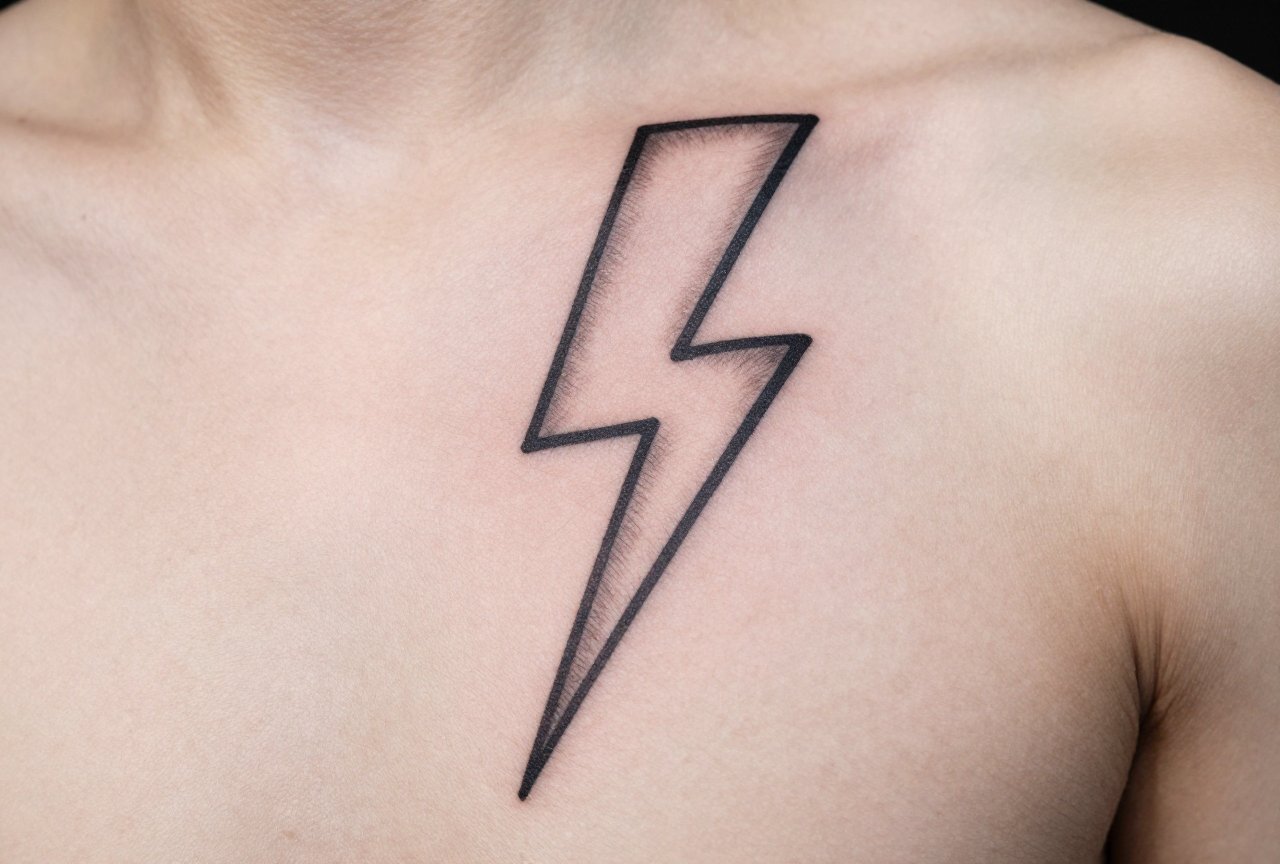
The standard zigzag with thick outlines and solid fill ages best across most placements. Traditional and neo-traditional approaches with bold line weights hold their shape over five, ten, fifteen years in ways that fine-line versions simply do not. If longevity matters to you, this is the safer direction.
Zeus’s Stylized Winged Bolt
The classical depiction with symmetrical wings and pointed ends reads immediately as mythological rather than natural lightning. It suits larger placements, upper arm, thigh, back, where the symmetry can read cleanly. At small scale the wing detail tends to collapse into indistinct marks.
Vajra Forms and Double Bolt
A vajra-derived design looks nothing like the Western lightning bolt: it is a scepter-like object with lotus and spoke ends. For someone specifically drawing on Hindu or Buddhist tradition, this is the accurate form. It reads as spiritual object more than weapon, which changes the whole energy of the piece.
Double bolts carry the military association noted above. Storm cloud integration softens the militancy and reads more natural. A clenched fist holding a bolt adds defiance explicitly, popular in protest and activist contexts.
Placement: What Works and What Does Not
Lightning bolt shapes interact with body placement in specific ways because the diagonal line either fights or follows natural body contours.
- Forearm: The natural length suits a bolt running wrist-to-elbow. Highly visible, reads confrontational. Sun exposure here accelerates fading; plan for touch-ups at the five-year mark.
- Calf: Good muscle cushion, strong canvas for branching or multi-bolt compositions. Heals predictably and holds saturation well over time.
- Upper arm: Classic placement, shoulder to elbow. Allows size without the sun exposure problem. The bolt’s angle can follow or cross the arm’s axis for different visual effects.
- Behind the ear: Minimalist bolts work here as a sharp accent, but you lose most detail at this scale. Fine-line versions blur fastest here due to movement and thin skin.
- Sternum: Central, private, dramatic. The vertical bolt follows the breastbone’s line naturally. Skin movement during healing can complicate things; choose an artist with chest experience.
Avoid fingers and hands unless you are prepared for frequent touch-ups. Hand skin sheds faster than almost anywhere else, and the bolt’s sharp angles turn soft quickly. Direction matters too: a bolt striking downward feels inevitable, one angled upward suggests defiance or aspiration.
Color vs. Black and Grey
The thunderbolt is one symbol where color genuinely earns its place. Electric blue or purple suggests supernatural or technological energy. Gold or yellow sits in the classical Zeus tradition, natural lightning given form. Bold color holds better on upper arm and calf placements than on hands, wrists, or behind the ear, where sun and friction work against pigment over time.
All-black versions read as severity and authority. They age cleanly and avoid any problematic color associations. If you are uncertain, black is the reliable default, and it works across every stylistic approach from traditional to fine line.
Sizing: Where Definition Breaks Down
Lightning bolts depend on sharp angles for their identity. As ink spreads over years, those angles round off. A bolt smaller than about two inches tends to lose its distinctiveness within five to seven years, especially in fine-line execution. The minimum viable size for a bolt that stays legible long-term is roughly palm-width for detailed work, smaller only if you commit to bold outlines with minimal interior detail.
For behind-the-ear placements, go simpler than you think you need to. A single clean zigzag line outlasts any intricate design at that scale.
Conclusion
The thunderbolt tattoo has survived millennia of cultural transmission because it compresses something genuinely hard to name: the moment force arrives without warning, changes the situation permanently, and moves on. You can load it with Zeus’s authority, Bowie’s theatricality, or a personal story of sudden rupture, and the symbol absorbs all of it without contradiction.
What you owe the design is craft. Choose bold over precious, especially if you are planning to keep it for decades. Work with an artist who understands line weight and placement relative to body movement. The bolt that still reads clearly in fifteen years is the one built to last, not the one that photographed best on the day you got it.
Frequently Asked Questions
Does a thunderbolt tattoo have to mean something specific, or can I just like how it looks?
You can absolutely get it for the aesthetic alone. Most artists respect genuine visual attraction over forced symbolism. Just know that others will project meaning onto it regardless of your intent.
Will a small thunderbolt tattoo blur or fade quickly?
Fine line versions do tend to soften faster than bold traditional work. The sharp angles that make lightning recognizable can round off over time. Plan for potential touch-ups, especially on high-movement areas like wrists or ankles.
Is the thunderbolt only a masculine tattoo symbol?
Not at all. The symbol’s power reads across the gender spectrum, and contemporary styling including delicate linework, watercolor backgrounds, and botanical integration has made it increasingly flexible in interpretation.
Can a thunderbolt tattoo work as a cover-up?
Sometimes, but it is challenging. The negative space and branching structure can incorporate small existing tattoos, but the bolt’s clarity requires relatively clean skin. A skilled artist can evaluate whether your existing tattoo’s darkness and placement allow for lightning’s specific geometry.
Related Tattoo Meanings
- Greek Mythology Tattoo Meanings: Symbols That Last
- Zeus Tattoo Meaning
- Lightning Tattoo Meaning
- Explore more