Zeus is the king of the gods in Greek mythology, and a Zeus tattoo carries that weight directly. It signals raw power, divine authority, and the kind of leadership that doesn’t ask permission. People don’t get this tattoo because it looks cool on a mood board. They get it because they feel a connection to something bigger, something sovereign.
The meanings run deeper than just ‘strong guy with a beard.’ Zeus represents cosmic order, justice, protection, and the force that holds chaos in check. If you’re drawn to the mythology, the visual drama of a thunderbolt in a fist, or the personal resonance of a father figure archetype, this tattoo carries real symbolic weight. Let’s break down what it actually means.
Core Symbolism: What a Zeus Tattoo Actually Means
Zeus tattoos are fundamentally about power and authority, but not arbitrary power. Zeus rules by divine right and upholds cosmic law. His symbolism covers leadership, justice, strength, and protection. He’s the sky father, the storm bringer, the one who enforces order among both gods and mortals. People who get his image are often drawn to that combination of raw strength and responsibility.
The thunderbolt is his signature attribute and the most recognized symbol tied to him. It represents swift, decisive force, the ability to act without hesitation. Other associated symbols include the eagle, which he commanded, the oak tree, which was sacred to him, and the scepter, which marks his kingship. Any of these elements added to a Zeus portrait deepen the meaning and ground it firmly in classical mythology.
Greek Mythology Background You Should Know
Zeus doesn't need a crown. The lightning bolt tells you everything.
In Greek mythology, Zeus is the youngest son of Titans Cronus and Rhea. He overthrew his father, freed his siblings, and divided dominion over the universe with his brothers, taking the sky for himself. He rules from Mount Olympus and is the father of gods like Athena, Apollo, Artemis, and Hermes, as well as many mortal heroes. His Roman equivalent is Jupiter, and many of the same visual conventions carry over between the two.
His character in myth is complex. He’s a protector and a lawgiver, but also unpredictable and capable of wrath. That complexity is actually part of the appeal for a lot of people. He’s not a simple hero. He’s a figure of enormous power who still has to navigate consequence. That makes him feel real and relatable in a way pure hero figures often don’t.
Popular Design Variations and What They Communicate
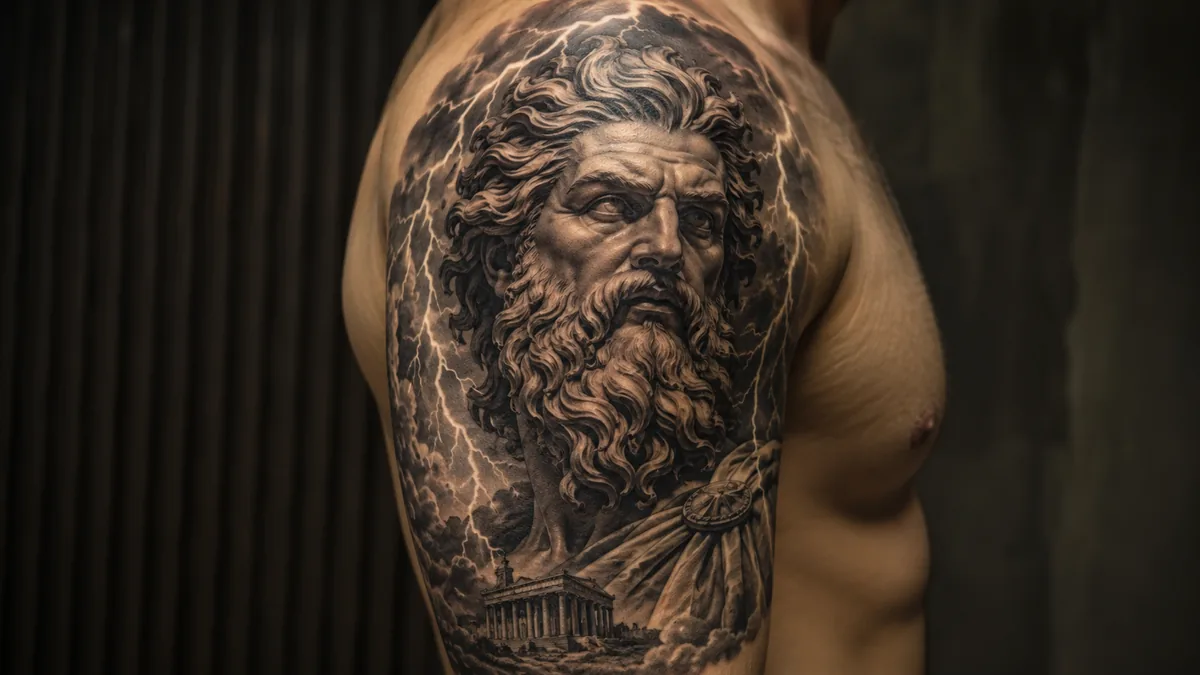
The most classic approach is a portrait: a bearded, powerful older man, often shown in profile or three-quarter view, with intense eyes and a commanding expression. Sometimes he’s mid-throw with a thunderbolt, sometimes seated on a throne, sometimes shown as a bust inspired by ancient Greek sculpture. Realistic portraiture in black and grey is the dominant style here. It reads as serious, timeless, and deeply tied to classical art.
Neo-traditional and illustrative styles have opened up Zeus designs considerably. You’ll see him rendered with bold outlines, dynamic compositions, storm clouds swirling around him, lightning splitting the background. Some people go geometric, pulling from ancient coin imagery or Grecian pottery art, with a flat graphic quality that’s clean and crispy. Watercolor washes can add drama, though they fade faster. Matching Zeus with an eagle or a thunderbolt alone gives you a cleaner, more symbolic piece if a full portrait feels like too much.
Black and Grey vs. Color: Which Holds Better
Black and grey is the strongest long-term choice for a Zeus portrait. Fine details in a realistic face, the texture of a beard, the depth in storm clouds, all of that reads beautifully in black and grey and holds its integrity over years when done by a solid hand. A skilled artist can get incredible depth and contrast with just black ink and good technique. Whip shading around the figure gives it that lived-in, sculptural quality that feels right for ancient mythology subject matter.
Color can absolutely work, especially in neo-traditional or illustrative styles where bold, saturated hues define the design. Deep blues and golds, electric yellows for the lightning bolt, are common and striking. The risk with color is that it requires more maintenance over time, particularly in high-wear areas. Saturated color on a large forearm or shin piece will need a touch-up session sooner than a comparable black and grey piece. Bold will hold better than fine-line color, regardless of style.
Best Placements and How the Tattoo Ages
For a detailed Zeus portrait or a full figure composition, you need real estate. The upper arm, shoulder, chest, back, and thigh are the best placements. These are lower-wear zones compared to hands, feet, or fingers, and they give an artist the space to build contrast and detail that makes this kind of tattoo actually land. A Zeus portrait crammed into a small, high-wear spot is going to blur and muddy within a few years. Give it room to breathe.
Fine-line Zeus pieces look incredible fresh but age harder, especially on the inner arm or anywhere with consistent friction and sun exposure. If you want fine line, go for it, just know that you may be back for a refresh in five to seven years. Bold, well-structured pieces on the outer upper arm or back hold their shape much longer. The goal is a piece that reads from across the room at twenty years, not just across the Instagram grid at day three.
Who Gets Zeus Tattoos and What It Says About Them
This isn’t a casual tattoo. People who choose Zeus are usually making a deliberate statement about identity. A lot of people get it as a tribute to personal power, marking a period of reclaiming authority over their own lives. Others get it for Greek heritage, family connection to the mythology, or a philosophical alignment with Stoic ideals where Zeus as cosmic order plays a significant role. Fathers sometimes get Zeus pieces as a reflection of their role as protector and authority in their family.
There’s also a growing interest in Greek mythology tattoos among people who studied classics, philosophy, or ancient history, and who want to wear that intellectual and cultural identity visibly. The tattoo carries gravitas. It’s not trying to be edgy or shock anyone. It communicates something specific about how you see yourself and what you value. That’s exactly the kind of intentional ink that holds meaning for decades.
Making It Personal: Details That Customize the Meaning
The specific elements you choose with a Zeus tattoo shape what it says about you. Adding his eagle, Aetos Dios, signals vision and dominance, a creature that flies above everything and sees all. A thunderbolt alone as a standalone piece is more minimalist but unmistakable, hitting that same symbolism without the full mythological portrait. The oak tree or oak wreath connects to his role as protector of guests and travelers, sacred groves were dedicated to him at Dodona.
If you’re going with a portrait, the mood of the face matters a lot. A calm, regal Zeus reads differently than a wrathful one mid-storm. Think about which aspect of his character you’re connecting with. You can also incorporate Greek key borders, ancient coin-style framing, or script in classical Greek to anchor the piece culturally. Talk through these choices with your artist before booking. The right reference images and a clear conversation about what this tattoo means to you is what separates a solid custom piece from a flash grab.
Pain Level by Placement: What to Expect
Pain is subjective, but placement matters. The outer upper arm and shoulder are generally the most tolerable spots for a large Zeus piece, with decent muscle and skin thickness buffering the sensation. The chest is more intense, especially near the sternum and collarbone, and ribs are famously spicy. The back is usually manageable for longer sessions, though the spine itself will get your attention. Thigh pieces are typically on the easier end, which makes that placement great for people nervous about their pain tolerance.
Upper arm and shoulder sessions can often run three to five hours for a detailed portrait without being unbearable for most people. Stay fed, stay hydrated, and don’t book a marathon session on an empty stomach. First-timers sometimes underestimate how mentally tiring a long sit can be, even when the physical pain is manageable. Break it into sessions if you need to. A half-finished Zeus that heals well is better than a pushed-through, blown-out mess that needs heavy rework.