
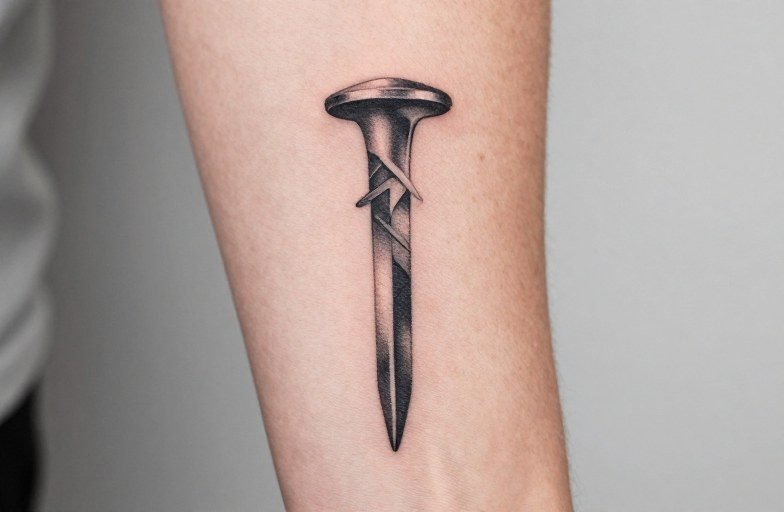
A railroad spike tattoo carries the weight of forward motion, literal and figurative. the design represents unstoppable progress, the brute labor of building infrastructure that connects people across distance, and the stubborn endurance of something hammered into place to hold everything together. The spike itself is a simple iron wedge, but its symbolism runs through American industrial history, labor pride, and the idea of being the thing that keeps the track from shifting under pressure.
Religious & Spiritual Angles
Christian iconography occasionally borrows the spike as a reference to the nails of the crucifixion, though this connection is less common than the carpenter’s square or traditional three-nail cluster. Some wearers blend the railroad spike with a crown of thorns or incorporate it into a larger Passion piece, drawing a line between Christ’s sacrifice and the suffering of laborers. The parallel is visual more than doctrinal, the spike as piercing, holding, enduring.
Secular Spirituality
Outside organized religion, the spike functions as a talisman of perseverance. People who’ve rebuilt their lives after addiction, incarceration, or catastrophic loss sometimes choose this image to mark the slow, hammered work of reconstruction. There’s no scripture behind it, but the metaphor holds: you don’t lay track in a day, and you don’t rebuild a life in one either.
Mythology & Folklore
American railroad folklore is thick with ghost stories and tall tales, and the spike sits at the center of several. John Henry, the steel-driving man who raced a steam drill and won at the cost of his life, is sometimes depicted with a hammer in one hand and a spike in the other. His image, often linked to African American folk hero traditions, makes the spike a symbol of human labor against mechanization, of flesh proving itself against the machine.
European Echoes
The iron nail appears in older European folk practices as a protective object. Horseshoe nails, door nails, and coffin nails all carried apotropaic meaning, warding off evil, sealing something away, or binding a promise. The railroad spike inherits some of this resonance, particularly when tattooed with a rusted, aged finish that suggests it has already done long service.
Best Placements
The elongated shape of a railroad spike makes it naturally suited to certain body areas and awkward in others. Forearms and calves work well, the vertical or diagonal orientation follows the muscle flow without fighting it. Ribs and spine placements can accommodate the full length, though the narrow point of the spike risks blurring over time in areas with significant skin movement.
- Forearm (outer or inner): Classic visibility, easy to build into a larger sleeve of industrial or Americana imagery. Line-heavy versions hold crisp here.
- Calf: The muscle curve flatters the taper. Good for larger, shaded pieces with wood grain or rail texture.
- Side of torso: Vertical placement follows the rib line. Best for collectors with established pain tolerance; the spike’s narrow detail can spread during healing.
- Hand or fingers: Possible but risky. The spike’s point migrates quickly on high-wear skin; expect touch-ups and eventual softening of fine lines.
- Thigh: Ample real estate for a spike driven through a wooden tie, with room for environmental storytelling.
One practical note: the spike’s silhouette is narrow. On small areas like wrists or ankles, it can look like a random pointed object without context. Consider scale carefully, a two-inch spike without surrounding elements often reads as abstract geometry rather than recognizable tool.
Design Tips & Pairings
Style dramatically changes how this tattoo reads. A photorealistic black-and-gray spike with rust pits and forged texture emphasizes decay and time served. Bold traditional linework with a limited color palette reads more like union pride or working-class heraldry. Neo-traditional approaches might wrap the spike with wild roses or banner scrolls, softening the industrial edge with romantic Americana.
Common Pairings
- Hammer: The obvious companion, completing the narrative of driving. Crossed hammer and spike echo military insignia structure.
- Railroad tracks: Perspective lines receding into distance, sometimes with a date or mile marker. Adds narrative depth but requires more space.
- Swallows or bluebirds: Traditional sailor and rail worker motifs of return and safe passage. The birds soften the spike’s severity.
- Wood grain tie: Grounds the spike in functional context. The contrast of organic wood and forged metal gives tattooers textural variety to showcase.
- Coordinates or dates: Specific locations of personal significance, a hometown depot, a crash site, a place where life changed direction.
Color choices matter. Rust orange and iron brown warm the image, connecting it to aged machinery. Cool steel grays and blue-black shadows push it toward something more ominous or ghostly. Red, when used, typically signals danger or blood, sometimes literal (railroad work was lethally hazardous) or metaphorical.
History & Cultural Roots
The golden spike ceremony at Promontory Summit, Utah, in 1869 completed the first transcontinental railroad, and that specific spike, though ceremonial, not functional, became an enduring American symbol. The actual labor behind it involved thousands of unnamed workers, including significant numbers of Chinese immigrants and Irish immigrants whose contributions were systematically erased from celebratory narratives. Some contemporary wearers choose the spike specifically to honor this hidden labor, a quiet corrective to history.
Union and Labor Context
Railroad brotherhoods and unions adopted imagery from their trade, and the spike appeared on pins, stickers, and eventually skin. For descendants of rail workers, the tattoo can function as family crest, less about personal struggle than about belonging to a lineage of people who maintained infrastructure most never think about. The Brotherhood of Railroad Trainmen and similar organizations used visual culture to build solidarity; the tattoo continues that tradition in individualized form.
Personal & Modern Meanings
Contemporary wearers often have no family connection to railroads. The spike has migrated into broader use as shorthand for several personal narratives: someone who keeps going when they want to stop, someone who holds things together for others, someone who has been hammered by circumstance and remained functional. The metaphor is elastic enough to accommodate without being so vague it means nothing.
Some choose it after completing long-term projects, marathons, degrees, construction of actual homes. The spike marks a finish line that was also a starting point. Others use it to commemorate relationships that required sustained effort, the slow building of trust over years rather than dramatic gestures.
The image also appears in recovery communities, where the language of “laying track” one day at a time resonates with established sobriety metaphors. The spike is the single action repeated until the line is complete.
The Takeaway
A railroad spike tattoo works because its source object is already loaded with physical reality. It is not an abstract symbol invented for decoration; it is a tool that required human sweat to function, that holds tons of moving steel in place, that rusts but does not quickly fail. The best versions of this tattoo respect that material history, rendered with attention to forged texture, to the violence of being driven, to the patina of long use.
The meaning is there in the object itself. Your job as a collector is deciding which facet matters to you: the labor, the endurance, the connection, the forward motion. A good tattooer will build the design around that specific weight rather than offering a generic spike that could belong to anyone. The image is common enough that personalization through placement, pairing, and detail quality becomes essential. Get the lines crisp, let the rust show where it matters, and know why it’s in your skin beyond the fact that it looks solid, which, admittedly, it does.
Frequently Asked Questions
Does a railroad spike tattoo always mean someone worked on trains?
Not at all. While some wearers have family ties to railroad labor, many choose it for the broader symbolism of endurance, progress, or personal struggle. The image has outgrown its literal origins.
How well does fine detail on a spike tattoo age?
The narrow point and any tiny rust pits tend to blur over 5-10 years, especially on high-movement areas. Bold outline with selective detail ages better than all-over photorealistic texture.
Can a railroad spike be part of a larger sleeve or does it work better alone?
It integrates beautifully into industrial, Americana, or folk art sleeves. Solo pieces work best at medium scale with enough surrounding context, wood grain, tracks, or tools, to make the object immediately recognizable.
Is there any negative association with railroad spike imagery?
The transcontinental railroad’s construction involved brutal conditions and exploited immigrant labor, particularly Chinese workers. Some view uncritical celebration of this imagery as glossing over that violence. Context and personal intent matter.
Related Tattoo Meanings
- North Star Tattoo Meaning
- Rat King Tattoo Meaning: Entangled Fate and Dark Symbolism
- Razorblade Tattoo Meaning: Edge, Risk and Self-Determination
- Explore more









