
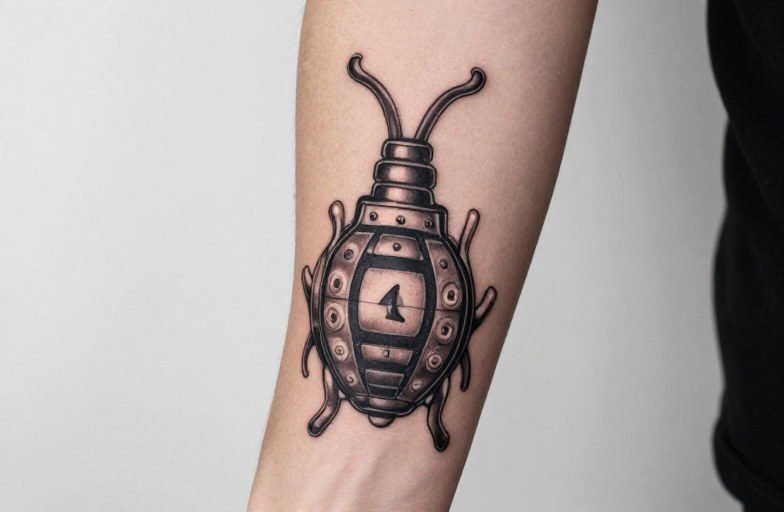
IGY6 stands for “I’ve got your six”, military slang for having someone’s back. The tattoo fuses a semicolon, an anchor, and specific colors into a compact symbol of veteran suicide prevention and peer solidarity. Semicolons represent survival after suicidal ideation; the anchor grounds the message in stability; teal and purple denote PTSD and military loss. Together, they create a wearable pledge between veterans and their supporters.
How It Ages on Skin
Small, high-contrast designs like IGY6 generally hold up better than fine-line trends, but placement and ink choices matter. The semicolon’s curve and the anchor’s straight lines age differently depending on where you put them and how much detail you pack in.
Line Weight and Detail Shrinking
The semicolon in IGY6 needs a confident stroke weight, too thin and the comma-tail bleeds into a blob within five years; too thick and it loses its literary delicacy. Most artists recommend 3-5 needle groupings for the punctuation, with the anchor at slightly heavier weight for visual hierarchy. Tiny text inside or around the symbol (some add “IGY6” spelled out) is the first thing to blur; plan on 10-12 point minimum if you insist on lettering, or accept that touch-ups will be part of the life of the piece.
Color Fading: Teal and Purple Reality
- Teal, a blue-green mix, shifts toward blue as yellow pigment particles fade faster; expect noticeable change by year 3-4 in sun-exposed spots.
- Purple, often built from red and blue blends, can split into muddy brown or pinkish tones as the reds degrade at different rates than blues.
- Black and grey versions eliminate this maintenance entirely and read clearly from farther distances.
- Color saturation in the IGY6 palette works best on lighter skin tones; on darker skin, the teal can disappear into ashiness without bold outlining.
Heavier black outlines around color fields slow the fade but create a more “traditional tattoo” look that some find clashes with the semicolon’s minimalist origins.
History & Cultural Roots
The IGY6 tattoo emerged from two separate movements that merged in veteran communities around 2012-2014. Understanding both strands explains why the symbol carries weight beyond generic “awareness” imagery.
The Semicolon Project
Project Semicolon began in 2013 as a social media movement where people drew semicolons on their wrists to represent surviving suicide attempts, a life sentence continued rather than ended. The punctuation metaphor (author chooses to continue) translated naturally to tattoo form. Veterans, already comfortable with permanent ink as identity markers, adopted the semicolon but found the original project’s civilian framing didn’t fully capture military-specific trauma: the hypervigilance, the moral injury, the loss of unit cohesion after discharge.
“Got Your Six” in Military Vernacular
“I’ve got your six” derives from clock-face orientation used in aviation and ground combat: twelve is forward, six is rear. The phrase solidified in Vietnam-era film and television, then became ubiquitous in Iraq and Afghanistan deployments. Combining it with the semicolon created a peer-to-peer language, veteran to veteran, that excluded well-meaning but sometimes alienating civilian sympathy. The tattoo became a recognition signal: if you know, you know.
The anchor’s addition is often linked to Navy and Marine Corps traditions, though Army and Air Force veterans have adopted it broadly as a general symbol of stability. Some trace the teal and purple color scheme to the Wounded Warrior Project’s early branding, though the exact origin is less documented than the symbol’s core components.
Mythology & Folklore
Unlike tattoos with ancient lineage, IGY6’s “mythology” is contemporary and self-consciously constructed, which doesn’t make it less powerful. Communities build meaning through repetition and ritual, not just antiquity.
The Anchor as Crossroads Symbol
Maritime anchors appear in early Christian catacomb art as disguised crosses during persecution periods, and in Greek mythology as the attribute of Poseidon and later of hope in Hebrews 6:19. For IGY6, the anchor’s resonance is more practical: it stops drift. Veterans describe the feeling of civilian life as current without direction; the anchor tattoo becomes a self-administered mooring point. This is modern folklore, shared interpretation among wearers rather than inherited tradition.
Color Symbolism in Military Ink
Teal specifically denotes PTSD awareness in military contexts, distinct from the broader mental health green ribbon. Purple represents military loss, Gold Star families use gold, but purple bridges to the “Purple Heart” wound tradition. The combination creates a dual mourning: for those who died by suicide and for the pre-trauma self. No ancient mythology required; the colors function as contemporary heraldry.
Who Chooses This Tattoo
Wearers fall into distinct categories with different design priorities. The tattoo’s flexibility, same symbol, different emotional weight, is part of its spread.
- Veterans with lived experience: Often the most private placement (ribs, upper thigh), sometimes without the full color scheme to maintain plausible deniability in professional settings. The semicolon may be larger, the anchor smaller, survival emphasized over stability.
- Veterans as peer supporters: More visible placement (forearm, calf), full color, sometimes with unit numbers or dates integrated. Functions as an open invitation to conversation.
- Family members of deceased veterans: Frequently incorporates dates, names, or dog tags. The “I” in IGY6 shifts from first-person to proxy, “I (still) got your six” even after death.
- Active-duty service members: Placement often governed by regulation; behind-the-ear or under-collarbone locations that pass in uniform but read in civilian clothes.
- Civilian supporters: Controversial within some veteran circles. Those who do get it typically have deep personal connection, spouses, long-term partners, mental health professionals who worked specific populations, rather than general “support the troops” sentiment.
There’s ongoing tension about civilian wear: some view it as appropriation of a peer-survival language; others welcome the visibility. Most artists suggest civilians consider companion symbols (standalone semicolon, different anchor designs) rather than direct IGY6 replication unless the personal connection is demonstrable.
Best Placements
The IGY6 design’s small scale opens options, but visibility carries social meaning in this specific community.
High-Visibility: Forearm, Calf, Shoulder Cap
Forearm placement, especially inner wrist near the original Project Semicolon location, creates immediate readability and invites the “what’s that?” conversation wearers often want. Calf works for those who want control over when it’s seen (shorts vs. pants). Shoulder cap integrates well with existing military tattoo collections. All three locations experience moderate sun exposure; plan for color maintenance or go black and grey.
Concealed: Ribs, Upper Thigh, Behind Ear
Ribs offer canvas for slightly larger versions with integrated text or dates, though the pain factor limits session length. Upper thigh conceals completely in professional dress; some female veterans prefer this location to avoid the “trauma tourism” questions that visible semicolons sometimes provoke. Behind ear is regulation-friendly for active duty but ages poorly due to thin skin and friction from glasses, masks, and hair products.
Scar cover-up is common with IGY6, specifically over self-harm scars on forearms or thighs. The semicolon’s curve can trace and soften existing line patterns. This requires an artist experienced in scar tissue saturation; ink deposits unevenly over fibrous tissue, and the emotional weight of the session demands professional sensitivity.
Color vs Black and Grey
This decision carries more symbolic weight for IGY6 than for most tattoos because the colors are codified.
Full Color: The Recognition Signal
Teal and purple IGY6 tattoos function as membership badges. In veteran-heavy spaces, VA waiting rooms, certain bars, motorcycle events, the colors trigger immediate acknowledgment. The downside is maintenance: teal demands touch-ups every 3-5 years in sunny climates, and the purple-to-brown fade can look unintentionally muddy. Color also limits artist selection; not every shop mixes consistent custom shades, and walking in with a reference photo of “this specific teal” requires a color-mixing specialist.
Black and Grey: The Quiet Version
Stripped of color, the symbol becomes ambiguous, readable to those who know, decorative to others. This suits professionals in conservative fields, those who prefer the semicolon’s literary origins over its military adaptation, or simply people who prioritize longevity over immediate recognition. Some artists add subtle grey-wash teal hints that read as shading rather than color, a compromise that ages better than full saturation but still nods to the tradition.
Single-needle blackwork versions have emerged in recent years, merging IGY6 with the fine-line aesthetic. These look striking fresh but face the same longevity concerns as all delicate work: the semicolon’s comma can disappear entirely within a decade.
Final Word
The IGY6 tattoo works because it compresses multiple survival languages into one compact form: the writer’s punctuation, the sailor’s anchor, the grunt’s directional slang. Its power depends on specificity, this isn’t generic “awareness” but a particular promise between people who’ve seen particular things. If you’re considering it, know which strand you’re pulling: the semicolon’s continuation, the anchor’s stability, or the six o’clock watch. Most wearers find the symbol gathers meaning after application, as strangers recognize it and the silent conversation begins. Choose placement and color based on how much of that conversation you want, and how often. The ink lasts; your relationship to being read as “survivor” or “supporter” may shift. Build in that flexibility, slightly larger scale than you think, slightly heavier line than trend suggests, and the tattoo will carry its weight as long as you do.
Frequently Asked Questions
Can civilians get an IGY6 tattoo without it being disrespectful?
It depends on your connection. Spouses, children, or clinicians with deep veteran relationships are generally accepted. General ‘support’ without personal stake often reads as appropriation. Consider a standalone semicolon or different anchor design if your link is indirect.
Does the IGY6 tattoo have to include all three elements?
No. Some wearers use just the semicolon and anchor, or spell out ‘IGY6’ with minimal imagery. The full color scheme is also optional. The symbol’s strength is its modularity, but removing too many elements risks making it unrecognizable to the community.
How much should an IGY6 tattoo cost?
Small, simple versions run $80-150 at reputable shops; detailed color work with custom elements reaches $300-500. Avoid bargain pricing, this symbol deserves an artist who understands its weight and won’t rush the line work.
Can IGY6 tattoos be combined with other military ink?
Absolutely. Common integrations include unit patches, MOS numbers, deployment dates, or dog tags. The semicolon’s curve can frame existing work or bridge separate pieces. Plan the composition with an artist experienced in military tattoo collections.
Related Tattoo Meanings
- Italian Word Meanings Tattoo Meaning: Language as Skin
- Jack Sparrow Tattoo Meaning: Freedom, Rebellion the Sea
- Jason Momoa Tattoo Meaning: The Shark Tooth and Polynesian Roots
- Explore more









