
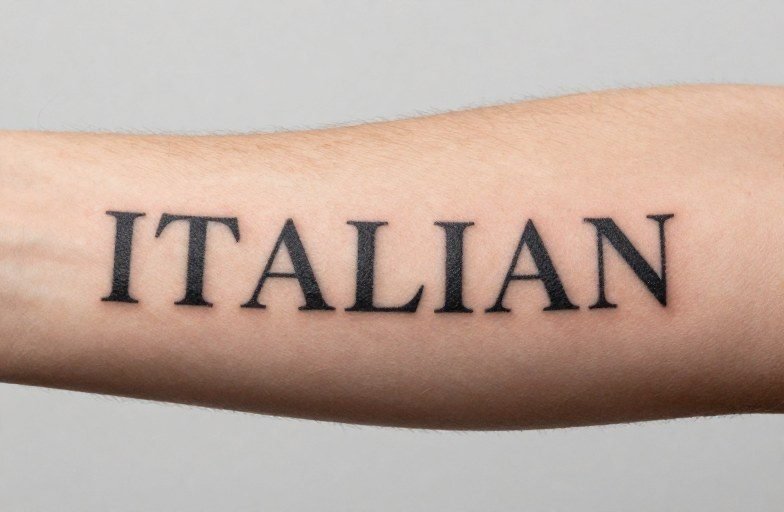
An Italian word tattoo inks a single term or short phrase from one of history’s most expressive languages directly onto skin. The meaning hinges on the specific word chosen, famiglia (family), forza (strength), sempre (always), but gains extra weight from Italian’s cultural associations with opera, Catholic ritual, Renaissance art, and immigrant heritage. Unlike symbols that need explanation, these tattoos speak plainly to those who read them and carry private significance for those who don’t.
Common Variations & Styles
Single Words vs. Phrases
Single-word tattoos dominate this category for good reason. Respiro (breath), luce (light), cuore (heart), each occupies minimal skin real estate while holding grammatical integrity in Italian. Phrases risk awkwardness; direct translations of English sayings often stumble. “Live laugh love” becomes vivi ridi ama, which sounds clunky to native ears. Better options include established Italian expressions: la dolce vita, il dolce far niente, or chi dorme non piglia pesci (he who sleeps doesn’t catch fish, roughly, you snooze, you lose). Script length determines placement; a single word fits a wrist, while a phrase needs a forearm, rib, or thigh to breathe.
Lettering Styles That Work
Traditional Italian hand-lettering favors serif fonts with slight flourish, think vintage wine labels, not wedding invitation copperplate. Many shops stock specific typefaces: Trajan for classical gravitas, Didot for thin, high-contrast elegance, custom brush scripts for looser energy. Line weight matters enormously. Hairline letters blur faster than bold strokes. A skilled artist will adjust letter spacing (tracking) for tattoo longevity; tight packing at small sizes turns to mush over five years. Shading behind or around text, soft grey wash, ornamental scrollwork, or minimal dotwork, can frame without competing. Red flags: overly elaborate fonts where ascenders and descenders tangle, or all-caps treatments that sacrifice Italian’s natural rhythm.
Symbolism & Core Meaning
Heritage and Connection
For Americans with Italian ancestry, these tattoos often mark specific lineage rather than generic pride. A grandmother’s dialect word, stunata (crazy, in Neapolitan) or minchione (fool), preserves a regional voice that standard Italian erased. The tattoo becomes an archive. Others choose words tied to ancestral hometowns, sometimes incorporating coordinates or small map elements. The symbolism isn’t “Italy” broadly; it’s this family, this kitchen, this particular way of being in the world.
Abstract Virtues Made Concrete
Italian’s phonetic warmth suits emotional vocabulary. Coraggio (courage), grazia (grace), tenerezza (tenderness), these carry more sonic weight than their English equivalents for some wearers. The choice sometimes reflects a period of study, travel, or relationship with an Italian speaker. Meaning here isn’t inherent to the language but built through personal use. A word chosen after a semester in Florence differs from one picked from Google Translate. The tattoo’s symbolism depends entirely on that backstory, which isn’t visible but shapes how the wearer carries it.
Religious & Spiritual Angles
Catholic Vocabulary
Italy’s Catholic inheritance makes religious Italian tattoos common even among non-practitioners. Perseveranza paired with a small cross, fede (faith) in Gothic script, speranza (hope) with anchor imagery, these draw on centuries of Italian devotional tradition. Latin dominates institutional Catholic art, but Italian vernacular prayer (padre nostro, ave maria) brings intimacy. Some trace this practice to immigrant communities where Italian replaced Latin in home worship. The tattoo functions as portable devotion, though artists report many clients choose religious Italian words for aesthetic or heritage reasons without active practice.
Secular Spirituality
Beyond doctrine, Italian offers vocabulary for existential states: attesa (waiting/expectation), nostalgia (a Portuguese loanword Italian adopted early), meraviglia (wonder). These suit seekers without institutional affiliation. The phrase amor fati (love of fate) appears frequently, technically Latin, but often mistaken as Italian and requested in Italianate scripts. Tattooers sometimes gently correct; others execute as requested. The spiritual angle here is Stoic or broadly philosophical rather than denominational.
Color vs Black and Grey
Black and grey dominates Italian word tattoos for practical and cultural reasons. The tradition of Italian ornamental lettering, shop signs, film titles, early 20th century advertising, worked in single ink. Color risks dating quickly; a crimson passione that seems bold in 2024 may read as era-specific by 2034. Exceptions exist. Small watercolor splashes behind text can suggest Italian sky or landscape without literal illustration. Traditional green-white-red flag elements rarely age well; they read as tourist merchandise. Gold ink (metallic yellow with white highlight) occasionally frames religious words, mimicking illuminated manuscript tradition. Most experienced artists steer clients toward bold black with subtle grey shading for maximum decade-spanning readability.
Who Chooses This Tattoo
Ancestry and Authenticity Questions
The client base splits roughly between heritage wearers and language enthusiasts, with some overlap. Heritage clients often arrive with specific family words, sometimes spelled in dialect rather than standard Italian. Artists should verify: dialect spelling varies by region, and family memory may not match dictionary forms. Non-heritage clients face different scrutiny. Italian word tattoos on bodies with no Italian connection can read as borrowed ethnicity, though less controversial than culturally sacred symbols from colonized peoples. The language’s global prestige (fashion, cuisine, opera) grants broader permission than most. Still, artists report occasional side-eye in Italian-American communities when obvious outsiders choose identity-heavy words like onore or rispetto.
Gender and Demographic Patterns
Placement choices often break along gender lines in ways that say more about tattoo industry norms than Italian culture. Men favor forearms, calves, and chest for Italian words; women more often choose ribs, feet, collarbones, and inner arms. Word choice shows some patterning too: forza and coraggio skew male in requests, bellezza and anima female. These are trends, not rules. Age range spans widely, from college students studying abroad to retirees honoring immigrant parents posthumously.
Best Placements
High-Visibility vs. Concealed
Forearm and wrist placements remain most popular for Italian word tattoos, offering daily visibility and easy reading by others. This matters for commemorative words meant as conversation starters. Inner bicep and rib placements hide more; the tattoo becomes private touchstone rather than public statement. Foot and ankle tattoos, once trendy for andare (to go) or travel-related words, have declined as clients learn about sun exposure and fading. Finger tattoos of single Italian words (sempre, mai) trend periodically but require frequent touch-ups; hand skin regenerates rapidly and holds ink poorly.
Scale and Skin Consideration
Italian’s frequent use of double consonants and accent marks demands adequate size. A word like caffè or fortuna needs minimum 1.5 inches in length for the accent to remain legible and the double letters distinct. Darker skin tones require bolder line weight; thin hairlines in Italianate scripts can blow out or disappear. Experienced artists adjust accordingly, sometimes simplifying flourishes that would muddy on melanin-rich skin. Stretching matters too, abdomen placements risk distortion with weight fluctuation, particularly problematic for words where letter shape carries meaning.
Before You Decide
Verify spelling with multiple sources, not just translation apps. Italian uses grave accents (è, à, ù) that change meaning; e (and) differs from è (is). Dialect variants complicate further, Sicilian, Neapolitan, Venetian, and dozens of regional languages diverge significantly from standard Tuscan Italian. If claiming heritage, consider whether standard Italian represents your actual ancestry or a nationalized version that erased your family’s specific voice.
Plan for aging. Italian’s beautiful cursive connections between letters blur faster than block text. Ask your artist to show healed photos of similar work, not fresh tattoos. Budget for touch-ups; even perfect application needs refreshing after five to ten years, sooner on hands or feet.
Finally, sit with the word. Italian’s emotional resonance can seduce; l’infinito sounds profound until you’re explaining it for the hundredth time. The best Italian word tattoos hold meaning that doesn’t require explanation, even when someone asks.
Frequently Asked Questions
Do Italian word tattoos need accent marks to be correct?
Yes, accents change meaning and pronunciation in Italian. è (is) and e (and) are different words. Skipping accents looks like an error to literate viewers and native speakers.
Is it okay to get an Italian word tattoo if I don’t speak Italian?
Many do, but choose carefully. Words tied to universal concepts (amore, pace) raise fewer eyebrows than identity-specific terms like onore or famiglia if you have no Italian connection.
How do I know if my family used standard Italian or dialect?
Ask older relatives specifically about pronunciation. Dialect often drops final vowels or substitutes consonants. If records exist, check Ellis Island manifests or church documents for spelling variations.
What’s the most common mistake with Italian phrase tattoos?
Direct English-to-Italian translation of idioms fails badly. “Live your best life” has no Italian equivalent; it emerges as nonsense. Use established Italian expressions or stick to single words with clear definitions.
Related Tattoo Meanings
- Veni Vidi Vici Tattoo Meaning: Conquest in Ink
- Mob Tattoo Meaning: Symbolism, History What It Actually Represents
- Aqua Tofana Tattoo Meaning: Poison, Power, and Rebellion
- Explore more









