
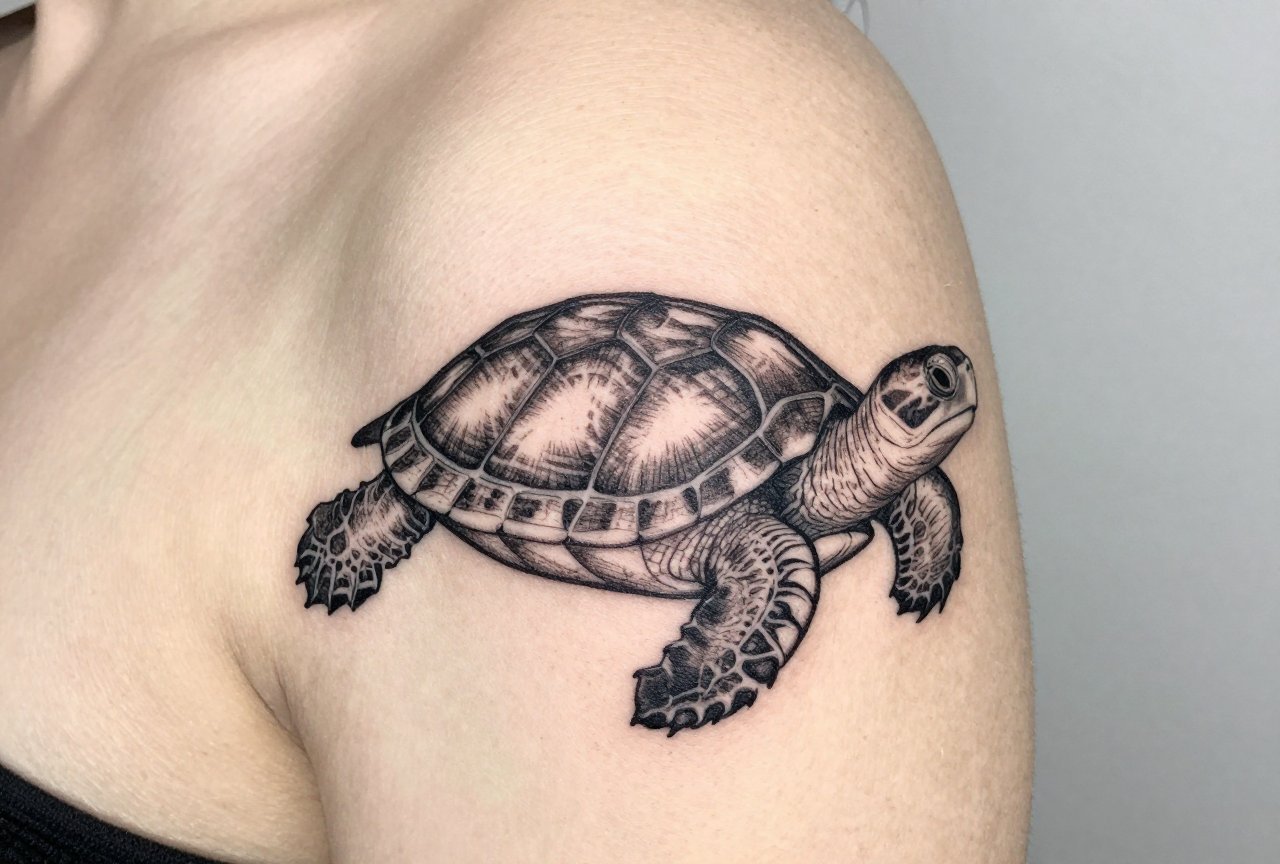
Turtle tattoos for women carry deep meaning rooted in patience, resilience, and the quiet strength of carrying your home with you. Across cultures, the turtle represents longevity, motherhood, and protection, qualities that resonate with women at every stage of life. I’ve tattooed dozens of these over the years, and each one carries a story that’s deeply personal to the person wearing it.
Symbolism & History
The turtle’s symbolic weight goes back thousands of years. In my chair, I hear these stories constantly, and they never get old.
Native American & Indigenous Roots
Many Native traditions see Turtle as carrying the world on her back, North America itself is sometimes called Turtle Island. For women with Indigenous heritage, this tattoo reconnects them to origin stories that were suppressed. The shell becomes a map, a foundation, a mother’s body holding up life. I’ve done these with clan symbols worked into the shell pattern, or with the turtle swimming upward toward light. Line work tends to hold better here than heavy shading, especially on darker skin tones where the contrast matters.
Pacific Islander & Asian Traditions
In Polynesian culture, the turtle, honu, represents the navigator, the one who finds home across vast water. Women choose this after divorce, after moving cross-country, after any journey where they had to trust their own internal compass. Japanese folklore gives us the minogame, a turtle so ancient it grows a tail of seaweed, symbolizing wisdom earned through survival. These designs often incorporate waves, cherry blossoms, or family crests.
- Longevity: turtles live decades, some species over a century
- Protection: the shell as boundary, sanctuary, self-preservation
- Motherhood: laying dozens of eggs, the slow trek to nesting grounds
- Steadiness: moving forward regardless of pace
- Earth connection: in Hindu mythology, the world rests on four elephants standing on a turtle
Common Variations & Styles
Not all turtle tattoos look alike. The style changes the meaning subtly, and I always walk clients through this before we start.
Realistic vs. Stylized
Realistic sea turtles with water backgrounds photograph beautifully fresh. But I’ve watched them age poorly when the shading is too soft or the scale detail too fine. After five years, that photorealistic eye often blurs into a dark spot. Stylized turtles, geometric, tribal, or watercolor-wash, hold their readability longer. The tribal honu with bold black lines and negative space? Still crisp after a decade. We see this a lot in cover-up consultations: the pretty, delicate turtle that became a blob.
Minimalist & Fine Line
Single-needle outline turtles behind the ear or on the wrist are huge right now. They read as quiet, personal, almost secret. The meaning shifts toward introspection rather than declaration. I tell clients these need touch-ups sooner, fine line on high-movement areas like the wrist can fade noticeably in 2-3 years. But the trade-off is worth it for women who want something understated.
- Mother-child pair: two turtles, one larger, often with initials hidden in shells
- Mandala shell: geometric patterns representing life’s complexity contained
- Cosmic turtle: shell as galaxy or moon phases, blending earth and sky
- Broken shell: survival, healing, visible vulnerability as strength
- Turtle with flowers: femininity layered onto endurance, softening the armor
Best Placements
Where you put it changes how you live with it. I’ve tattooed turtles on ribs, shoulder blades, thighs, ankles, collarbones, and once, a tiny one on the inside of a lip (don’t recommend; it fell out).
The upper back/shoulder blade gives space for detail and flows with the body’s natural curve, turtle swimming forward, following the spine. Thigh pieces allow for larger compositions with water, coral, or family names worked in. Ankle and foot placements are popular but brutal to heal; I’ve had clients limp for days. The constant friction from shoes and socks can pull ink out.
Ribs hurt. Everyone knows this. But the turtle on the rib cage, side-view with flippers extended, follows the body’s architecture so naturally that women endure the pain specifically for that placement. It becomes private, revealed only in swimsuits or intimacy. The meaning deepens with that hiddenness.
Wrist and forearm are visible, daily reminders. I’ve noticed women who choose these spots are often in active recovery, grief, addiction, abusive relationships, who need the turtle’s patience as a visible anchor. “Slow down,” one client told me. “That’s what she tells me every morning.”
Who Chooses This Tattoo / Personal Meanings
After fifteen years in shops, I can spot patterns without stereotyping. The women who sit for turtle tattoos share certain qualities even when their stories differ wildly.
Mothers & Grandmothers
New moms get turtles constantly. The shell-as-womb metaphor is obvious, but it’s more than that. One woman explained it as “finally understanding what it means to carry something that will outlive you.” Grandmothers sometimes add hatchlings to existing pieces, each tiny turtle representing a grandchild. The shell becomes a family record, growing over years like tree rings.
Survivors & Travelers
Women who’ve been through prolonged hardship, medical, emotional, financial, gravitate toward turtle symbolism without always knowing why. The turtle doesn’t fight; it endures. It doesn’t rush; it arrives. I’ve tattooed turtles on women finishing chemotherapy, leaving cults, surviving prison. The healing reality is physical and symbolic: the tattoo hurts, then it scabs, then it settles, then it becomes part of you. That process mirrors their own.
Travelers choose turtles differently. These are women who’ve lived abroad, who’ve been digital nomads, who feel unmoored by choice. The turtle carries home, so they never lose it. “I’m not running away,” one told me. “I’m just slow-moving.”
Similar Symbols
Clients often come in debating between a turtle and something adjacent. I help them sort it out.
Elephants share the maternal, long-lived qualities but read heavier, more mournful. Koi represent perseverance but with masculine energy in Japanese tradition; women sometimes feel that’s not quite theirs. The phoenix is rebirth through fire, dramatic and instantaneous. The turtle is rebirth through time, through sheer refusal to stop. I’ve had women start with phoenix concepts and end with turtles because they didn’t want their survival to look explosive, they wanted it to look inevitable.
Butterflies are transformation, yes, but fleeting. Turtles outlast. Women choosing between these are often choosing how they see their own change: as a moment or as a lifelong practice.
- Elephant: similar maternal weight, but less mobile, more stationary
- Koi: overlapping perseverance symbolism, different cultural context
- Phoenix: rebirth through destruction vs. endurance through persistence
- Butterfly: transformation as event vs. turtle’s transformation as process
- Oak tree: similar longevity, but rooted rather than journeying
Final Thoughts
Turtle tattoos for women refuse to be trendy. They’ve been requested steadily across my entire career, immune to the boom-and-bust of other imagery. That staying power says something about what women actually need from their symbols, not flash, not shock, but something steady they can grow into and keep growing with.
The best turtle tattoos I’ve done weren’t the most technically impressive. They were the ones where the woman knew exactly why she was there, even if she couldn’t fully articulate it. The shell. The slowness. The carrying of weight that doesn’t crush. The arriving anyway.
If you’re considering this, spend time with the image before you commit. Draw it. Dream it. Let it wait. The turtle would approve.
Frequently Asked Questions
Does a turtle tattoo always have to be feminine or delicate?
Not at all. I’ve done bold, heavy blackwork turtles on women who wanted strength without softness. The meaning is yours to shape, the style just carries it differently.
How well do turtle tattoos age on older skin?
Bold lines and solid black hold better than fine detail everywhere, but especially as skin changes. I usually steer mature clients toward cleaner, less photorealistic designs that will read clearly for decades.
Can I incorporate my children’s names or birthdates into a turtle design?
Absolutely. The shell’s hexagonal pattern is perfect for hiding initials or dates. I’ve worked them into scute shapes, or placed text along the shell’s edge where it won’t distort as much over time.
What does it mean if the turtle is swimming upward versus downward?
Direction matters. Upward usually reads as aspiration, breaking through, reaching for light. Downward suggests grounding, diving deep, going inward. Sideways is journey, movement, the long path forward. I discuss this with clients because it changes the emotional tone significantly.
Related Tattoo Meanings
- Yggdrasil Tattoo Meaning: Roots, Branches What It Actually Means
- 10Th Planet Tattoo Meaning: Jiu-Jitsu Loyalty Rebellion
- 187 Tattoo Meaning: Street Code, Penal Code, and Ink
- Explore more









