
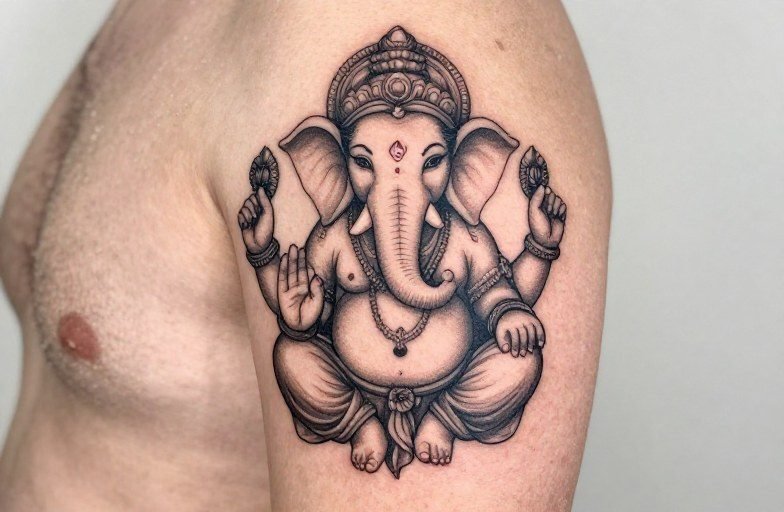
A Ganesha tattoo most commonly represents the removal of obstacles, the start of new ventures, and the cultivation of wisdom. The elephant-headed Hindu deity embodies a paradox that resonates across belief systems: immense physical power paired with approachable gentleness, fierce protection balanced with playful curiosity. For many wearers, the image functions as a personal symbol of overcoming barriers, internal or external, and moving forward with intention.
Symbolism & History
Ganesha’s iconography is densely packed with meaning, and understanding it helps clarify what a tattoo actually communicates. Each element carries specific significance that has developed over centuries of devotional art.
The Elephant Head & Broken Tusk
The elephant head symbolizes unmatched memory, intelligence, and the ability to discriminate between paths. Ganesha’s single broken tusk, often depicted in his hand as a writing instrument, references the sacrifice of perfection for purpose, he broke it to transcribe the Mahabharata when no suitable scribe could be found. In tattoo form, this detail can emphasize dedication to craft, learning, or creative work over polished appearance.
The Mouse Vehicle & Modak Sweet
Ganesha’s vahana (vehicle), a small mouse, represents desire kept under control, small enough to slip through obstacles, yet directed rather than chaotic. The modak sweet he holds signifies the rewards of spiritual practice. Tattoo compositions that include these elements shift the meaning toward discipline and earned satisfaction rather than mere luck or blessing.
- Single tusk: Sacrifice, focused purpose, imperfection in service of greater goals
- Large ears: Attentive listening, willingness to hear before acting
- Small eyes: Concentrated focus, meditation, inward attention
- Trunk direction: Curved left (common in household images, associated with worldly success); curved right (rarer, associated with renunciation and strict spiritual discipline, tattoo artists should verify client intention, as this distinction matters to knowledgeable observers)
Historically, Ganesha imagery migrated from temple sculpture and domestic shrine paintings into tattooable form as global travel and spiritual seeking expanded in the late twentieth century. The imagery is often linked to the spread of yoga and meditation practices in the West, though specific dating of this transition remains diffuse. Some trace its tattoo popularity to the 1990s and 2000s alongside broader interest in Hindu devotional imagery, but the timeline varies significantly by region and subculture.
Common Variations & Styles
How Ganesha is rendered dramatically affects what the tattoo communicates and how it ages. Style choice isn’t merely aesthetic, it shapes readability and longevity.
Traditional & Neo-Traditional
Bold black outlines with limited color palettes (saffron, deep reds, forest greens) reference Indian miniature painting and calendar art traditions. These hold up well over decades, the heavy line weight prevents the blurring that softens fine detail. Neo-traditional approaches introduce more saturated color gradients and decorative elements like mandala backgrounds or lotus bases, blending devotional imagery with Western tattoo conventions.
Blackwork & Dotwork
Single-needle and stippled techniques create intricate, almost engraved appearances. These excel at rendering Ganesha’s jewelry, the texture of elephant skin, and ornamental halos. The trade-off: dotwork and extremely fine lines blur faster than bold traditional work, particularly on high-movement areas like wrists or ankles. Expect touch-ups within 5-8 years for detailed blackwork on these placements.
Realistic & Portrait-Style
Photographic rendering of Ganesha statues or painted depictions requires substantial skin real estate to avoid muddiness. The trunk’s spiral, the multiple arms, and the layered jewelry demand space. Attempting realistic Ganesha below 5-6 inches typically results in indistinct gray masses within a few years as ink spreads slightly in the dermis.
- Watercolor/abstraction: Color splashes behind a structured Ganesha outline can work; fully abstracted Ganesha often becomes unrecognizable without the anchor of clear iconography
- Minimalist/line-only: Effective for experienced collectors with established tattoo vocabulary; risky as a first or only piece due to recognition issues
- Sacred geometry integration: Ganesha silhouettes filled with geometric patterns merge devotional and contemporary aesthetics
Best Placements
Ganesha’s multiple arms, elaborate crown, and curved trunk create compositional challenges that favor certain body areas.
Thigh and calf: Cylindrical muscle structure complements the vertical orientation of seated Ganesha images. The thigh’s relatively stable skin (less stretching than stomach, less movement than forearm) preserves detail well. Outer thigh specifically offers flat working surface for symmetrical compositions.
Upper arm/shoulder cap: The rounded deltoid echoes the circular halos common in Ganesha depictions. This placement allows the deity to “face” outward or toward the body depending on rotation, a subtle but meaningful choice for the wearer.
Back: Full back pieces accommodate the most complex iconography, multiple arms fully extended, attendant figures, complete mandala environments. The skin here ages relatively well with proper aftercare, though central spine placement involves more sensation during sessions.
Forearm and wrist: Possible for simplified or partial Ganesha imagery (head and trunk only, perhaps), but the frequent flexion and extension accelerates detail loss. Expect bolder, more graphic approaches here rather than fine devotional painting.
Chest/sternum: The central vertical axis suits Ganesha’s role as a threshold guardian, but sternum tattooing is notably intense and the skin texture varies significantly between individuals. Healed results can be excellent or disappointing depending on skin type.
Who Chooses This Tattoo / Personal Meanings
There’s no single profile, but patterns emerge in consultation conversations. Understanding these helps clarify whether Ganesha imagery genuinely fits your intention.
Practical & Life-Transition Contexts
People marking major launches, businesses, recoveries, relocations, graduations, often gravitate toward obstacle-removal symbolism. The tattoo functions as a permanent marker of a specific threshold crossed, not vague spiritual aspiration. For these wearers, the broken tusk detail often resonates particularly, representing what was sacrificed to reach the current position.
Creative & Intellectual Workers
Writers, musicians, and craftspeople sometimes connect with Ganesha as patron of letters and learning. The writing tusk, the large ears for listening, and the controlled mouse of disciplined desire speak to creative process more than product. These tattoos often incorporate specific tools, pens, instruments, code brackets, integrated with traditional iconography.
Heritage & Complex Identity
For those with South Asian heritage navigating diaspora identity, Ganesha tattoos can carry familial and cultural weight that outsiders shouldn’t assume or imitate casually. The imagery may connect to specific household practices, regional Ganesha traditions (Maharashtrian, Tamil, Bengali forms differ notably), or family deity relationships. Non-South Asian wearers should consider whether their connection to the symbolism is specific and sustained enough to justify permanent religious imagery, or whether more universal obstacle-removal symbols might serve without potential appropriation concerns.
Similar Symbols
If Ganesha’s specific Hindu devotional context doesn’t fit your situation, related symbols offer overlapping meanings with different cultural footprints.
- Obstacles/removal: The Japanese koi swimming upstream (perseverance through difficulty), Hercules and the Hydra (sequential problem-solving), or the Roman god Janus (thresholds, beginnings)
- Wisdom/learning: Athena’s owl, Thoth’s ibis, or the Buddhist Bodhisattva Manjushri wielding the sword of discriminating awareness
- Elephant symbolism without specific deity: African elephant profiles emphasizing memory and matriarchal strength, or the Buddhist six-tusked white elephant associated with the Buddha’s conception
- Threshold guardians: Chinese guardian lions (foo dogs), Egyptian sphinx, or protective eyes across multiple traditions
Some wearers combine Ganesha with these related symbols, perhaps Ganesha as central figure with koi swimming through the composition’s lower border, or a lotus base that references Buddhist and Hindu traditions simultaneously. These combinations require careful composition to avoid visual incoherence or unintentional theological juxtaposition.
Final Thoughts
A Ganesha tattoo works best when the wearer understands at least the basic iconography they’re carrying, the trunk direction, the tusk significance, the mouse’s meaning. This isn’t about gatekeeping or demanding scholarly devotion; it’s about ensuring the image on your skin aligns with your actual intention rather than a generic notion of “good luck.” The most successful pieces I’ve seen result from specific conversations about which Ganesha stories or attributes matter to that person, then translating those into visual choices: perhaps the writing tusk emphasized, perhaps the mouse enlarged and detailed, perhaps the background left empty to suggest the space of obstacles being cleared. The image is ancient and widely circulated, but your particular configuration of it can be precise and personal.
Frequently Asked Questions
Does the direction of Ganesha’s trunk matter in a tattoo?
Yes, it carries distinct traditional associations. Left-curving trunks connect to household prosperity and worldly success; right-curving trunks relate to stricter spiritual discipline and renunciation. Most tattoo depictions use left-curving trunks, but if you want the rarer right orientation, understand its connotations.
Is it culturally appropriate for non-Hindus to get Ganesha tattoos?
There’s no universal consensus, but the key factor is sustained, respectful engagement rather than casual aesthetic borrowing. If Ganesha’s specific stories and attributes genuinely resonate with your life, many practitioners accept sincere adoption; if you simply want an elephant-headed “good luck” image, more universal symbols might avoid appropriation concerns.
How well do detailed Ganesha tattoos age over time?
Fine jewelry details, intricate mandala backgrounds, and subtle shading blur faster than bold outlines. Expect 5-10 years before touch-ups become desirable, sooner on hands, feet, and high-movement areas. Bold traditional or neo-traditional approaches typically age most gracefully.
What’s the most common placement mistake with Ganesha tattoos?
Attempting too much detail in too small a space. Ganesha’s multiple arms, elaborate crown, and curved trunk need room to read clearly. Below 4-5 inches, arms merge, trunk becomes a blob, and the distinctive iconography disappears. Either simplify the composition or expand the placement.
Related Tattoo Meanings
- Yantra Tattoo Meaning
- Gladiolus Tattoo Meaning: Strength, Memory, and August Births
- Grace Pauline Kelley Face Tattoo Meaning: Ink, Faith, and Controversy
- Explore more









