
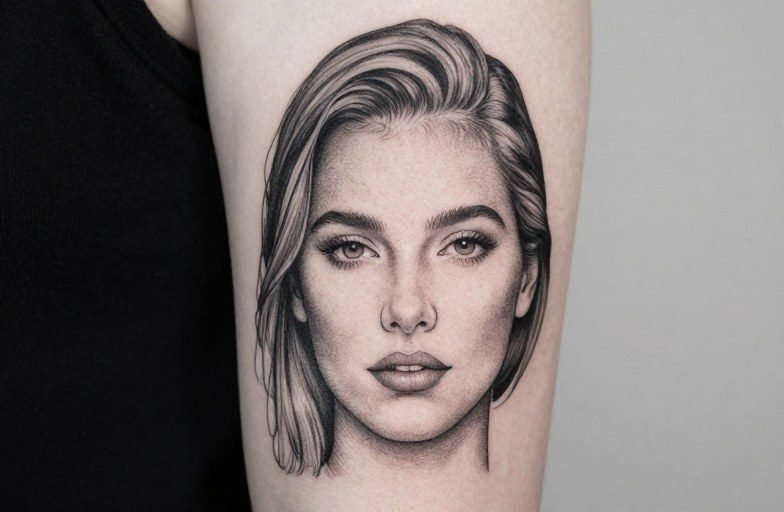
Grace Pauline Kelley, daughter of country singer Wynonna Judd, carries several face tattoos that blend religious devotion with the visual language of incarceration and recovery. The most prominent, a cross near her eye and script across her cheek, signals faith, penitence, and survival within systems that mark bodies as permanently as they mark records. These aren’t decorative choices; they’re public declarations made in a context where facial ink carries immediate social weight.
Symbolism & History
The Cross: Faith Under Scrutiny
Facial crosses have long circulated in prison and street tattoo culture, often linked to Christian identity, time served, or protection sought through visible devotion. The placement near the eye, sometimes called a “teardrop cross” variant, intensifies this: the bearer sees through their faith, or their faith watches how they see the world. For Kelley, the cross sits where makeup can’t easily hide it, where every mirror and every interaction confronts the symbol. That’s the point. Religious face tattoos reject the private compartmentalization of belief; they make piety unavoidable, for the wearer and everyone who meets them.
Script and Lettering: Words as Armor
Kelley’s cheek script, reportedly reading “Faith”, follows a tradition of word-based face tattoos that function as self-addressed mantras or public warnings. Unlike decorative script on ribs or forearms, facial lettering speaks before the bearer does. The font choice matters: bold, blackletter, or handwritten styles each carry different connotations. Blackletter (“Old English”) dominates in prison tattooing due to its bold readability and association with Chicano and street culture. Lighter, more cursive scripts suggest different origins, sometimes suburban tattoo-shop aesthetics, sometimes deliberate softness against the harshness of facial placement.
- Placement near the eye: Draws immediate attention; impossible to ignore in conversation
- Black ink saturation: Required for longevity on high-movement facial skin
- Single-word messaging: Functions as both personal reminder and public statement
- Religious iconography: Connects to broader traditions of suffering, redemption, and witness
Common Variations & Styles
Face tattoos in this symbolic territory rarely exist in isolation. Common companions include teardrops (their meaning shifts by region: murder, mourning, or gang affiliation), spider webs (time in prison, caught in the system), and three dots (mi vida loca, the crazy life). Kelley’s choices notably exclude some of these more criminally coded marks, leaning instead into overt religious imagery, perhaps a deliberate reframing, perhaps genuine conversion, perhaps both.
Style-wise, these tattoos typically run:
- Linework-heavy: Fine lines blur faster on faces; bold outlines hold
- Limited color: Black and grey dominate; color fades unpredictably on sun-exposed facial skin
- Small scale: Facial real estate is tight; designs compress, details sacrifice
- High contrast: Needed for readability at conversation distance
Cover-up or modification becomes nearly impossible on saturated facial ink. The cross, once placed, commits the bearer to its visibility or to expensive, painful laser removal that rarely achieves complete erasure.
Best Placements
The face offers limited, high-stakes real estate. Kelley’s cross sits at the outer eye corner, classic placement that frames the gaze without obstructing it. The cheek provides the largest flat surface, accommodating script or small icons. Forehead placement reads more aggressively, more “mask-like.” Jawline and neck transitions blur the boundary between face and body, sometimes signaling different intent than pure facial ink.
Skin here differs critically from arm or back:
- Faster cell turnover means faster fading
- Sun exposure is constant and largely unavoidable
- Movement from expressions, smiling, squinting, talking, stresses ink lines
- Sebaceous density varies; the T-zone holds ink differently than drier cheek areas
Experienced artists adjust needle depth and ink load for these conditions. Too shallow, the ink falls out; too deep, blowout creates fuzzy edges that age poorly on visible skin.
Who Chooses This Tattoo / Personal Meanings
The Context of Kelley’s Ink
Facial tattoos in mainstream society still trigger immediate assumptions: criminal history, instability, irreversible life choices. Kelley received hers during and after periods of incarceration and substance struggle, contexts where facial marking carries different social currency than in tattoo-collecting circles. Inside, visible ink can signal toughness, affiliation, or spiritual survival. Outside, it becomes a barrier to employment, housing, and social integration, sometimes deliberately, as a commitment to leaving conventional life behind.
Beyond the Individual
People drawn to similar imagery, crosses, script, religious symbols on highly visible skin, often share certain motivations:
- Permanent marking of a transformation (sobriety, conversion, survival)
- Rejection of social mobility and its demands for “professional” appearance
- Alignment with subcultures where facial ink signals authenticity or commitment
- Trauma processing made external and unerasable
The meaning isn’t fixed. A cross tattooed in prison may shift as the bearer moves through recovery, religious doubt, or renewed struggle. The ink stays; interpretation moves.
Similar Symbols
Kelley’s tattoos sit within a recognizable family of marks. Crosses near eyes appear in Russian prison tattooing (often linked to “thief in law” status or Orthodox identity), in Chicano black-and-grey traditions, and in contemporary street tattooing globally. The specific combination, cross plus script, echoes “pray for me” or “only God can judge me” tattoos common in hip-hop and sports culture, though facial placement radicalizes the statement.
Comparable symbols include:
- praying hands: Often paired with rosaries, memorial dates, or names; less confrontational than facial crosses
- “Only God Can Judge Me” script: Popularized by Tupac; frequently placed on ribs or abdomen, occasionally face
- Teardrops: More criminally coded; Kelley notably avoids this, perhaps distinguishing her narrative
- “Faith” or “Hope” standalone script: Common in recovery tattooing, usually on wrists or collarbones; facial placement escalates commitment
These symbols share a thread: they respond to judgment, social, legal, divine, by preemptively declaring the bearer’s own framework for meaning.
Final Thoughts
Grace Pauline Kelley’s face tattoos resist easy reading. They’re simultaneously authentic personal expression and products of constrained choice, available tools in environments where marking the body carries established meanings whether the bearer intends them or not. The cross and script speak faith, but faith tattooed on the face in black ink speaks something else too: a refusal to separate belief from visibility, struggle from public identity, past from present. The ink will fade, blur, maybe require touch-ups or removal attempts. The social mark it makes, for better and worse, persists differently.
Frequently Asked Questions
Do face tattoos like Kelley’s make it harder to find jobs?
Yes. Despite growing tattoo acceptance, visible facial ink still excludes most professional, customer-facing, and corporate roles. Some industries, certain music, art, and tattoo-adjacent fields, are exceptions, but the barrier remains real and widely documented.
Can religious face tattoos be removed if someone changes their beliefs?
Laser removal is possible but difficult on facial skin due to sensitivity, proximity to eyes, and the dense black ink typically used. Complete removal is rare; most achieve significant fading over multiple expensive sessions.
Why do people get tattoos in prison instead of waiting for professional shops?
Prison tattooing happens with available materials, often improvised needles and ink, because waiting isn’t an option for those marking time, affiliation, or survival in immediate contexts. The art quality suffers, but the social function doesn’t require professional execution.
What’s the difference between a prison cross tattoo and one from a shop?
Execution quality varies dramatically, but the social meaning differs more. Prison crosses carry immediate context of incarceration; shop-done religious facial tattoos may signal subcultural affiliation, spiritual commitment, or aesthetic choice without the same institutional weight.
Related Tattoo Meanings
- Hyena Tattoo Meaning: Resilience, Laughter Shadow
- Indigenous Chin Stripe Tattoo Meaning: Culture Identity
- Johnny Silverhand Tattoo Meaning: Cyberpunk Rebellion Inked
- Explore more









