
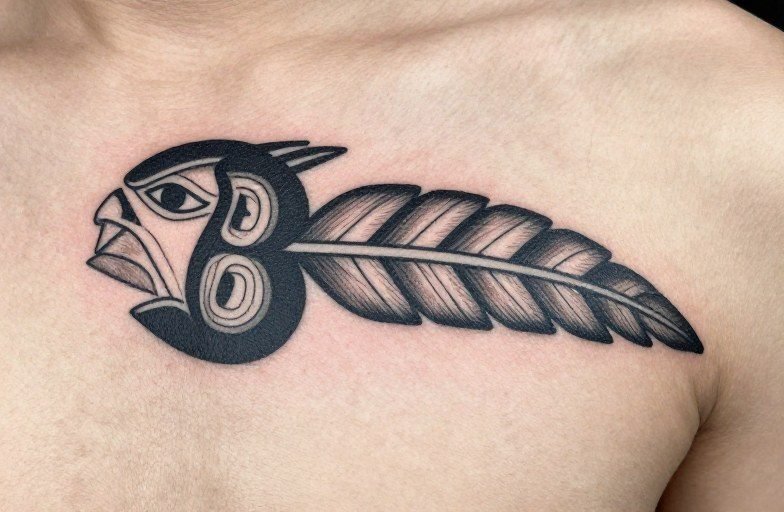
The chin stripe tattoo carries weight as a marker of cultural identity, womanhood, and belonging within several Indigenous communities. Most widely recognized from the Inuit tradition of tavlugun or kakiniit, these vertical lines running from the lower lip to the chin signaled a girl’s passage into womanhood and her readiness for marriage. Beyond the Arctic, similar facial markings appear in the tattooing practices of Haida, Tlingit, and other Pacific Northwest and Alaskan peoples, though specific meanings shift between nations and families.
Symbolism & History
Coming-of-age and social role
Among Inuit communities, the chin stripe traditionally marked a pivotal transition. A young woman received her tattoo when she reached menstruation, signaling her new status as a potential wife and mother. The lines were not decorative afterthoughts; they were earned through survival, endurance, and community acceptance. Some trace the practice to pre-contact periods, with tattooing tools made from bone needles and soot-based ink. The pain itself was part of the ritual, a physical threshold crossed publicly.
The number of lines held significance too. A single stripe might denote a specific family or regional origin. Multiple parallel lines could indicate completed tasks, successful hunts, or children born. These were not uniform codes, interpretation depended on the specific community and the knowledge held by elder women who administered the marks.
Spiritual and protective functions
Beyond social signaling, facial tattoos often carried spiritual purpose. The chin area, close to the mouth and breath, was sometimes seen as a conduit between the physical and spiritual realms. Markings here could serve as protection during childbirth, ensure safe passage to the afterlife, or identify the wearer to ancestors in the next world. Some Inuit tattooists included small dots or additional lines near the eyes or cheeks that worked in conjunction with the chin stripe as a complete spiritual map.
Colonial suppression nearly erased these practices. Missionaries and government agents actively discouraged tattooing, and by the mid-20th century, living practitioners had become rare. The knowledge survived primarily through photographs, museum collections, and fragmented oral histories passed through families who kept the memory alive despite external pressure.
Common Variations & Styles
Not all chin stripes look identical, and modern wearers have developed approaches that balance historical reference with personal expression.
- Traditional single or double line: The most recognized form, one or two bold vertical stripes running from the center of the lower lip to the chin’s edge. Traditionally done with hand-poking methods, though some revivalists use machine work with a stippled texture to mimic the original aesthetic.
- Thick vs. thin weight: Historical photographs show considerable variation in line width. Some stripes were barely a centimeter across; others spanned the full width of the chin. Width sometimes correlated with age or status, though documentation remains incomplete.
- Accompanying facial markings: The chin stripe rarely stood alone historically. Parallel lines on the cheeks, dot patterns at the corners of the eyes, or horizontal bars across the forehead completed the facial composition. Modern wearers sometimes adopt the chin stripe in isolation, which shifts its visual impact.
- Contemporary stylistic choices: Some Indigenous tattoo revivalists incorporate traditional motifs within or flanking the stripe, miniature ulus, animal silhouettes, or abstracted landforms. Others keep the line pure but experiment with color, using dark blue or brown instead of pure black to suggest historical ink sources.
Best Placements
The chin stripe demands specific anatomical consideration. The skin here differs significantly from arms or ribs.
Central placement is non-negotiable. The stripe must follow the vertical midline of the face, from the vermilion border of the lower lip downward. Even slight deviation reads as asymmetry because the face is what viewers study most intently. A skilled artist will map this with the client upright, not lying down, since tissue shifts with gravity.
Length decisions matter. Some stripes stop at the natural crease below the lip; others extend to the bony edge of the chin or slightly onto the submental area. Longer lines age more gracefully because they incorporate more stable skin, but they also become visible from lower angles. Shorter placements stay hidden when the mouth is at rest but reveal themselves during speech.
Skin type challenges. The chin area moves constantly, talking, eating, expressing. This mobility accelerates ink diffusion over time. Oily skin types see faster blur. The area also experiences frequent contact from hands, phones, and pillows during healing. Line work here needs to be slightly bolder than equivalent designs on the forearm to maintain readability through decades.
Who Chooses This Tattoo / Personal Meanings
Indigenous revival and reconnection
The primary contemporary context involves Indigenous people, particularly Inuit, Inupiat, and Yupik women, reclaiming a practice that was forcibly interrupted. For these wearers, the chin stripe functions as language without words: a visible declaration of survival and continuation. The decision often involves consultation with elders, community approval, or participation in organized tattooing gatherings where traditional methods are taught. The meaning is collective before it is personal.
Non-Indigenous adoption and its complexities
Some non-Indigenous people have requested chin stripes, drawn to the aesthetic or seeking to express solidarity. This remains deeply contested. Several Indigenous tattoo practitioners explicitly refuse to apply traditional markings to non-Indigenous clients, viewing the designs as specific cultural property tied to bloodlines and lived experience. Others distinguish between specific family patterns (which they protect) and generalized geometric forms (which they consider more broadly available). The consensus leans toward caution: without community connection, the chin stripe risks becoming costume rather than commitment.
For those with mixed heritage or distant Indigenous ancestry, the decision carries additional weight. The stripe can become a point of reconnection or a source of imposter syndrome, depending on community acceptance. There is no universal rule, each family and nation determines belonging differently.
Similar Symbols
Several tattoo traditions occupy adjacent symbolic territory without being identical.
- Maori moko kauae: The chin tattoo for Maori women, consisting of curved patterns rather than straight lines. Also marks status and genealogy, but the visual language and specific cultural context differ entirely. The spiral forms (koru) and placement on the chin and lower lip create a distinct aesthetic.
- Filipino batok facial markings: Among Kalinga and other Philippine groups, facial tattoos indicated warrior status or protection. The geometric patterns share the function of social signaling but differ in form and gender association.
- Contemporary vertical line tattoos: Minimalist single-line face tattoos have emerged in Western tattoo culture as abstract decoration. These lack the specific cultural weight but sometimes inadvertently echo traditional forms, creating confusion or appropriation concerns.
Final Thoughts
The chin stripe tattoo resists simple interpretation because its meaning is layered through specific communities, individual histories, and the violence of interruption followed by deliberate revival. For Indigenous wearers, it remains primarily a practice of continuation, evidence that colonial suppression did not succeed. The stripe on a chin today is not identical to the stripe of two hundred years ago; contexts change, and living traditions adapt.
For anyone considering this design, the essential question is not aesthetic preference but relationship. Do you have standing within the tradition that created this mark? Does your community recognize your right to wear it? The answers determine whether the tattoo speaks of belonging or appropriation. In a field crowded with borrowed symbols, the chin stripe demands more than admiration, it requires connection, patience, and the humility to accept that some markings remain guarded by the people who never stopped remembering them.
Frequently Asked Questions
Can anyone get an Indigenous chin stripe tattoo, or is it only for certain people?
Most Indigenous tattoo practitioners restrict traditional chin stripes to clients with verified community ties, particularly Inuit, Inupiat, and Yupik heritage. Some will tattoo non-Indigenous clients with modified designs that avoid specific family patterns, but many refuse entirely. The design carries specific cultural weight that makes open adoption problematic.
How painful is getting a chin stripe tattoo compared to other facial tattoos?
The chin area ranks high on the pain scale due to thin skin directly over bone, plus dense nerve endings. The lip border itself is particularly sensitive. However, the procedure is usually quick, often completed in under an hour for simple line work, which limits total exposure time.
Does a chin stripe tattoo fade faster than tattoos on other body parts?
Yes, facial tattoos generally age faster due to constant movement, sun exposure, and the thinner dermis in this area. The chin stripe specifically sees friction from eating, talking, and pillow contact. Bold line work and diligent sun protection help, but expect some softening within 5-10 years regardless.
What should I look for in an artist if I’m seeking a traditional-style chin stripe?
Seek artists with specific experience in Indigenous tattoo revival, particularly those trained in hand-poking methods. Ask about their consultation process with elders or community knowledge-keepers. Be wary of artists who treat this as standard line work without cultural preparation, the technical skill matters less than the ethical framework.
Related Tattoo Meanings
- Longhorn Tattoo Meaning: Symbolism, Styles Placement
- Nunu Tattoo Meaning: Symbolism, Styles Placement Guide
- Poisonous Tree Tattoo Meaning: Danger, Growth Protection
- Explore more









