
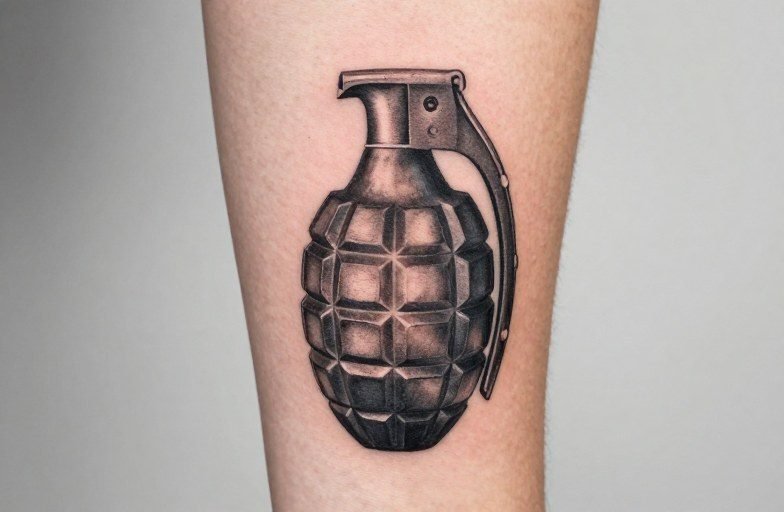
A grenade tattoo most often represents explosive force held in check, potential energy waiting for release. For many, it becomes a symbol of personal power, the ability to fundamentally alter a situation, or surviving something that detonated their old life. Others gravitate toward its visual of controlled chaos: destruction with purpose, contained within a recognizable form.
Similar & Related Symbols
Bombs, dynamite sticks, and lit fuses share this DNA of pending destruction, but the grenade carries a specific intimacy. Unlike a distant bomb drop, a grenade is thrown by hand, close enough to feel the heat. That personal proximity changes the symbolism from anonymous warfare to individual agency.
Firearms and Bladed Weapons
Guns and knives represent directed threat; the grenade is indiscriminate once released. This distinction matters for people who want their tattoo to say “I changed everything around me” rather than “I targeted someone.” A lit stick of dynamite comes closest in spirit, though its mining and construction associations soften the violence. The molotov cocktail overlaps in street-level rebellion imagery, but lacks the military precision of a grenade’s machined casing.
Explosive Imagery in Non-Weapon Form
Some people pair the grenade with breaking chains, shattering clocks, or bursting skulls to emphasize transformation rather than destruction. A grenade sprouting flowers or roots is a common juxtaposition, destruction feeding renewal. The heart-as-grenade variant, sometimes with the pin pulled, speaks to love as something volatile and potentially devastating.
How It Ages on Skin
The grenade’s detailed casing, those diamond-patterned segments and mechanical ridges, presents real challenges over time. Fine lines between the segments blur together. The visual punch depends on contrast: dark recessed areas against raised metal highlights. Without sufficient black saturation, a grenade becomes a blobby oval in five to ten years.
Placement and Scale
- Forearms and outer biceps give enough flat real estate for the cylindrical form to read clearly
- Hands and fingers force extreme simplification; the diamond pattern rarely survives
- Thighs and calves accommodate larger versions with the segment detail intact
- Ribs and stomachs distort the shape with body movement
Line Work vs. Shading
Outline-only grenades age poorly. The form needs dimensional shading to register as metal, not just a strange pineapple shape. Solid black fill in the recessed segments, with greywash or whip-shading on the raised ridges, holds definition longest. White highlights for the pin and lever? Those vanish fastest on most skin tones. Plan for them to disappear; the design should read without them.
History & Cultural Roots
The modern hand grenade descends from 17th-century European designs, though explosive compounds in thrown vessels trace much further back. Tattoo adoption of military equipment surged with 20th-century warfare imagery, particularly in American and European traditional tattooing. Sailor Jerry’s flash sheets included grenades among his military collection, often rendered with bold black outlines and limited color.
Punk and hardcore scenes embraced the grenade in the 1980s, stripping away patriotic framing to use it as pure rebellion symbol. Street art and graffiti culture reinforced this association. The image detached from specific military service to become a broader shorthand for disruptive force against systems.
Regional Variations
In Russian prison tattooing, explosive imagery often signified a sentence for violent crime or a willingness to “blow up” a situation rather than negotiate. Mexican and Chicano tattoo traditions sometimes incorporated grenades into religious tableaux, particularly San Judas or Santa Muerte imagery, suggesting divine intervention as explosive disruption of mortal fate. These contexts are specific and shouldn’t be adopted casually without understanding their weight.
Who Chooses This Tattoo
Veterans and active service members sometimes select grenades as unit-specific imagery or to mark particular combat roles. The 11B infantryman, the combat engineer, these MOS designations carry visual shorthand that includes explosive ordnance. But military affiliation is far from the only motivation.
People who’ve rebuilt after catastrophic life changes, sobriety, leaving abusive situations, surviving prison, often describe the grenade as representing the moment everything blew apart before reconstruction. Musicians in aggressive genres, particularly those with political lyrics, use it as stage-presented iconography. A smaller group simply responds to the formal qualities: the satisfying geometry, the mechanical precision, the immediate visual recognition.
Gender and Placement Patterns
There’s no meaningful gender divide in who chooses this image, though placement differs. Women more often place grenades on ribs, upper thighs, or collarbones, areas that allow for stylized or integrated compositions. Men frequently go forearm, calf, or chest, treating it as standalone emblem. These are trends, not rules; the image works anywhere the scale allows.
Religious & Spiritual Angles
Explicitly religious grenade tattoos are uncommon but not absent. The “divine grenade” or “holy hand grenade” references Monty Python for some, but others use it sincerely, God’s judgment as inescapable explosive force. Saint Barbara, patron of artillery and miners, occasionally appears with explosive imagery in Eastern Orthodox-influenced tattooing.
Buddhist and Hindu contexts sometimes employ the grenade differently: destruction of illusion, the explosive shattering of ego or attachment. This requires careful handling to avoid trivializing actual spiritual practice. A lotus emerging from grenade fragments reads differently than a grenade replacing Buddha’s head.
Taboo and Tension
Some religious traditions reject all weapon imagery on the body. Others distinguish between tools of state violence and personal spiritual metaphor. The grenade’s indiscriminate nature makes it harder to justify as “righteous defense” than a sword or shield. Anyone with religious community ties should consider how this reads within their specific context.
Common Variations & Styles
American traditional renders the grenade with bold black outlines, limited red or green color, and stylized simplicity. The “pineapple” grenade, Mk 2 style with its segmented body, dominates this approach. Neo-traditional allows for more illustrative detail, custom color palettes, and integrated ornamental elements.
Black and grey realism attempts photographic accuracy: machined metal texture, correct lever and pin geometry, shadow play. This demands significant technical skill; bad realism looks like a smudged photograph. New school pushes proportions, adds cartoon elements, or merges the grenade with unexpected forms, animal heads, household objects, organic textures.
Compositional Approaches
- Single grenade, pin pulled, sometimes with smoke or sparks suggesting imminent detonation
- Multiple grenades in a cluster or pattern, often with varying states (armed, spent, fragmented)
- Grenade as heart replacement, brain, or other organ, literalizing “exploding with emotion”
- Fragmentation moment, casing splitting, contents dispersing in freeze-frame
- Grenade integrated into larger military or political tableau
Lettering and banners pair frequently with grenades, though the combination risks cliché. “Born to explode” or similar phrases rarely improve the image. Better to let the form speak or integrate text that carries genuine personal specificity.
What to Remember
The grenade carries unavoidable associations with violence, warfare, and harm. These don’t disappear because your personal meaning differs. In professional settings, visible grenade tattoos may require explanation or acceptance of misreading. The image also attracts attention from law enforcement in ways that a flower or bird does not, unfairly, perhaps, but predictably.
Technically, this is a demanding tattoo to execute well and to maintain. The geometric precision reveals sloppy work immediately. The detailed casing blurs without adequate saturation and scale. Budget for a larger piece than you might initially want, or accept a simplified, more graphic interpretation.
Most importantly, consider whether the grenade’s specific symbolism, contained potential, sudden transformation, indiscriminate impact, matches your actual intention. Many people drawn to this image find that dynamite, a breaking wave, or a phoenix better captures what they mean. The grenade is not a generic toughness marker. It’s a specific tool with specific history, and it works best when chosen with that weight in mind.
Frequently Asked Questions
Does a grenade tattoo automatically mean someone was in the military?
Not at all. While service members do choose this image, plenty of civilians wear it for personal transformation, rebellion symbolism, or purely aesthetic reasons. Military affiliation is one context among many.
How big does a grenade tattoo need to be to keep its detail?
At minimum, about three inches in the longest dimension for basic segment recognition. For realistic shading and readable mechanical detail, four to five inches works significantly better. Smaller than that, go bold and graphic rather than detailed.
Will a grenade tattoo affect job prospects?
Visible weapon imagery can raise flags in conservative industries, education, healthcare, and some corporate environments. Coverable placement forestalls most issues, but hand, neck, or face placement carries real professional risk regardless of personal meaning.
What’s the difference between a pineapple grenade and a modern baseball grenade in tattoo form?
The Mk 2 “pineapple” with its segmented body is visually distinctive and reads immediately as grenade. The modern M67 baseball style is smoother and rounder, less visually interesting for tattooing, and sometimes mistaken for a generic ball or fruit at smaller sizes.
Related Tattoo Meanings
- Potato Masher Tattoo Meaning
- Ms13 Tattoo Meaning
- Gryphon Tattoo Meaning: Power, Guardianship, and Duality
- Explore more









