
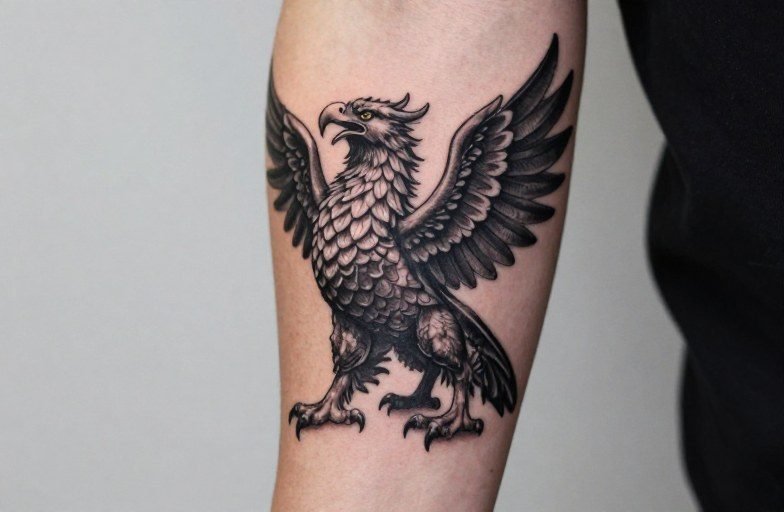
A gryphon tattoo represents the fusion of two apex predators: the lion’s grounded courage and the eagle’s commanding perspective. This hybrid creature has served for millennia as a guardian symbol, a marker of noble authority, and an emblem of balanced duality. On skin, it translates to someone who values both raw strength and strategic clarity, or who sees themselves as a protector of what’s theirs.
Religious & Spiritual Angles
Spiritual interpretations of the gryphon run deep across several traditions, though none claim exclusive ownership of the creature.
Christian Symbolism
In medieval Christian art, the gryphon often appeared as a guardian of the divine. Its dual nature, part earthly beast, part heavenly bird, made it a natural metaphor for Christ’s own dual nature, human and divine. Some trace this association to early Byzantine iconography, where gryphons flank saints and sacred objects. The creature’s vigilance also connected it to spiritual watchfulness, the idea of guarding one’s faith against corruption. For believers today, a gryphon can signal that same protective stance toward their spiritual life, not as a feature but as a quiet commitment.
Pagan and Esoteric Traditions
Neopagan and hermetic practitioners often link the gryphon to elemental mastery. The lion commands earth and fire; the eagle, air and the solar principle. Together, they suggest a practitioner who has integrated opposing forces within themselves. In alchemical imagery, this union of fixed and volatile principles mirrors the Great Work itself, the transformation of base material into something refined. A gryphon tattoo in these circles might mark initiation, personal achievement, or simply an affinity for symbolic complexity over straightforward imagery.
History & Cultural Roots
The gryphon’s visual history stretches across surprising geography and time.
Ancient Near Eastern Origins
The earliest known gryphon depictions emerge from Bronze Age Central Asia, often linked to Scythian goldwork and Persian royal art. These weren’t mere decorations. They guarded tombs, flanked thrones, and appeared on seals as emblems of legitimate authority. The creature’s composite nature may have expressed the ideal ruler: the lion’s dominion over land, the eagle’s supremacy in sky. For someone drawn to ancient history, a gryphon tattoo can carry this weight of archaic kingship without needing to reference any specific culture directly.
Greek and Roman Adaptation
Greeks adopted the gryphon as a guardian of gold and a foe of the one-eyed Arimaspi. Roman legions later used the image on standards and architecture. The shift from royal to military symbolism matters for placement choices. A gryphon rendered in classical style, clean lines, profile stance, architectural framing, reads differently than a more organic or aggressive interpretation. The former suggests discipline and tradition; the latter, personal ferocity.
Who Chooses This Tattoo
Certain patterns emerge among people who sit for gryphon work, though no single profile dominates.
- Military and first responders often gravitate toward the guardian aspect, the creature’s role as boundary-keeper and defender of treasure or territory.
- Parents sometimes select gryphons after children are born, the dual nature representing the need to be both gentle and fierce, present and watchful.
- People in leadership positions may choose the symbol without announcing it as such, preferring mythic imagery over literal corporate iconography.
- Those with mixed heritage or dual citizenship occasionally find personal resonance in a creature that belongs fully to neither earth nor sky, yet commands both.
The gryphon also attracts people who find single-animal tattoos too common. A wolf or lion announces one quality; a gryphon complicates the message in ways that suit certain personalities.
Design Tips & Pairings
Successful gryphon tattoos require attention to the creature’s structural challenges.
Placement and Scale
The gryphon’s wings demand real estate. Small designs, under three inches, tend to muddy the wing structure, turning elegant feathers into indistinct shading. The upper back, outer thigh, and ribs offer enough flat surface for wings to read clearly. Chest placement works if the wings wrap onto the shoulders, but center-chest-only designs often compress the creature awkwardly. Forearms and calves can accommodate gryphons, but the artist must simplify the wing architecture or curve it aggressively around the limb’s cylinder.
Complementary Elements
Common pairings include:
- Keys or shields, emphasizing the guardian function
- Broken chains, suggesting liberation through strength
- Compasses or astrolabes, playing up the eagle’s aerial perspective
- Floral elements, typically oak or thistle, grounding the creature in specific regional symbolism
Avoid overcrowding. The gryphon itself is already visually dense; surrounding it with too many secondary symbols weakens the primary impact.
Color vs Black and Grey
This choice fundamentally alters the tattoo’s character.
Color gryphons typically emphasize the eagle’s golden-brown plumage and the lion’s tawny hide, sometimes adding red for the beak or talons. This reads as more literal, more mythologically “accurate,” and tends to suit brighter skin tones where pigment stays vivid. The downside: color fades faster in sun-exposed placements, and the gryphon’s detailed feathering requires more frequent touch-ups than simpler color designs.
Black and grey gryphons shift focus toward texture and form. The contrast between smooth lion musculature and layered wing feathers becomes the entire point. This approach ages more gracefully on most people, and it allows for dramatic lighting effects, moonlit, torch-lit, emerging from shadow, that color work struggles to achieve. For a more menacing or solemn tone, black and grey usually serves better.
Personal & Modern Meanings
Contemporary wearers often strip away historical layers to find personal relevance.
The Duality Reading
Modern psychology-influenced interpretations favor the gryphon as integrated opposites: instinct and intellect, aggression and discernment, loyalty and independence. The tattoo marks not achievement but aspiration, the ongoing work of holding contradictory qualities in functional balance. This resonates particularly with people who’ve moved between conflicting worlds: rural to urban, working class to professional, one culture to another.
The Protector Reinterpretation
Some wearers reject the royal and military associations entirely, focusing instead on personal guardianship. The gryphon protects not gold or empire but relationships, creative work, sobriety, mental health, whatever the individual defines as their treasure. This meaning remains private unless the wearer chooses to explain, which suits many modern tattoo collectors who prefer their symbolism to operate below conversational level.
Final Thoughts
The gryphon endures because it refuses simplicity. A wolf tattoo means loyalty; a dragon, power. The gryphon demands you hold both lion and eagle in mind simultaneously, and that cognitive complexity rewards repeated viewing. For the wearer, it offers a symbol that can shift emphasis over years, guardian today, integrated duality tomorrow, without requiring new ink. The key is honest placement and an artist who understands how wing structure translates to human anatomy. Done well, a gryphon tattoo carries weight without shouting, myth without pretension, and enough visual density to reward attention across decades.
Frequently Asked Questions
Does a gryphon tattoo always have to include wings?
Technically, a wingless gryphon is closer to ancient Near Eastern originals, but most modern viewers expect the eagle wings. Going wingless risks the tattoo reading as a generic lion. If you want the hybrid identity clear, include at least partial wing structure.
How well does a gryphon tattoo age compared to simpler animal designs?
The detailed feathering and fur texture can blur over time, especially on high-movement areas like ribs or elbows. Bold line weight in the wing bones and facial structure helps maintain readability. Expect more touch-ups than a solid black panther, but less than fine-line floral work.
Can a gryphon tattoo work in a minimalist style?
Minimalist gryphons are difficult because the creature’s identity depends on combining two distinct animals. Over-simplification usually yields an ambiguous bird-lion blob. If you want cleaner lines, consider a heraldic or geometric interpretation that abstracts the forms rather than reducing detail.
What’s the difference between a gryphon and a hippogriff tattoo?
A gryphon combines eagle and lion; a hippogriff combines eagle and horse. The hippogriff is generally more elegant and swift in symbolism, while the gryphon carries heavier guardian and royal associations. Choose based on whether you want to emphasize protective vigilance or noble freedom.
Related Tattoo Meanings
- Guillotine Tattoo Meaning: Death, Rebellion Sharp Change
- Gypsy Symbols Tattoo Meaning: Cards, Moons Traveler Lore
- Hands Touching Tattoo Meaning: Connection, Creation The Divine
- Explore more









