
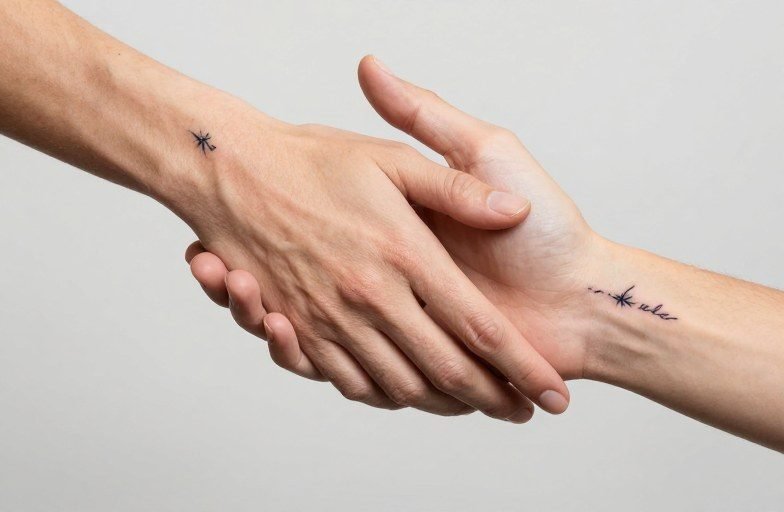
The hands touching tattoo, most famously echoing Michelangelo’s Creation of Adam, fundamentally represents the moment of connection between two separate entities. That gap between the fingers, almost meeting but not quite, holds the tension of desire, potential, and the space where meaning actually lives. Beyond the religious reading, this motif translates to human intimacy, creative spark, grief and remembrance, or the reaching across any divide: living and dead, self and other, mortal and something larger.
Design Tips & Pairings
Composition makes or breaks this piece. The hands themselves are anatomically demanding, ten fingers, two wrists, the subtle twist of forearm bones. Poor draftsmanship here is immediately obvious, so reference quality matters enormously.
What Surrounds the Hands
Negative space between the fingertips functions as active design element, not empty background. Some build symbolism into that gap: a small heart, a flame, a single word, a constellation. Others let the void speak for itself. Background elements need restraint, too much ornament and the central gesture gets lost. A simple radial burst, soft clouds, or nothing at all often carries more weight than elaborate framing.
- Pair with script along the wrist line or forearm edge, never across the fingers themselves
- Floral elements wrapping the wrists soften masculine-leaning versions without weakening the gesture
- Geometric borders or mandala fragments behind the hands create contrast between organic and structured
- Matching or mirrored versions work for couples, same design, each wearing one hand
Line Weight and Detail Level
Single-needle fine lines suit smaller scales and delicate readings, parent and child hands, memorial pieces. Heavier line work with bold shading reads stronger from distance and ages more forgivingly. The creases across knuckles and palm lines reward careful attention but quickly become muddy if overworked. A skilled artist simplifies these to their essential geometry rather than tracing every fold.
How It Ages on Skin
Hands are notoriously difficult real estate. Constant movement, sun exposure, and the thin, mobile skin over tendons and bones all conspire against longevity. This specific design compounds those challenges because its emotional impact depends on readable finger separation and delicate fingertip detail.
The Specific Vulnerabilities
Fine lines between nearly-touching fingers blur together first. What reads as charged negative space at month three can become an indistinct grey blob by year five. Plan for this: slightly exaggerated gaps, heavier line at the finger edges, or deliberate dotwork texture that maintains structure even as it softens. Palm lines and knuckle creases spread and fade fastest; many artists now omit them entirely or reduce to single suggestive strokes.
Color saturation drops faster on hands than almost anywhere else. Blacks go charcoal, greys go blue-green, reds go pink then peach. Touch-ups are not optional maintenance here, they’re part of the lifecycle. Budget for one within two years, possibly sooner if you work with your hands or sun exposure is unavoidable.
Similar & Related Symbols
The hands touching motif sits within a broader family of gesture-based imagery, each carrying distinct nuance worth understanding before committing.
Close Cousins and Their Differences
Two hands clasped in handshake or prayer eliminates the gap, the tension of almost-connection replaced by completed union. The mano cornuta (horned hand) and mano fico (fig sign) are protective gestures with ancient Mediterranean roots, more talismanic than relational. The Hamsa or Hand of Fatima offers protection through an eye-centered palm design, decorative rather than interactive. The Buddhist abhaya and varada mudras carry specific spiritual teachings through precise finger positions.
Contemporary relatives include the “reach” or “helping hand” tattoo, single hand extended downward, often associated with sobriety, mental health recovery, or surviving hardship. The “missing piece” variation shows one hand with a puzzle-shaped void, another hand holding the corresponding piece. These share DNA with the touching hands motif but speak to different moments: ongoing need versus completed connection.
Best Placements
Scale and orientation shift meaning more than people expect. Vertical compositions with hands reaching top-to-bottom emphasize aspiration, divine or otherwise. Horizontal arrangements read as human-to-human, eye-level equality.
What Works Where
- Forearm, inner: Most common for good reason, natural viewing angle, manageable pain, enough flat surface for detail. The inner wrist edge lets the gesture point toward the heart
- Upper arm/shoulder: Larger scale allows two full forearms, more dramatic composition. Wraps slightly around the deltoid curve
- Chest, centered: The Michelangelo reference feels intentional here. Sternum placement between the pectorals mirrors the Sistine Chapel ceiling’s orientation
- Back, between shoulder blades: Room for the full Sistine reference including draped fabric, surrounding figures, or custom background
- Thigh: Flat, large, easy to heal. Less visible for professional contexts, though the personal intimacy of this motif sometimes calls for more frequent viewing
Hand tattoos on the actual hand, knuckles, fingers, back of hand, are possible but inadvisable for this specific design. The detail required cannot survive the placement’s natural degradation. If you want hands on your hands, simplify to iconic silhouette or accept rapid fading.
Common Variations & Styles
The core gesture adapts across aesthetic boundaries without losing recognition. Each style carries implicit mood.
Style-Specific Approaches
American traditional renders the hands bold and graphic, limited color palette, heavy black outlines. The gap between fingers becomes a solid shape, almost logo-like. Neo-traditional allows more illustrative detail, jewel tones, ornamental elements like pearls or gold cuffs. Black and grey realism pursues photographic accuracy, veins, tendon tension, the subtle shift of skin over bone. This demands the most technical skill and the most maintenance.
Minimalist and single-line versions reduce the gesture to its absolute essence: two curved strokes, five points each, nearly meeting. These work at small scale, heal reliably, but risk becoming generic without personal customization. Abstract and geometric interpretations fragment the hands into planes and angles, preserving the reaching gesture while abandoning anatomical accuracy. Japanese-inspired versions might incorporate the motif within a larger sleeve narrative, the hands emerging from wind bars or cloud patterns.
Color vs Black and Grey
The original Sistine reference is painted in full Renaissance color, but tattoo translation doesn’t automatically follow.
When Each Serves
Black and grey dominates for several practical reasons. Skin tone itself provides warmth; adding color often fights against rather than enhances the flesh. The dramatic chiaroscuro of the original painting translates naturally to greywash. Memorial pieces, spiritual pieces, and anything seeking timeless rather than contemporary feeling tend toward monochrome.
Color earns its place when specific elements demand it: the red thread of fate connecting fingertips in some East Asian interpretations; the blue and gold of celestial backgrounds; the green of Eden’s landscape; the actual skin tone difference between two specific people being depicted. Watercolor-style splashes behind the hands can suggest energy, emotion, or environment without defining it literally. One effective compromise: black and grey hands with a single color accent in the gap, a small heart, a word, a flame drawing the eye to the charged space between.
Whatever palette you choose, understand that hand-adjacent placements (forearm, wrist) see enough sun that color will shift. Yellows and light greens fade fastest. Deep blues and reds hold longest. White ink is essentially temporary on this placement, gone to nothing within a few years.
Final Word
The hands touching tattoo endures because the gesture is universal before it becomes specific. Two beings reaching toward each other, whether that’s God and Adam, parent and child, lovers separated by death or distance, or the artist’s own two hands meeting in creation, contains enough room for your particular meaning without requiring you to explain it. The design’s strength lives in that ambiguity, in the charged space where connection is imminent but not yet completed. Choose an artist who understands anatomy and negative space equally well. Prioritize the gap as much as the fingers. Plan for aging, especially if detail tempts you toward fine line work. And let the image carry what you need it to carry, without overloading it with text or ornament that diminishes the gesture’s quiet power.
Frequently Asked Questions
Does the hands touching tattoo always have religious meaning?
No. While Michelangelo’s Creation of Adam is the most famous reference, people choose this for romantic connection, memorial, artistic creation, or personal milestones. The gesture predates Christianity and crosses cultural boundaries.
How much should I expect to pay for a quality hands touching tattoo?
A skilled black and grey piece with proper detail typically runs $400-$800 for forearm size, more for larger or color work. This is not a design to bargain-hunt, anatomical errors are obvious and permanent.
Can the hands be customized to represent specific people?
Yes, though it requires strong reference photos and an artist experienced in portrait work. Simpler approaches include matching jewelry, sleeve details, or skin tone variations rather than full likenesses.
Why do so many versions leave a gap between the fingers instead of touching?
The gap creates narrative tension and open interpretation. Touching hands complete the story; almost-touching invites the viewer into the moment of potential, making the meaning participatory rather than fixed.
Related Tattoo Meanings
- Heart Rate Tattoo Meaning: Life, Loss Everything Between
- Hercules Tattoo Meaning: Strength, Labor, and Redemption
- Hog Symbolism Tattoo Meaning: Grit, Prosperity Defiance
- Explore more









