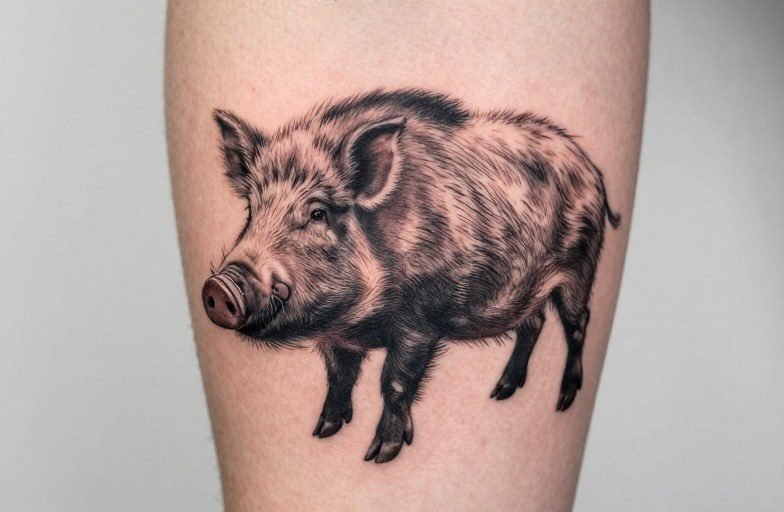
A hog tattoo typically signals hardiness, resourcefulness, and an earthy refusal to be domesticated. Across American traditional flash sheets, Southern heritage pieces, and neo-folk designs, the hog represents someone who can thrive on little, protect what’s theirs, and doesn’t flinch from mud or work. The meaning tightens or expands depending on breed choice, accompanying imagery, and whether the animal is shown calm, charging, or rooting.
Similar & Related Symbols
Pigs and hogs occupy overlapping symbolic territory, but the distinction matters in tattooing. “Pig” tends toward farmyard innocence, gluttony, or savings imagery (piggy banks). “Hog” skews wilder, heavier, more aggressive. Razorbacks, boars, and feral hogs each carry different visual weight.
Boar vs. Domestic Hog
Boar tattoos lean martial and ancient. Celtic warrior boars, Norse Gullinbursti, and Japanese inoshishi all emphasize tusks, bristle, and combat readiness. The domestic hog, by contrast, suits themes of abundance, sustenance, and groundedness. A charging boar needs dynamic composition; a resting hog allows for fuller body detail and softer shading.
Regional Variants
- Razorback: Arkansas and Texas football culture, plus backwoods self-sufficiency
- Wild boar: European hunting tradition, masculine rite-of-passage imagery
- Pot-bellied pig: Irony, pet devotion, or anti-corporate sentiment (think “capitalist pig” reversals)
- Guinea hog: Heritage breed revival, agricultural nostalgia, Black Southern farming history
Skull variants share ground with deer or steer skulls but read more working-class, less romantic. A hog skull with cotton or tobacco leaves anchors specifically to Southern agricultural memory, not generic “country” aesthetic.
Religious & Spiritual Angles
The hog’s spiritual reputation is checkered, which actually makes for more interesting tattoo conversation than universally positive symbols.
Abrahamic Complexities
Judaism and Islam prohibit pork consumption, so a hog tattoo on someone from these backgrounds usually signals deliberate transgression, cultural departure, or reclaimed identity rather than devotion. Some Jewish tattoo collectors use the pig ironically, confronting historical trauma through taboo. Christian contexts vary: medieval Europe sometimes cast the hog as demonic (Circe’s swine, the Gadarene demons), while St. Anthony the Abbot is depicted with a pig as companion animal, symbolizing patience and temptation resisted.
East Asian Traditions
In the Chinese zodiac, the pig (often conflated with hog in Western translation) represents honesty, tolerance, and fortune. The twelfth zodiac position carries completion and satisfaction. Japanese folklore offers the inoshishi as mountain spirit and fierce protector, distinct from the barnyard pig. A tattoo pairing the boar with sakura or mountain scenery reads specifically Japanese; with coins and ingots, it reads Chinese fortune symbolism.
Celtic and Germanic Roots
The boar was sacred to Freyr and Freya in Norse tradition, often linked to fertility and battle frenzy. Celtic warriors adopted boar-crest helmets and boar-tusk necklaces. These associations survive in tattooing through knotwork bodies, torc collars, and aggressive frontal poses.
Design Tips & Pairings
Placement and detail level should match the hog’s symbolic register. A small, cute outline reads entirely differently than a shoulder-to-hip back piece of a rooting feral sow.
What Works Where
- Thigh or calf: Full body in profile, allows for bristle texture and accurate anatomy
- Chest or sternum: Head-on or charging pose, tusks pointing toward collarbone
- Forearm: American traditional head with banner, readable at handshake distance
- Hand or knuckles: Simplified head only, high contrast for aging visibility
- Ribcage: Extended scene with environment (mud, oak, hounds), demands larger scale
Line weight matters. Hog bristle demands varied needle grouping, tight liners for hair texture, soft shaders for the snout’s pink-to-grey transition. Black and grey ages more predictably on hog skin tones than color, though a well-saturated traditional green and red piece holds if the pigment load is heavy enough.
Common Pairings and Their Effects
Crossed axes or rifle: hunting heritage, provider identity. Cotton bolls: Southern agricultural memory, often family-specific. Coins or gold: prosperity magic, sometimes ironic given the “filthy lucre” association. Chains or broken shackles: defiance, refusing to be penned. Floral elements (magnolia, kudzu): softening the masculine default, adding regional specificity.
Personal & Modern Meanings
Contemporary hog tattoos often bypass traditional symbolism entirely, operating through personal narrative and subcultural identity.
Working-Class Reclamation
The hog as “dirty,” “low,” or “uncouth” becomes a badge for those reclaiming class stigma. A heavily tattooed hog, a hog in coveralls, or a hog with a specific trade tool (welding mask, logging truck) transforms the animal into self-portrait. This differs from generic “tough animal” tattoos through specificity of detail, brand marks, recognizable landscape, particular breed accuracy.
Feminine and Maternal Readings
Sows are ferocious mothers. A nursing sow with pronounced teats, a sow shielding piglets, or a sow in defensive posture reclaims the hog from purely masculine hunting imagery. These designs require anatomical confidence from the artist; poorly rendered, they read as cartoon rather than powerful. Placement on the abdomen, hip, or upper back emphasizes the maternal connection without requiring explicit human figuration.
Political and Countercultural Use
“Hog” as police slur (from motorcycle unit origins, then generalized) occasionally appears in anti-authoritarian tattooing, though this usage risks misinterpretation without clear contextual framing. More common is the environmentalist feral hog, an invasive species disrupting fragile ecosystems, tattooed as complex villain rather than pure symbol. These pieces often show landscape damage, native species in flight, or the hog at night with infrared gaze.
How It Ages on Skin
Hog tattoos face specific aging challenges. The snout’s complex curvature blurs faster than flatter surfaces. Fine bristle lines, especially in greywash, can muddy into uniform texture within five to seven years. Tusks, if rendered as thin white highlights without surrounding dark support, disappear entirely as surrounding skin tans or ages.
For longevity: establish the eye with solid dark pigment, not delicate linework. Build the snout’s shape through value contrast rather than outline alone. Bristle should be suggested through clustered short strokes, not individual hair-by-hair rendering. Color saturation in the ears and nose (pink tones) fades to neutral; plan for this by ensuring enough underlying value structure that the form survives pigment loss.
On darker skin tones, the traditional “pink pig” palette requires adjustment. Magenta and purple undertones read more clearly over time than straight red-white mixtures. A skilled artist will swatch and test rather than default to flash sheet colors.
Who Chooses This Tattoo
The demographic is broader than rural white men, though that association persists. Collectors include: Southern women reclaiming agricultural heritage, hunters marking a specific memorable animal, chefs and butchers with professional pride, zodiac pig sign bearers seeking something less cute than standard pig imagery, and metal or folk punk fans drawn to the creature’s outsider status.
What unifies them is usually a personal connection to land, food production, or stubborn independence. The hog tattoo rarely functions as pure aesthetic choice; there’s almost always a story of grandfather’s farm, a formative hunt, or a self-identification with the animal’s reputation for being underestimated and dangerous when cornered.
Artists report that hog requests spike during economic downturns, possibly because the animal’s ability to convert scraps to survival resonates. The correlation isn’t rigid, but shop floor observation suggests the symbol’s appeal tightens when resourcefulness feels personally relevant.
The Bottom Line
A hog tattoo succeeds when it commits to specificity: particular breed, particular regional context, particular emotional register. The generic angry boar with flames or tribal swirls reads as mall-core fantasy art. The accurate Guinea hog with a known farm’s fence line, or a charging razorback with actual Arkansas mountain laurel, carries weight because the details are earned.
Choose your artist for animal tattoo experience, not just technical polish. Hog anatomy is tricky, short legs, heavy torso, deceptive skull proportions. A wolf specialist or big cat artist may not automatically translate. Ask to see healed pig or boar work, not just fresh photos. The snout softens, the eyes shrink, the bristle settles. What holds is structure, contrast, and the conviction behind choosing an animal that refuses to be pretty.
Frequently Asked Questions
Does a hog tattoo have negative connotations in some cultures?
Yes. In Judaism and Islam, the pig is explicitly prohibited, so a hog tattoo can read as deliberate boundary-crossing or reclaimed identity rather than neutral symbolism. In medieval Christian iconography, swine sometimes represented demonic temptation or gluttony. Context and placement determine whether these resonances are active or dormant.
What’s the difference between a pig tattoo and a hog tattoo in meaning?
Pig leans domestic, cute, or financial (piggy banks, savings, innocence). Hog skews wild, self-sufficient, aggressive, and working-class. The visual distinction matters too: pigs have softer features, shorter snouts, rounder bodies; hogs show longer legs, pronounced tusks, bristle ridge, and leaner build.
How detailed should the bristle be for a hog tattoo that ages well?
Suggest bristle through clustered short strokes and value contrast rather than individual hair rendering. Fine linework for texture blurs within years. The eye and snout structure, built with solid dark pigment, survive decades; the hair detail is secondary and should be designed to fade gracefully into atmospheric texture.
Is a hog tattoo only appropriate for hunters or rural people?
No, though hunting and agricultural heritage are common motivators. Chefs, zodiac sign bearers, environmentalists, and working-class identity reclaimers all choose hog imagery. The key is authentic personal connection rather than borrowed aesthetic. A generic hog without specific detail reads as costume; a specific breed with meaningful context reads as identity.
Related Tattoo Meanings
- Poisonous Tree Tattoo Meaning: Danger, Growth Protection
- Horse Shoe Tattoo Meaning: Luck, Protection Folk Symbolism
- Igy6 Tattoo Meaning: Semicolon, Anchor, and Veteran Solidarity
- Explore more