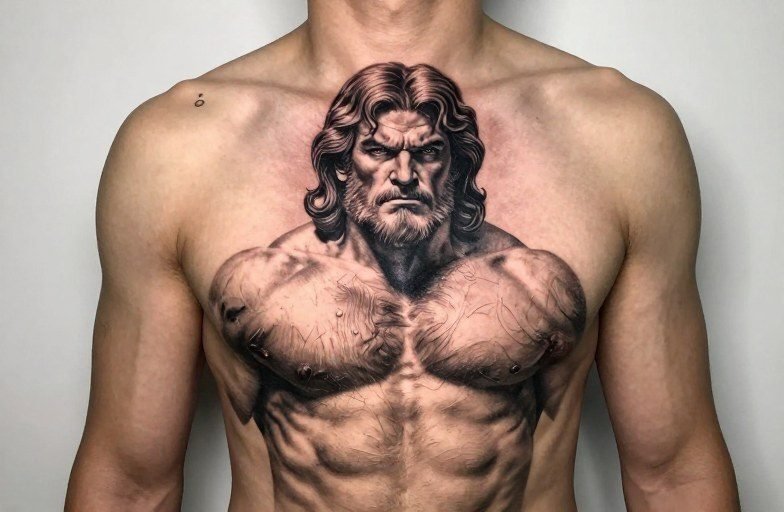
A Hercules tattoo typically signals strength pushed to its absolute limit, physical power tested by impossible tasks, but also the quieter endurance of someone who keeps going after public failure. The Greek hero’s most famous exploits, the Twelve Labors, were penance, not glory-seeking. That distinction matters: this ink often marks someone who has rebuilt themselves through deliberate effort rather than natural talent.
Symbolism & Core Meaning
At its center, Hercules represents forced transformation. The hero began as a drunken killer and ended as a laborer who earned peace through suffering. This arc, punishment, sustained effort, eventual integration, resonates with people who have worked through addiction, prison, military trauma, or any experience where public identity had to be rebuilt stone by stone.
The Labors as Personal Metaphor
Each Labor offers specific symbolic weight. The Nemean Lion (skin as armor) speaks to making protection from what once threatened you. The Hydra (heads that multiply when cut) maps onto problems that worsen when handled aggressively, debt, resentment, certain family dynamics. The Apples of the Hesperides, requiring Atlas to hold the sky, acknowledges that some burdens must be temporarily shouldered by others while you complete your task. Choosing a specific Labor rather than generic “strong Hercules” shows real thought.
The Club, the Lion Skin, and the Bow
Hercules’s attributes carry distinct meanings:
- The club: crude, improvised force; the tool of someone without formal training or resources who succeeds anyway through persistence
- The lion skin: trophy transformed into functional protection; past victory becoming present defense
- The bow: ranged precision, suggesting calculated strength rather than mere brawling
Artists often combine these awkwardly. A bow with a club makes visual sense but symbolic tension, know which aspect you want emphasized.
Mythology & Folklore
The Hercules myth exists in layered versions, and tattoo choices often unconsciously pick among them. The Greek Heracles was a figure of explosive, dangerous strength, he killed his family in a fit of madness, and his Labors were servitude to a cowardly king. The Roman Hercules absorbed Etruscan and Italic elements, becoming more associated with commercial protection and boundary-guarding. Renaissance art, particularly the Farnese Hercules statue, emphasized exhausted completion rather than heroic action: the hero leaning on his club, muscles spent.
The Apotheosis and What It Omits
Hercules’s death is often skipped in tattoo imagery. After the Labors, his second wife Deianira gave him a poisoned shirt; he burned himself alive on a pyre. Only then did he ascend to Olympus. Some trace apotheosis imagery to older Near Eastern dying-rising god patterns. The full arc, suffering, false recovery, second catastrophe, voluntary destruction, finally peace, contains more psychological accuracy than the sanitized version. A tattoo showing the burning pyre rather than the triumphant hero is rare but devastatingly precise for certain experiences.
Modern Adaptations and Pop Culture
Disney’s 1997 animation created a separate visual vocabulary: youthful, optimistic, distinctly American. The physique is gymnast-lean rather than weightlifter-massive. This version works for people who want aspiration rather than survival narrative. The Dwayne Johnson film (2014) split the difference, showing Hercules as a mercenary whose legend outpaced his reality. Both versions are valid source material, but mixing visual languages, classical Farnese torso with Disney facial structure, usually produces incoherent results.
Religious & Spiritual Angles
Early Christians often linked Hercules to Samson: both killed lions with bare hands, both were undone by women, both achieved redemption through suffering. This typological reading made Hercules imagery available in Christian art without direct pagan identification. Some medieval churches included Hercules in facade programs as a pre-Christian moral exemplar.
Stoic and Cynic Philosophy
The Cynics claimed Hercules as their ideal, rejecting comfort, accepting hardship voluntarily, finding freedom through ascetic discipline. The Stoics, particularly Epictetus, used Hercules’s choice of Labor over pleasure as the model of rational living. For someone with philosophical leanings, this framing separates the tattoo from mere gym-culture posturing. The Labors become exercises in will-training rather than obstacle-clearing.
Neopagan and Esoteric Reclaimings
Modern Hellenic reconstruction sometimes treats Heracles as a theos, a deified mortal accessible to human petition. This differs from Olympian worship, more like ancestor veneration with superhuman scale. Some esoteric traditions map the Twelve Labors onto zodiacal or initiatory stages. These frameworks are rarely visible in the tattoo itself but shape the private meaning for the wearer.
How It Ages on Skin
Hercules imagery presents specific technical challenges. The classical ideal depends on precise anatomical rendering, muscle insertions, foreshortening, weight distribution. Small scale collapses this; a 3-inch bicep piece becomes muddy abstraction within five years. The lion skin headdress requires careful differentiation between human and animal textures; without it, the face reads as inexplicably hairy.
Line Weight and Shading Strategy
Black-and-gray realism dominates Hercules portraiture, but the subject suits bold traditional approaches surprisingly well. Thick lines hold; the simplified forms of American traditional, dropped details, exaggerated shoulders, minimal shading, age with more integrity than hyper-detailed realism. If you want classical sculpture reference, consider that marble’s soft transitions don’t translate directly to skin; tattooed “smoothness” requires deliberate contrast and highlight placement that will shift as skin changes.
Color Considerations
The Nemean lion’s golden hide offers natural color opportunity, but yellows and oranges fade fastest to muddy residue. Red for blood or cape works better long-term. Skin tone matters enormously: on darker skin, the “marble white” of classical sculpture requires negative space and un-inked skin rather than white pigment, which ages to gray-green. Discuss this explicitly with your artist; portfolio photos rarely show healed results on multiple skin tones.
Best Placements
The full Farnese Hercules composition, standing hero, club, lion skin, needs vertical space. Thighs and outer calves accommodate this naturally. The back offers width for action compositions: wrestling the lion, battling the Hydra. Chest pieces work when Hercules is shown in bust form or with compressed verticality, but the broad-shoulder-to-narrow-waist ratio that defines the classical ideal gets distorted across pectoral muscle movement.
Scale and Viewing Distance
Forearm and calf placements invite closer inspection; the narrative details of specific Labors read here. Shoulder caps and upper arms suit iconic, immediately recognizable treatment, club raised, lion skin clear. The hand or neck, if professionally appropriate, carries particular weight: Hercules as what you present first, what you cannot hide.
Movement and Muscle Dynamics
Consider how your body moves. A flexed bicep with Hercules at rest creates dissonance; the tattoo should either oppose or amplify the muscle’s action. The tension of wrestling poses suits dynamic muscle contraction. Exhausted, leaning poses work better on relaxed muscle groups, thigh, relaxed upper arm, torso side.
Similar & Related Symbols
Samson offers the closest parallel: Hebrew rather than Greek, divine strength rather than earned, but similar narrative arc and lion-killing origin. The visual language differs, no club, no lion skin as armor, hair as vulnerability rather than decorative. Atlas, often confused with Hercules, represents sustained burden without the narrative of transformation; better for static endurance than recovery. Prometheus, another punished titan, offers intellectual rather than physical suffering.
Modern Athletic Equivalents
Some choose contemporary strongman imagery, Eddie Hall, Hafþór Júlíus Björnsson, historical circus performers. These carry documentary specificity but lack mythic scalability. They record achievement rather than process. The choice between mythic and historical athletic imagery often reveals whether the wearer sees their strength as personal accomplishment or participation in something larger.
Feminine and Non-Binary Adaptations
Hercules imagery is aggressively masculine in classical sources, but the underlying themes, forced labor, redemption through effort, integration after fragmentation, are not gendered. Some artists render the figure androgynously; others keep the iconography (club, lion, Labors) with a differently gendered figure. The myth of Omphale, where Hercules served as a woman’s slave and wore her clothing, offers underexplored visual territory for subverting the hypermasculine default.
Final Thoughts
A Hercules tattoo done well requires choosing which Hercules, Greek or Roman, suffering or triumphant, philosophical or athletic, classical or pop-cultural. The default imagery risks generic “strength” without the specific weight that makes this figure endure across millennia. The best pieces acknowledge the punishment that preceded the glory, the exhaustion that underlies the muscle, the burning that finally released the hero. That complexity is the point. Anyone can want strength. The Hercules narrative asks what you’ll do when strength fails, when reputation collapses, when the only path forward is through tasks no one wants to watch.
Frequently Asked Questions
Does a Hercules tattoo always mean someone is into bodybuilding?
Not necessarily. While gym culture has adopted Hercules imagery, the original myth emphasizes endurance through punishment and redemption after failure. Many people choose this symbol for recovery from addiction, military service, or other experiences where sustained effort rebuilt their lives.
What’s the difference between Heracles and Hercules in tattoo imagery?
Heracles is the Greek original, often shown in more violent, less idealized forms with specific Labors emphasized. Hercules is the Roman adaptation, frequently more polished and associated with guardian or commercial protection. Visually, Greek sources tend toward athletic realism; Roman toward monumental bulk.
How big does a Hercules tattoo need to be to work?
For full narrative detail with recognizable Labors, plan for at least palm-sized area. Iconic treatment, club, lion skin, distinctive silhouette, can work smaller. Classical anatomical realism requires significant scale; simplified traditional or neo-traditional approaches survive better at smaller sizes.
Can Hercules imagery work for someone who doesn’t identify as male?
Absolutely. The core themes, transformation through difficult labor, rebuilding after public failure, are universal. Some artists use the Omphale episode where Hercules wore women’s clothing, or render the figure androgynously while keeping the symbolic attributes. The iconography matters more than the gender presentation.
Related Tattoo Meanings
- Ganesha Tattoo Meaning: Symbolism, Styles Placement Guide
- Ilia Topuria Back Tattoo Meaning: Symbolism Style Guide
- Athena Tattoo Meaning
- Explore more