
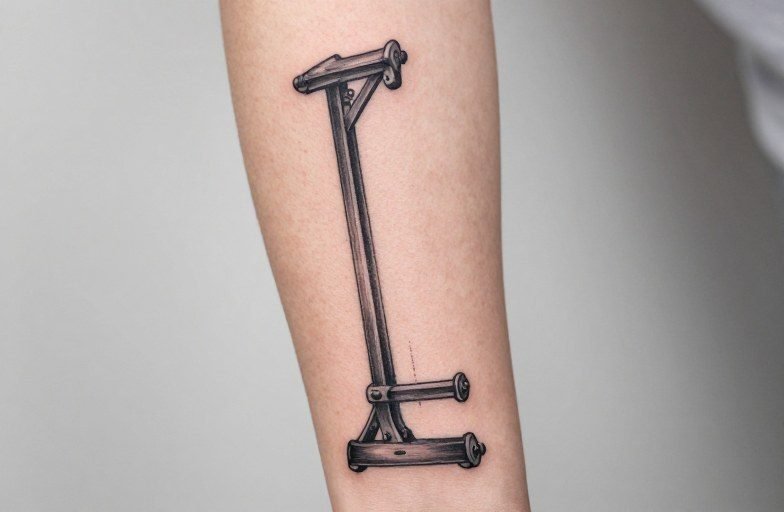
The guillotine tattoo carries a heavy, unmistakable charge: finality, political upheaval, and the razor-thin line between power and victimhood. Most people who choose this image aren’t glorifying execution, they’re drawn to its symbolic weight as a marker of decisive change, justice (or injustice), and the stripping away of old identities. It can represent cutting ties, surviving systemic violence, or confronting mortality without softening the edges.
Symbolism & Core Meaning
The Revolutionary Legacy
Linked most strongly to the French Revolution, the guillotine became the great equalizer of death, noble and commoner alike met the same blade. That egalitarian brutality gives the image its political punch. A guillotine tattoo can signal anti-authoritarian sentiment, class consciousness, or skepticism toward institutional power. The blade itself, suspended and waiting, creates natural tension in the design; that moment before the drop speaks to uncertainty, to consequences hanging in the balance.
Mortality and the Absurd
Some wearers connect the guillotine to existential themes: the randomness of death, the machinery of state violence, the body as object. Camus and Sartre both circled these ideas, and the tattoo sometimes functions as a memento mori stripped of romanticism. Unlike a peaceful skull or sleeping skeleton, the guillotine insists on agency and violence. There’s no gentle passing here, only decision, mechanism, and severance.
- Finality and irreversible choice
- Justice, vengeance, or systemic critique
- Class consciousness and the “leveling” of death
- Existential confrontation with mortality
- Severing past selves, relationships, or addictions
Design Tips & Pairings
Composition and Placement
The guillotine’s vertical structure suits certain body parts naturally. The full apparatus, blade, lunette, posts, and basket, reads best on flat or elongated areas: the outer forearm, side of the calf, ribs running vertically, or the spine. A simplified blade and lunette (the neck collar) can work smaller, tucked behind an ear or on a wrist, but detail gets lost below about three inches. The basket beneath, sometimes shown with a single head or empty, adds narrative weight; empty suggests potential, occupied confirms consequence.
Common Pairings
Roses entwined with the posts soften the image without defanging it, creating that classic beauty-and-death contrast. Hourglasses, pocket watches, or clock faces reinforce the waiting aspect. Political imagery, crowns being crushed, tricolor ribbons, or raised fists, pushes the revolutionary reading. For personal transformation themes, snakes or phoenixes nearby can suggest what comes after the severing. I think the strongest guillotine tattoos commit to one emotional register rather than mixing too many; the image is already busy with meaning.
- Full apparatus: forearm, calf, ribs, spine
- Minimal blade+lunette: wrist, behind ear, ankle
- Single needle or fine line for delicate, intellectual feel
- Bold traditional for punk or political statement
Personal & Modern Meanings
Contemporary wearers often detach the guillotine from its historical specifics. The blade becomes a metaphor for cutting out toxic patterns, ending careers, leaving religions, or surviving breakups. There’s a therapeutic bluntness to it: this thing is over, decisively, without negotiation. Some recovery communities have adopted the image to mark “the day everything changed”, not celebration, but grim acknowledgment of necessary violence against the self.
The guillotine also appears in goth, punk, and heavy metal aesthetics where its shock value serves subcultural identity. Here the meaning is less personal narrative than affiliation: a visual shorthand for anti-establishment, anti-optimist, or darkly humorous worldview. The cartoonish or exaggerated versions, oversized blade, stylized blood, comedic expressions on the condemned, lean into absurdism rather than tragedy. Both approaches are valid, but they read very differently across the room.
Religious & Spiritual Angles
Christian and Martyrdom Readings
The guillotine intersects uncomfortably with Christian iconography. The Reign of Terror specifically targeted clergy and religious orders; some saints and blesseds were guillotined rather than breaking faith. For Catholic wearers with French heritage, the image can function as ancestral memorial, connecting to the Martyrs of Compiègne or other executed religious. The blade then becomes not political statement but witness to faith under persecution. This reading requires careful handling, the guillotine remains an instrument of state terror, not holy martyrdom itself.
Karma and Karmic Severance
In looser spiritual frameworks, the guillotine represents karmic cutting: the instant when accumulated action produces unavoidable consequence. Some Buddhist-adjacent interpretations use it to contemplate impermanence, though actual Buddhist practice tends toward gentler imagery. The guillotine’s speed and irreversibility can mirror certain Hindu or tantric concepts of sudden spiritual death, ego death as violent rupture rather than gradual dissolution. These are modern syncretic readings, not traditional associations, and most practitioners would acknowledge that distance.
How It Ages on Skin
Guillotine tattoos face predictable aging challenges. The blade’s thin edge, often rendered as a bright highlight or single needle line, spreads and softens over five to ten years. The lunette’s curved interior can blob out if too small. Rope details on the blade mechanism turn to fuzzy stripes. The basket’s weave pattern, if intricate, becomes indistinguishable from shading.
What holds up: strong contrast between the dark posts and negative space, the triangular silhouette of the blade, the basic rectangular structure. Simpler versions age significantly better. On hands, fingers, or feet, high-wear areas, the guillotine’s fine details deteriorate fastest; the blade edge especially becomes a grey smear. Inner bicep and thigh, protected but prone to stretching, can distort the vertical alignment as skin changes. Forearm outer and calf side remain the sweet spots for longevity.
Touch-ups are common with this design. The rope and mechanical elements typically need reinforcement after several years. Black and grey versions age more gracefully than color, which brings us to:
Color vs Black and Grey
The Case for Black and Grey
Most guillotine tattoos work better without color. The historical photographs and woodcuts that inform the image are monochrome; color can feel applied rather than integral. Black and grey allows focus on the blade’s gleam, the wood grain of the posts, the shadow inside the basket. It ages cleaner, touches up easier, and carries the somber weight most wearers want. Silver or white ink for the blade edge rarely stays bright; expect it to settle to a muted grey within two years.
When Color Works
Tricolor ribbons (blue, white, red) explicitly invoke the French Revolution and can anchor the political reading. Deep crimson for blood, used sparingly, creates focal points without becoming cartoonish. A single red rose against black and grey structure borrows from traditional tattoo conventions effectively. Full color realism on the guillotine is rare for good reason, the image is fundamentally graphic, not painterly, and color realism tends to soften its impact. Neo-traditional approaches with limited palettes (black, red, gold, maybe green) succeed more often than full spectrum work.
Final Word
The guillotine tattoo demands commitment. It is not decorative, not easily explained away, not flattering in most social contexts. That friction is precisely its value. Whether marking political rage, personal severance, existential confrontation, or ancestral trauma, the image refuses to comfort. Choose it with full knowledge of how it reads across the room, how it ages on your particular skin, and what conversations it will start. The blade drops once; the tattoo stays.
Frequently Asked Questions
Does a guillotine tattoo always mean someone is violent or angry?
Not necessarily. Many wearers use it to symbolize cutting out negative patterns, surviving systemic injustice, or confronting mortality. The context of the surrounding design and placement usually clarifies the intent.
How big does a guillotine tattoo need to be to read clearly?
The full apparatus needs at least four to five inches of vertical space to keep the blade, lunette, and basket distinguishable. Simplified versions with just blade and collar can work smaller, around two to three inches, but lose narrative detail.
Is the guillotine tattoo connected to any specific music or subculture?
It appears frequently in punk, metal, and goth aesthetics as anti-establishment imagery, often referencing the French Revolution’s class violence or functioning as general dark symbolism. Specific bands or scenes may adopt it, but no single subculture owns it.
Can a guillotine tattoo be done in a minimalist style?
Yes, but carefully. The triangular blade and curved lunette remain recognizable even stripped down, but the rope mechanism and basket details usually disappear. Single needle or fine line approaches work best for minimalist versions, though they require more frequent touch-ups.
Related Tattoo Meanings
- Gypsy Symbols Tattoo Meaning: Cards, Moons Traveler Lore
- Hands Touching Tattoo Meaning: Connection, Creation The Divine
- Happy Face Tattoo Meaning: Smiles, Irony, and Ink
- Explore more









