
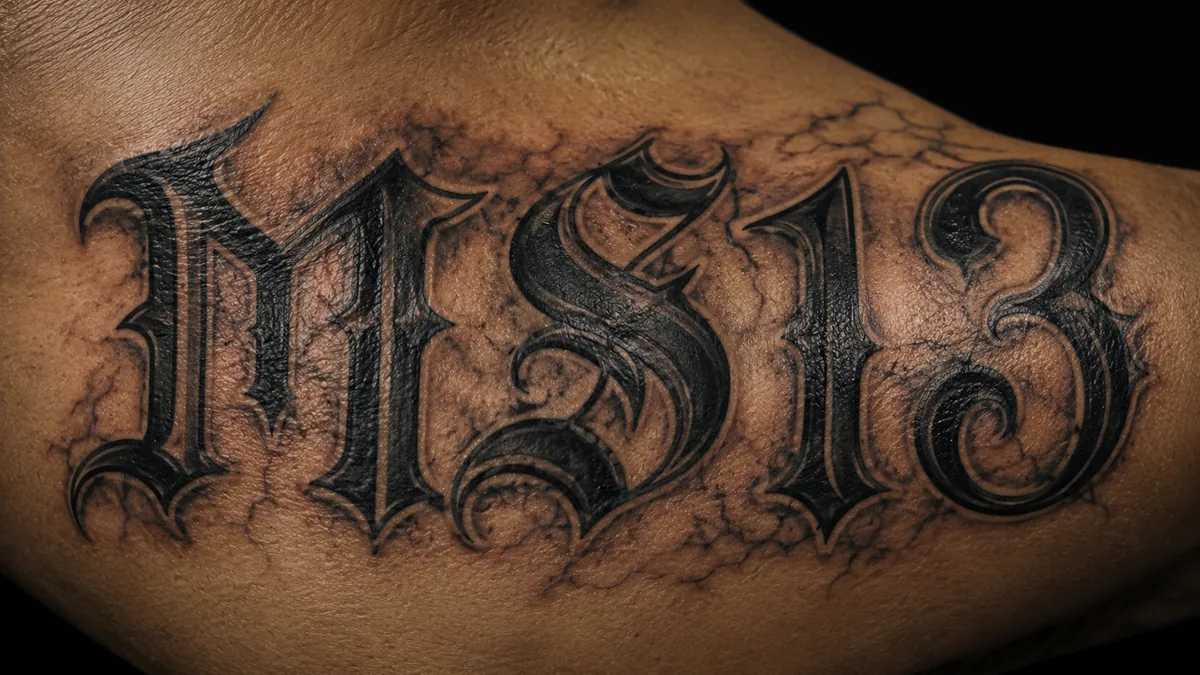
MS-13 tattoos are not decorative. They are a declaration. The letters, the number, the imagery, all of it exists to communicate one thing: allegiance to Mara Salvatrucha, one of the most recognized and feared street gangs in the Western Hemisphere. If you’re asking what this tattoo means, the answer is direct and the context matters a lot.
If you’re a client who inherited one and wants it covered, someone researching the history, or just curious what that gothic script means on a documentary, this breakdown covers what the tattoo actually says, where it comes from, and how artists handle it today.
What MS-13 Stands For
MS-13 is shorthand for Mara Salvatrucha. ‘Mara’ is Central American slang for gang or crew. ‘Salvatrucha’ refers to tough Salvadorans, guys shaped by hardship and war. The 13 connects directly to the letter M, the 13th letter of the alphabet, and also signals historical ties to the Mexican Mafia, the prison organization that held influence over much of Southern California’s gang landscape in the 1980s. That number is not casual. It’s structural.
The tattoo with ‘MS,’ ‘MS-13,’ or ‘Mara Salvatrucha’ spelled out in heavy gothic lettering is a membership brand. It tells other gang members, rivals, and law enforcement exactly where the wearer stands. There is no ambiguity built into the design. The explicitness is the point. The ink is meant to be read from across the room.
The History Behind the Mark
Some ink tells a story. This one tells law enforcement exactly where to look.
MS-13 formed in Los Angeles in the early 1980s. Salvadoran refugees, many of them displaced by a brutal civil war that ran from 1980 to 1992, landed in poor neighborhoods like Pico-Union. They faced attacks from established gangs and banded together for protection. That defensive structure quickly evolved into something more organized and more violent. The gang took root in LA and spread through cliques.
Starting in the late 1980s, U.S. authorities began mass-deporting gang members to El Salvador and neighboring countries. Those deportees carried LA gang culture, symbols, and structure back to Central America, planting MS-13 in places already weakened by post-war poverty. By the 2000s, the gang had become transnational, operating across the US, El Salvador, Honduras, Guatemala, and parts of Mexico. The tattoo traveled with it.
Core Symbolism in the Tattoo
The ‘MS’ or ’13’ lettering is the foundation, but the imagery that surrounds it carries its own weight. Weapons, particularly guns, grenades, and bullets, signal lethality and pride in criminal capacity. Skulls and devil figures project fearlessness and rejection of conventional authority. Spider webs appear frequently and represent entrapment in the life, prison time, or the gang’s spread across territory. These are not random choices. Each element reinforces the same core message: power and permanence.
Some designs include religious imagery, crosses and saints, but they’re reinterpreted. In MS-13 context, that iconography does not signal faith in a traditional sense. It fuses with the gang’s aesthetic of violence and defiance, creating a visual language that says ‘this is my life, fully.’ The tattoos are intentionally aggressive. They are built to intimidate outsiders and communicate status to insiders simultaneously.
Placement and What It Communicates
Face, neck, hands, chest, forearms. MS-13 tattoos go where they cannot be hidden. That visibility is deliberate. Placing gang ink on the face or neck is the ultimate commitment signal. It closes off conventional employment, signals you are not trying to blend into mainstream society, and tells every other gang member you passed the point of no return. The placement choice is part of the statement.
Chest and back pieces tend to be larger and more detailed, often full ‘Mara Salvatrucha’ scripts combined with imagery. Forearm placements are common and readable at arm’s length, which matters for identification on the street. In tattoo terms, these are high-traffic placements. The ink holds well in most of these zones, but hands and fingers will fade faster. For the purpose this tattoo serves, fading is not really the concern.
Style Variations: Gothic, Script, and Imagery
The dominant style is gothic blackletter, thick vertical strokes with sharp serifs, high contrast, heavy black. It reads bold from a distance, which is exactly what gang tattoo lettering needs to do. Some pieces use Chicano-style script, a flowing cursive tradition rooted in Los Angeles barrio culture that shares DNA with both prison tattooing and traditional American lettering. Both styles are done in solid black and grey, no color, consistent with prison tattooing roots where color was not an option.
Imagery elements like skulls, weapons, and spider webs are drawn in a similar black and grey realism or illustrative style. Some pieces are rough and scrappy, done with improvised tools in jails or early in a member’s time. Others are clean shop work done by professional artists. The quality varies widely, but the vocabulary stays consistent. You will not find watercolor or fine-line versions of this tattoo. The aesthetic is aggressive by design.
Common Misconceptions: What It Is Not
A 13 alone is not MS-13. A skull is not MS-13. A cross is not MS-13. Experts consistently note that genuine MS-13 tattoos are explicit. They spell it out. The letters MS or the full name Mara Salvatrucha in gothic script, combined with the number 13 and surrounding imagery, form the actual identifier. Isolated numbers or generic dark imagery shared with dozens of other tattoo traditions do not make someone a gang member.
This matters because misidentification happens, and it has real consequences for people. Someone with a 13 tattooed for a birthday, a sports number, or luck has been wrongly profiled. The tattoo community and law enforcement have both made this error. Context, pattern, and the full combination of elements are what establish the meaning. A single motif taken out of context proves nothing.
Cover-Ups and Removals: What Artists Need to Know
Artists get asked to cover these. It happens. Heavy gothic blackletter over a large area is one of the more technically demanding cover-up jobs you will take on. The ink is usually dense and saturated. Fine line, watercolor, and light realism will not bury it. You need bold designs with heavy blacks: neo-traditional, blackwork, large ornamental pieces, or gothic hybrid compositions where the darkest elements sit directly over the original letters. Expect the new piece to be at least two to three times the size of the original.
Laser sessions before the cover-up make a real difference. Even one or two treatments to knock the black down give you a lot more options and let you avoid a completely blacked-out result. If the client is skipping laser, be honest about what is achievable. You are also covering a significant social signal, not just old ink. Work with clients who are committed to the change and understand what a solid removal plan looks like. Verify the client’s situation and intent before taking the job.
Who Gets This Tattoo and the Personal Weight It Carries
MS-13 tattoos are overwhelmingly associated with actual gang members. That is the honest answer. This is not a symbol that migrated into mainstream tattoo culture. It did not get adopted by people outside the gang context the way some prison motifs or outlaw imagery eventually did. The people wearing this ink, historically, got it as a membership marker during gang life. The tattoo signals you were in, and in deeply.
Former members seeking to leave the gang and rebuild their lives often pursue removal or cover-up as a practical and psychological step. For them, getting the ink covered is not just an aesthetic choice. It is a safety issue and an identity shift. For artists, understanding that weight matters. You are not just doing a technical cover-up. You are helping someone close a chapter. That deserves respect and serious work.









