
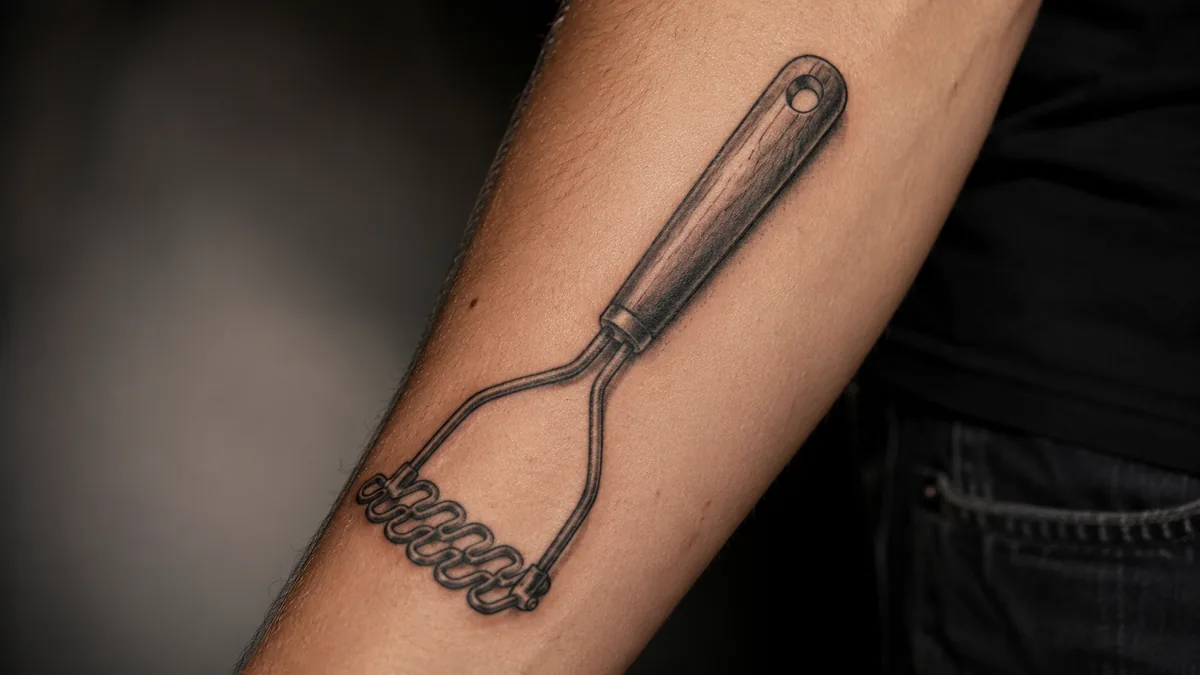
The potato masher tattoo is one of those pieces that stops people mid-conversation. It’s a kitchen utensil. It’s a grenade. It’s someone’s inside joke with their dead grandma. That’s exactly what makes it interesting.
There’s no single rulebook meaning here, no ancient tradition backing it up. What exists is a genuine split between two very different readings: the domestic comfort angle and the military history angle. Your design tells the story. Let’s break both down.
The Core Meanings: What a Potato Masher Tattoo Actually Says
At its most direct, a potato masher tattoo pulls from the object itself. Potatoes are a humble staple. The masher turns raw starch into something warm and shared. That reads as comfort, nourishment, home, and a grounded personality. People who get this piece often describe a specific family connection, a grandmother’s Sunday table, a ritual that meant safety as a kid.
The other dominant reading is military. Allied troops in World War I and World War II called the German Stielhandgranate the potato masher because the stick-and-cylinder silhouette looks almost identical to the kitchen tool. So if your reference is that shape with a bit of grit to it, the meaning flips completely into combat history, danger, and frontline identity. Context does all the work here.
The Military History Behind the Name
The most meaningful tools never end up in a museum — they end up on your skin.
The German Model 24 stick grenade was the standard offensive grenade for German forces from WWI through WWII. The long wooden handle and cylindrical head made it instantly recognizable on the battlefield, and Allied soldiers started calling it the potato masher almost immediately. It was built for assault, close-quarters trench fighting, clearing bunkers. That’s not subtle history.
Veterans, military historians, and descendants of soldiers who served in those wars sometimes carry this image as a personal marker. It says: I know what happened in those trenches, or my family was part of that story. On its own, without surrounding symbols, it reads as historical interest. Keep the design context clean if that’s your intent. A realistic Stielhandgranate looks nothing like your grandma’s kitchen masher. The shape tells the viewer which direction you’re going.
Domestic Symbolism: Comfort, Family, and the Everyday
On the home-cooking side, this tattoo carries warmth. Mashed potatoes show up at Thanksgiving, at funerals, at the first meal someone cooks after a loss. They’re not glamorous food. That’s the point. Getting the masher tattooed says something about valuing simple, real things over pretense. It’s a working-class aesthetic, unpolished on purpose.
A lot of people tie this piece to a specific person. Mom’s recipe. A grandparent who made mashed potatoes every Sunday. Comfort food as a tribute acts the same way a portrait does, just with less emotional weight on the day of the appointment. It’s personal without being heavy, which is exactly why some people prefer it.
Humor and the Quirky Tattoo Tradition
Not every tattoo needs to carry heavy meaning. The quirky food tattoo is a real category, and the potato masher fits right in. Wearing something unexpected on your skin tells people you don’t take yourself too seriously. It signals a laid-back attitude, a sense of humor, maybe a willingness to explain yourself at every pool party for the rest of your life.
This category of tattoo is chosen intentionally. It’s not lazy or random. People who get odd, everyday-object pieces are usually confident collectors who want variety across their skin. The potato masher sits comfortably alongside other kitchen tools, cartoon vegetables, and offbeat imagery. If that’s your vibe, own it. A solid traditional potato masher with a bold outline and clean fill is going to read great and age well.
Design Variations and Style Choices
The kitchen-tool version works in almost any style. Traditional and neo-traditional are the strongest choices because the bold outlines and solid fill hold up over time. A clean silhouette with minimal internal detail reads from across the room, which is what you want with a small or mid-size object tattoo. Fine line can work on a larger scale but the wire grid pattern of a masher head can blow out in high-movement zones if the lines are too thin.
The grenade version pushes toward blackwork, illustrative, or realistic depending on what mood you’re after. Realistic tends to land harder in military contexts. Illustrative with a touch of texture and a banner gives it old-school flash energy. Color pops on both versions. A saturated pop of yellow, warm orange, or classic Americana red can make a kitchen masher read fun and bold. The grenade version usually stays black and grey to keep it grounded and serious.
Placement, Pain, and How It Ages
For a small to mid-size masher, the outer forearm, upper arm, and outer calf are your best bets. Flat skin, low-wear zones, holds detail well over the years. The inner forearm is solid too if you want to see it daily. Avoid knuckles, fingers, and the inside of the elbow if you care about longevity. High-friction spots chew up fine detail fast, and any wire-grid pattern on the masher head will blur into mush within a few years on a bad placement.
Pain-wise, the outer forearm and upper arm are manageable for most people. Ribs and sternum are spicy if you want to make a statement. The calf is more comfortable than people expect. Whatever placement you choose, size up a little. A masher that reads clean at two inches across will still look intentional at ten years post-healing. Go too small and the wire grid or handle detail turns to smudge faster than you’d like.
Who Gets This Tattoo and How to Make It Personal
The people walking into studios with this concept split pretty evenly between folks with a specific story and people who just love the image. Family tribute collectors, military history buffs, chefs and kitchen workers, and tattoo enthusiasts who want something unexpected all land in this camp. It’s not a mainstream flash choice, which gives it character before you even open your mouth.
To make it personal, give it one specific detail that locks it to your story. A date on a banner, a sprig of rosemary tucked next to the handle, the shape of a specific vintage masher from your grandmother’s kitchen, or a tiny potato resting below it. Small additions do the work without cluttering the piece. Talk to your artist about what matters to you and let them push the composition. A solid artist will take your idea and make it hit harder than what you walked in with.









