A broken sword tattoo carries serious weight. It’s not decorative filler. People choose it because it says something true about them, something about loss, surrender, or choosing peace over continued fighting. The meaning cuts both ways, and that’s exactly why it works.
a broken sword represents a story that changed direction. Maybe a battle ended. Maybe a person walked away from something they once fought hard for. That ambiguity is the appeal. One image holds multiple truths, and depending on the details in the design, it can read very differently on different people.
Core Symbolism: What a Broken Sword Actually Means
The most common reading is defeat, but not the shameful kind. A broken sword historically meant a warrior was done fighting, either because he lost or because he chose to lay down his arms. There’s a big difference between those two, and good tattoo artists will ask which one you mean before drawing a single line. The symbolism branches fast.
Alongside defeat, a broken sword also represents sacrifice, the end of conflict, and transition. Some people get it to mark leaving a toxic situation, a career, a relationship, or a war. Others get it as a reminder that strength doesn’t always mean pushing through. Sometimes stopping is the hardest and bravest move a person makes.
Historical and Cultural Background
The sword doesn't have to be whole to prove you survived the fight.
Broken swords show up across real history and mythology. In medieval Europe, a knight’s sword was broken during a formal ceremony of dishonor, called degradation, when stripped of rank. That image carried shame. But in Japanese warrior culture, a broken blade held different weight. A samurai’s sword was his soul, and a broken one marked the end of a warrior’s path, sometimes chosen, sometimes forced.
Norse mythology references broken weapons too. Sigurd’s father Sigmund fights with a sword that shatters, and the pieces are kept and reforged into something greater. That angle gives the broken sword a resurrection reading, something destroyed that becomes stronger. These aren’t invented meanings. They’re documented across multiple cultures, which is why the tattoo holds up across very different people and stories.
Popular Design Variations
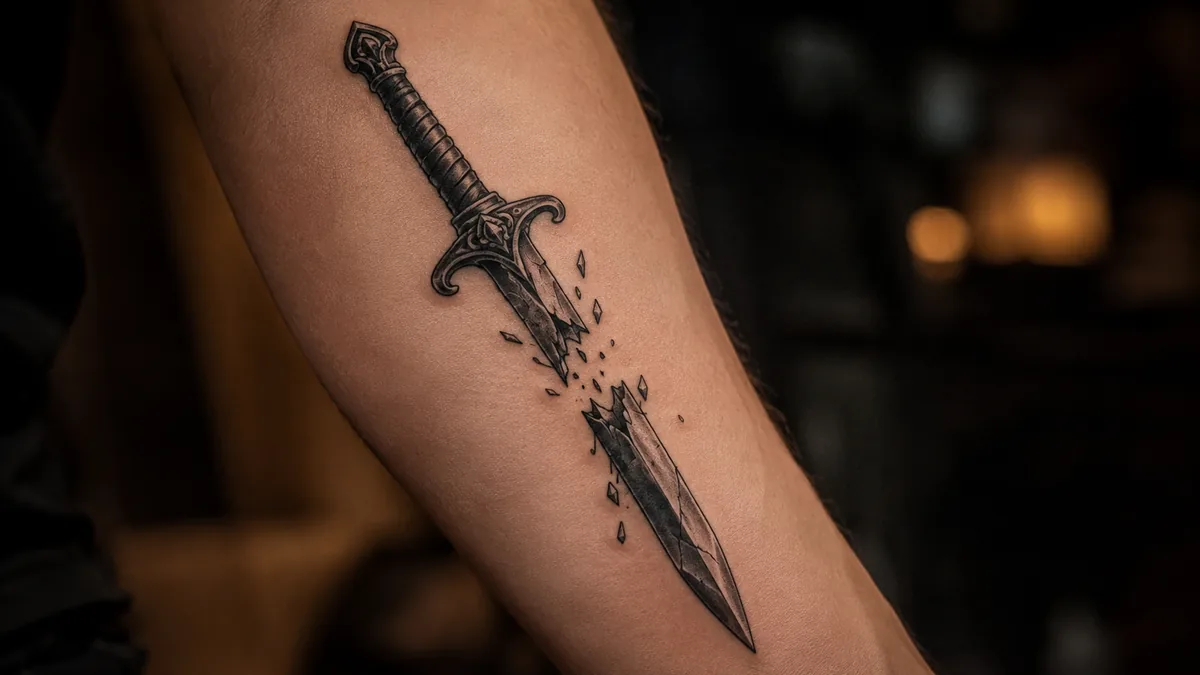
The most popular version shows a sword snapped cleanly at the blade, often with the hilt intact. The hilt-and-stub design reads instantly from a distance, which matters. Other versions show the blade mid-snap with stress fractures radiating outward, more dramatic, more motion. Some clients add elements like a wrapped hand releasing the hilt, blood on the break point, or vines growing through the gap where the blade split.
Fine line broken swords look elegant and work well small. Bold traditional or neo-traditional versions with thick black outlines hold better over time and read strong even on high-movement skin. Illustrative and blackwork styles are both solid choices. The broken sword also pairs naturally with other symbols: shields, roses, ravens, banners with text, or flames licking up from the break point.
Black and Grey vs Color
Black and grey is the dominant choice for broken swords, and for good reason. The subject matter is heavy. Grayscale reinforces that weight. A skilled artist can whip shade the metal to look cold and dense, make the break point look sharp and jagged, and use negative space to suggest rust or age. That’s where the storytelling lives in a black and grey piece.
Color works, but it requires intention. A sword with a gold hilt and a silver blade that’s been cracked and dulled at the break reads like lost glory. Deep reds around the fracture point hit hard. Full saturated Japanese-style work with the broken blade sitting in a field of peonies or waves is a completely different read, more about transformation than loss. Both are legitimate. The color choices tell the viewer which story you’re in.
Best Placements and How It Ages
The forearm is the top placement for this design. A vertical sword running from wrist toward the elbow fills the space naturally, the geometry just fits, and it reads clean. The upper arm and thigh are close seconds. The ribs work for longer, more cinematic compositions. The shin is an underrated spot for a bold vertical blade. Stay away from fingers and the sides of hands for anything you want crisp in five years.
Swords have a lot of straight lines, and straight lines will show any blowout or migration fast. High-wear zones like the wrist and inner elbow will soften over time. That’s just physics. On the outer forearm, upper arm, or thigh, a bold broken sword with solid black linework and clean fills will age predictably and look solid for decades. Fine line versions in low-wear zones also hold well if the artist has a steady hand and the client follows aftercare.
Pain Zones by Placement
The outer forearm and upper outer arm are about as manageable as it gets. The skin sits over muscle, it moves predictably under the needle, and most people handle those spots well even on longer sessions. The ribs are a different story. Spicy is an understatement for a full rib piece. The shin has a reputation for being rough near the bone at the front edge.
The inner arm and inner thigh are more sensitive than they look, thin skin, close to nerves, and the client tends to flinch more there. If placement is flexible, go for the outer zones first. You’ll sit better for the session, the artist gets cleaner linework, and the healed result is sharper. A broken sword with jagged edges and detail around the fracture needs a client who can stay still.
Who Gets This Tattoo and How to Make It Personal
Veterans get it. People leaving long careers get it. Survivors of bad relationships get it. People who walked away from addiction get it. The broken sword lands anywhere a person can point to a moment when they stopped fighting something and either lost, surrendered with dignity, or chose a different kind of strength. It’s one of the few symbols that works for both the guy who lost and the guy who chose to stop.
To make it personal, bring the context into the design. A date on the hilt. A name engraved in the blade. Initials worked into the crossguard. Specific damage, like a blade that looks like it was struck by something identifiable. These details make the piece yours. Talk to your artist about what the break means to you, because the way they render that snap point, clean, jagged, explosive, gradual, will carry your meaning better than any caption ever could.