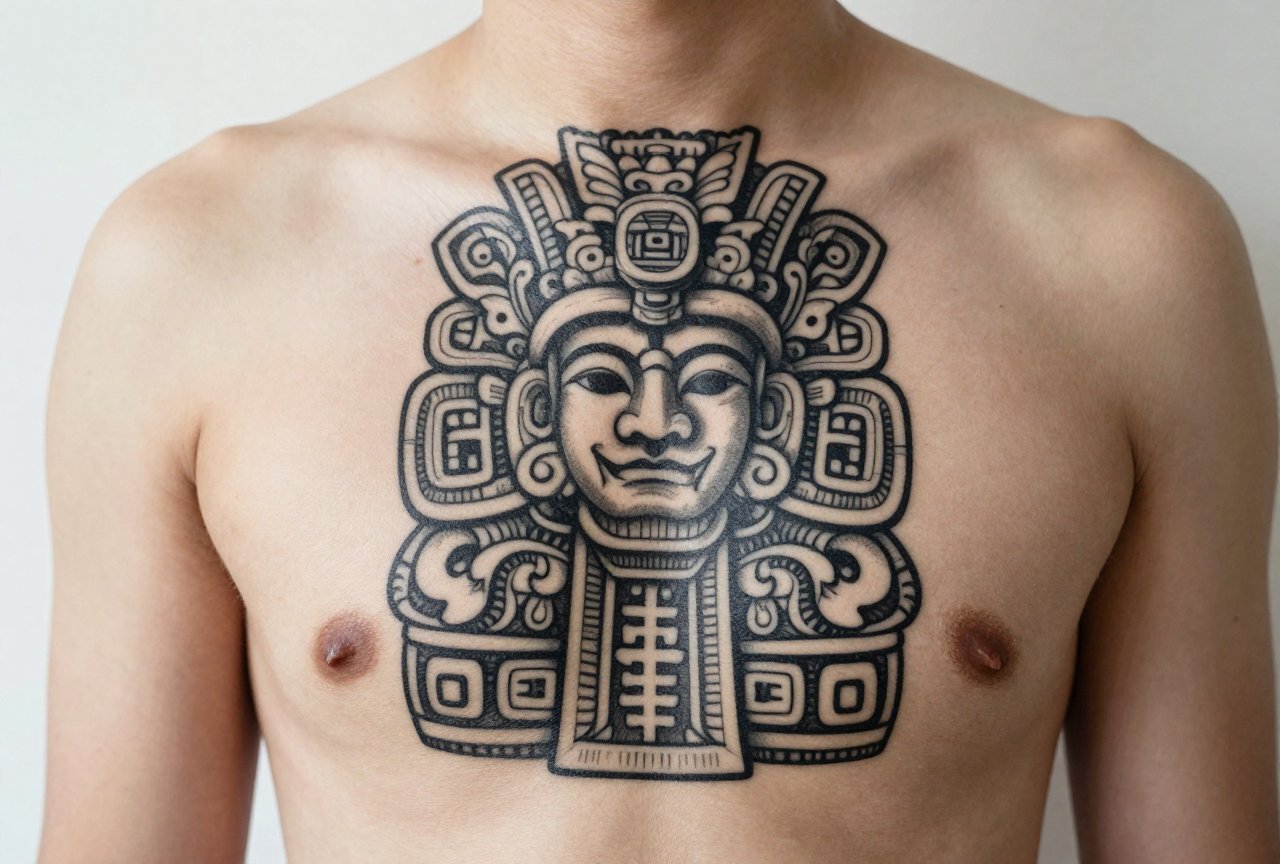
Mayan tattoos pull from one of the most sophisticated pre-Columbian civilizations, turning carved limestone glyphs and stucco temple reliefs into living skin art. At their core, these designs channel cosmic cycles, personal identity through the tzolk’in calendar, and spiritual protection, meanings that still hit hard for people seeking something deeper than decorative ink.
Symbolism & History
The Maya didn’t tattoo casually. Murals and ceramic figures show body modification as ritual practice, often marking status, military prowess, or religious devotion. When I stencil a Hunab Ku or a calendar glyph on someone, we’re continuing a conversation that started around fires in the Petén jungle two thousand years ago.
The Calendar Glyphs
The tzolk’in 260-day sacred calendar remains the most requested Mayan imagery in my chair. Each day has a nahual, a spirit essence, often animal-shaped, that shapes personality and destiny. Someone born under Kawuq (the thunderstorm) might get that glyph for personal strength. I’ve tattooed Imox (the crocodile, water and primordial creativity) on painters and musicians who feel that chaotic, generative energy. These aren’t generic zodiac copies; the Maya believed your birth date literally formed your soul’s contract with the universe.
Gods & Cosmic Forces
Kukulkan, the feathered serpent, twists across ribs and backs in my shop regularly. Unlike the Aztec Quetzalcoatl, the Mayan version carries specific associations with the Venus cycle and seasonal renewal. Itzamna, the supreme creator, appears less often but hits different for clients reconnecting with indigenous heritage, his aged, long-nosed profile comes from Classic period codices. The Hero Twins from the Popol Vuh, Hunahpu and Xbalanque, make powerful brother tattoos or memorial pieces. I’ve done matching forearm pieces for two siblings who lost their father; the Twins’ underworld journey resonated with their own grief and resilience.
- Hunab Ku, the galactic center, unity consciousness, often rendered as a squared spiral; popular for chest pieces
- Tikal temple silhouettes, ancestral connection, architectural achievement, usually simplified for readability at small sizes
- Jaguar (B’alam), night sun, underworld power, military elite; thick black lines hold up best over decades
- Maize god, rebirth, sustenance, the human body formed from corn dough in creation myths
Common Variations & Styles
Style choice changes everything about how these symbols read and age. I’ve watched clients agonize between historical accuracy and contemporary legibility, there’s no single right answer, but there are definitely wrong ones for certain skin types and lifestyles.
Blackwork & Traditional Approaches
Heavy black fill mimics the carved stelae and codex ink best. The Dresden Codex’s deep reds and blacks translate naturally to bold American traditional or straight blackwork. These age like champions. I did a full Hunab Ku back piece on a construction worker five years ago, sun exposure, hard labor, zero touch-ups needed because we packed that black solid. Fine line Mayan glyphs, conversely, blur faster than you’d think. The geometric precision that makes them beautiful also makes blowouts devastating. I steer detail-oriented clients toward larger sizes or simplified forms.
Neo-Mayan & Fusion Styles
Some of my favorite pieces blend Mayan structure with other traditions. A client last month brought reference combining Tikal temple geometry with Polynesian spearheads, his mixed Guatemalan and Samoan heritage, rendered as a full sleeve. Another regular does dotwork mandalas incorporating the 20 day-signs as orbital elements. These work when the artist understands both vocabularies deeply. I’ve also seen disastrous “tribal” mashups where Mayan curves get thrown into generic black sleeves with zero cultural literacy. We see this a lot in walk-in shops near tourist zones. Ask your artist specifically about their glyph research.
Best Placements
Mayan imagery carries specific placement logic from the culture itself. Ear spools, facial tattoos, and chest markings appear in archaeological record, modern adaptations follow some of that energy while adapting to professional realities.
The chest centers Hunab Ku or sun symbols beautifully, echoing how rulers wore pectoral jade ornaments. I’ve placed Kukulkan as a sternum piece that follows the sternum’s natural line, serpent mouth at the solar plexus, tail curling toward the throat. Ribs work for vertical glyphs and temple scenes, though I warn clients: that spot hurts like hell, and the stretch with breathing can distort geometry over time. Upper arms and thighs give the most stable canvas for detailed calendar wheels. I’ve tattooed the full 260-day tzolk’in as a circular thigh piece, took three sessions, but the client can read her children’s birth nahuals in sequence now.
Hands and fingers? I talk people out of fine Mayan glyphs there. The detail required for authentic-looking uinal (month) symbols won’t survive two years of washing and sun. If someone insists, we go big and bold, simplified jaguar profiles, heavy black, no interior detail.
Who Chooses This Tattoo / Personal Meanings
In my experience, three distinct groups gravitate toward Mayan tattoos. Each carries different emotional weight, and I adjust my consultation accordingly.
Heritage Seekers
Guatemalan, Mexican, and Honduran clients often come after family loss or during identity exploration. A woman from Quetzaltenango got her grandmother’s birth nahual, Iq’ (wind, breath, spirit), after the old woman’s passing. She wept in the chair. This isn’t rare. For these clients, I emphasize historical accuracy and often suggest they bring family stories or regional variants, the K’iche’ Maya calendar differs subtly from Yucatec traditions. Getting it wrong feels like a betrayal.
Spiritual Explorers
The 2012 phenomenon left lasting interest in Mayan cosmology, for better and worse. Some clients arrive with genuine respect for the mathematical and astronomical sophistication; others want “ancient wisdom” as aesthetic. I don’t gatekeep spirituality, but I do ask questions. What does the Long Count actually mean to you? Why this glyph versus another? The ones who can answer get better tattoos because their intention shapes the design session.
Pattern & Geometry Lovers
Some people just respond to the visual language. The Maya perfected mathematical tessellation centuries before Escher. A software engineer got a simplified version of the Xibalba (underworld) ballcourt marker from Copán because the recursive geometry pleased his brain. No ancestry, no spiritual claim, just human pattern recognition. That’s valid too, though I still educate on origins.
Similar Symbols
Clients often cross-shop Mesoamerican traditions. Aztec imagery shares some glyphs, the calendar systems have structural parallels, but the Mexica (Aztec) emphasis on militarism and sacrifice differs from Classic Maya focus on time, astronomy, and agricultural cycles. I see confusion most often with the sun stone versus the Maya Long Count. They’re not interchangeable. Mixtec codices offer another geometric tradition, more narrative and less mathematically rigid.
Outside the Americas, Egyptian hieroglyphic tattoos sometimes appeal to the same crowd seeking “ancient writing systems.” The visual similarity is superficial, Mayan glyphs are logosyllabic, more complex than Egyptian’s primarily phonetic system, but the emotional draw (ancestral wisdom, permanence) overlaps. Celtic knotwork and Nordic runes also compete for the “ancient geometric” slot. Each carries its own cultural weight; I encourage clients to sit with why they’re drawn specifically to Maya rather than defaulting to the most familiar ancient culture.
Final Thoughts
Mayan tattoos demand homework. The glyphs are dense with meaning, the history is still being reconstructed by archaeologists, and the living Maya communities in Chiapas, Guatemala, and the Yucatán maintain unbroken traditions that deserve respect. I’ve turned away clients wanting “Mayan stuff” without curiosity, tattooing isn’t a vending machine for ancient credibility.
That said, when the connection is real, these tattoos hold power. The client with the grandmother’s wind glyph sends me photos every Day of the Dead. The construction worker’s Hunab Ku back piece has grayed slightly but still reads clean from across a job site. Good Mayan work, like the stelae that inspired it, is built to outlast its makers. Choose your symbols with intention, your artist with scrutiny, and your placement with an eye toward decades, not just your next Instagram post.
Frequently Asked Questions
Do I need Mayan ancestry to get a Mayan tattoo?
No, but you need respect. Research the specific glyph or god, understand its context, and avoid treating an entire civilization as aesthetic wallpaper. I’ve tattooed Mayan symbols on people from every background when they approached the work with genuine curiosity.
How do I find my Mayan birth glyph?
Online tzolk’in calculators exist, but quality varies. The 260-day sacred calendar differs from the 365-day haab’, and your nahual depends on which system you follow. I send clients to reputable Maya calendar scholars or suggest they consult with living Daykeepers where possible.
Will fine Mayan detail blur over time?
Yes, inevitably. The geometric precision that makes glyphs beautiful is vulnerable to aging and sun damage. I recommend bold blackwork for longevity, or accepting that detailed pieces need touch-ups every 5-10 years. Placement on low-movement, low-sun areas helps.
What’s the difference between Mayan and Aztec tattoo imagery?
Though neighboring cultures, they had distinct visual languages and spiritual priorities. Aztec art emphasizes militarism, sacrifice, and the sun stone’s cyclical violence. Classic Maya focuses on astronomical observation, the Long Count’s deep time, and agricultural renewal. The glyphs are not interchangeable.
Related Tattoo Meanings
- Jaguar Tattoo Meaning
- Black Jaguar Tattoo Meaning
- Cute Chest Tattoos for Females: Meaning, Symbolism Why Women Choose
- Explore more