
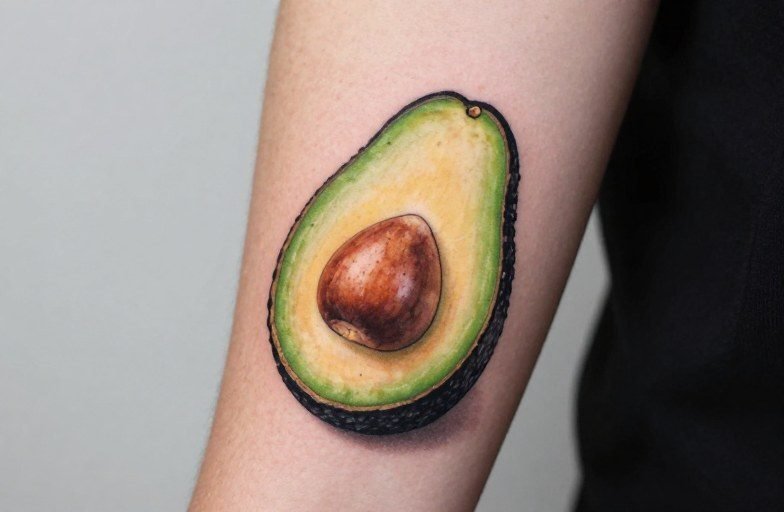
An avocado tattoo most commonly signals nourishment, growth, and the quiet pride of taking care of yourself. The fruit’s distinctive shape, pear-like, with a central pit, lends itself to both minimalist linework and detailed color pieces. Its modern cultural baggage runs deep too: millennial shorthand, wellness culture, and a certain dry humor about being “basic” in the best way.
Symbolism & Core Meaning
The Pit and the Flesh
The avocado’s anatomy carries its own visual language. The large central seed reads as potential, something buried that becomes a tree. Surrounding it, the soft green flesh suggests vulnerability held together by a tougher outer skin. Some choose to show the fruit split open, pit exposed, as a metaphor for emotional openness. Others keep it whole, emphasizing self-protection and wholeness.
Regional and Cultural Threads
Native to Mesoamerica, the avocado (ahuacatl in Nahuatl) carries associations with fertility and abundance in Mexican and Central American traditions, though these connections are often linked to rather than definitively proven. The Aztec symbol for avocado remains a recognizable motif in Chicano tattooing, sometimes blended with calavera or floral elements. Modern wearers with Mexican heritage sometimes use the fruit as a quiet cultural anchor, distinct from more common iconography like sugar skulls or eagles.
How It Ages on Skin
Color Realities
That creamy green-yellow gradient? It faces real challenges over time. Lighter yellow-greens fade fastest, often shifting toward a dull olive or muddy brown within five to eight years. Darker forest greens hold better but can blur at edges. Solid black linework defining the shape preserves readability longest. If you want color, plan for touch-ups or accept the muted version as part of the piece’s life.
Line vs. Shading
Single-needle or fine-line avocados look crisp initially but suffer disproportionately. The fruit’s smooth curves require consistent line weight; wavering looks like a mistake, not style. Traditional bold outlines with limited color packing age more gracefully. Stippled texture for the flesh’s interior can create interesting shadow without relying on color saturation that won’t last.
Best Placements
The avocado’s natural proportions suit certain body contours better than others. The elongated pear shape follows muscle and bone in ways that either complement or fight the form.
- Forearm, outer: The classic. Vertical orientation follows the radius naturally. Easy to show or cover. Space for a small stem or leaf extending toward the elbow.
- Ribcage, floating: Follows the curve between ribs. The pit sits near a natural hollow. Painful, but the shape nests well.
- Upper thigh, front or outer: Ample canvas for detail or for pairing with other food/fruit elements. Less sun exposure preserves color.
- Behind the ear: Miniature versions work here if the artist simplifies aggressively, outline only, perhaps a tiny leaf. Anything more becomes illegible.
- Ankle or wrist: Horizontal placement required. Can feel cramped unless scaled down significantly. The pit becomes a dot; the shape risks reading as generic teardrop.
Avoid wrapping the design around cylindrical areas (wrist circumference, upper arm) unless the artist accounts for distortion. The avocado’s asymmetry looks wrong when twisted.
Design Tips & Pairings
Complementary Elements
Toast transforms the avocado into a specific cultural reference, the “avocado toast” phenomenon, sometimes worn ironically, sometimes sincerely as a marker of simple pleasure. Knives, particularly vintage chef’s knives, add domestic craft or culinary profession. Leaves and branches push toward botanical illustration, more serious and less pop-culture. Hearts, either held in the fruit’s center or replacing the pit, work for couples who share a love of cooking or a specific memory involving the fruit.
Style Variations
American traditional handles the avocado surprisingly well: bold black outline, limited green palette, maybe a banner with text. Japanese neotraditional can incorporate it as a still-life element among other foods or flowers. Fine-line and single-needle dominate current trends but require extra care in aftercare and sun protection. Blackwork stippling creates texture without color dependency. Watercolor, despite its popularity, struggles here, the avocado’s form needs structure, and bleeding color without outlines often dissolves into unrecognizable shape.
Similar & Related Symbols
The pomegranate shares the split-fruit, seed-revealing vocabulary but carries older, more mythic weight, Persephone, fertility, death and rebirth. Choosing avocado over pomegranate usually signals modernity, humor, or personal specificity over archetypal resonance. The lemon or lime offers similar bright color and food-culture reference but lacks the avocado’s particular body-positive, self-care associations. The peach has overtaken it in some internet slang contexts, but the avocado retains more nutritional, less purely sexual connotation.
Botanical tattoos generally, ferns, monstera leaves, eucalyptus, share the wellness-aesthetic territory. The avocado distinguishes itself by being a fruit, something consumed and internalized, rather than purely decorative plant matter. This makes it more intimate, more about what you take in and make part of yourself.
Personal & Modern Meanings
Beyond the broad symbolism, people arrive at avocado tattoos through specific, often unglamorous paths. Recovery from eating disorders sometimes involves reclaiming foods as nourishment rather than threat, the avocado, with its “healthy fat” cultural status, becomes a marker of permission to eat. Chronic illness communities use it as in-group recognition, sometimes paired with spoons (referencing Spoon Theory) or other disability symbols.
The ironic deployment matters too. Getting an avocado tattoo because it’s “basic” demonstrates awareness of the critique and refusal to be shamed by it. It’s a particular kind of millennial and Gen-Z humor: self-deprecating, culturally literate, unwilling to abandon pleasure because it’s mocked. Some pair it with text, “extra,” “ripe,” “not yet”, that plays on the fruit’s ripeness window as metaphor for personal timing or emotional state.
What to Remember
An avocado tattoo works best when the specific meaning is clear to you, even if invisible to others. The design’s success depends heavily on the artist’s handling of curves and color longevity, this is not a forgiving shape for beginners. Green ink fades and shifts; plan for that reality. Placement should respect the natural vertical orientation unless you’re deliberately subverting it. Most importantly, the avocado occupies a specific cultural moment; whether that moment endures or dates the piece is a choice you make by getting it. The fruit itself has existed for millennia. Your reason for wearing it is what matters.
Frequently Asked Questions
Does an avocado tattoo always mean something about healthy eating?
No. While nutrition and wellness are common associations, people choose this design for cultural heritage, irony, recovery milestones, or purely aesthetic reasons. The meaning depends on your personal context, not a fixed dictionary definition.
How much detail can you realistically fit in a small avocado tattoo?
Very little at under two inches. The pit becomes a simple circle, the flesh a single color or outline gap. For finger-sized or behind-the-ear placements, strip down to silhouette or outline-only to preserve any recognizable structure over time.
What green inks last longest in avocado tattoos?
Deeper forest and emerald greens outlast yellow-greens and lime shades. Blue-based greens tend to stay truer than yellow-based ones. Your artist can recommend specific brands with better longevity, but all greens require more frequent refresh than black or red.
Can an avocado tattoo work in all-black ink?
Absolutely. Blackwork and grayscale versions rely on texture and negative space to suggest the flesh’s interior. Crosshatching or stippling where the green would be, solid black for the skin, and clean outline make for a striking, long-lasting piece without any color at all.
Related Tattoo Meanings
- Axe Tattoo Meaning: Symbolism, Design Placement Guide
- Ballerina Tattoo Meaning: Grace, Discipline, and Hidden Strength
- Band Aid Tattoo Meaning: Healing, Humor Heart
- Explore more









