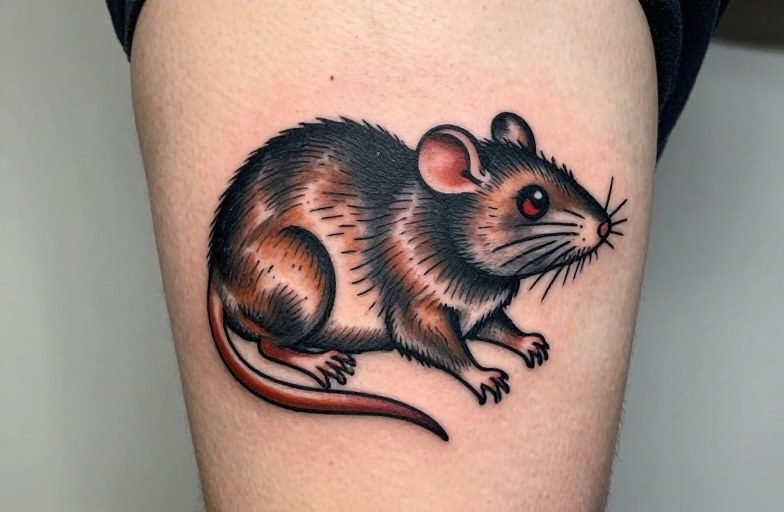
The American traditional rat tattoo follows the rules of the broader style: thick black outlines, saturated color limited to red, yellow, green, and black, minimal shading through whip shading or solid color blocks, and imagery that reads clearly from across a room. The rat itself gets rendered with rounded ears, prominent whiskers, a naked tail curling with movement, and often cheese, daggers, or banners worked into the composition. What separates a good one from a forgettable one is how well the artist respects the constraints of the style while giving the animal actual personality.
Cost and Sessions
What Drives the Price
Most American traditional rat tattoos fall between palm-sized and dinner-plate sized. A clean single rat with no background, running 3-4 inches, typically takes one session of two to three hours. Add a dagger through it, a banner with lettering, or a moon-and-cheese background, and you are looking at three to four hours minimum. Hourly rates vary dramatically by city and shop reputation, anywhere from $150 to $400 per hour is standard in major US markets. Flat rates for simple designs exist but are less common for custom work.
The real cost factor most people miss: design complexity that violates traditional conventions. A rat rendered with photorealistic fur texture, subtle color gradations, or tiny details between toes will take longer, cost more, and age worse. Artists who specialize in this style often steer you toward bolder, simpler solutions because they know what holds.
Session Planning
- Small rat (2-3 inches, no background): 1 session, 1.5-2 hours
- Medium rat with banner or small prop: 1 session, 2.5-3.5 hours
- Large rat with full background, multiple elements: 2 sessions, 4-6 hours total
- Cover-up or scar integration: add 30-50% time
Booking a separate consultation for larger pieces is standard practice. Bring reference images of rats you like the posture of, not just tattoo photos. A good artist will redraw from animal reference rather than copy another tattoo.
How It Ages
The Five-Year Reality
American traditional work is built to age. The heavy black outline acts as a fence, keeping color from migrating outward. Solid color blocks hold better than delicate stippling or fine lines. A traditional rat tattoo at five years should still read as a rat from ten feet away, the ears distinct, the tail’s curl visible, the whiskers present if not razor-sharp.
Where it fails: thin tail lines that were not packed with enough black, whiskers drawn too fine, or grey wash shading used instead of solid black or color. The tail especially is a vulnerability point. Artists sometimes render it too thin to be elegant, and within a few years it becomes a blurry string.
Color Longevity
Red holds well in traditional palettes. Yellow fades fastest but remains visible against black outlines. Green settles into a softer, sometimes blue-tinged version of itself. Black stays black. The cheese prop common in rat designs, usually yellow, will need touch-up attention before the rat itself does. Sun exposure accelerates everything; a forearm rat sees more degradation than a thigh rat in the same person.
Color vs Black and Grey
When Color Works
The classic American traditional rat uses color: red eyes, green background accents, yellow cheese, maybe a red banner. Color gives the composition its poster-like impact. It also fits the historical context, sailors and working-class collectors wanted visible, legible work that did not blend into skin tone.
Color demands more skin real estate to be effective. A tiny all-color rat becomes mud. The minimum effective size for a colored traditional rat is roughly 3 inches in the longest dimension, with 4+ preferred if you are adding secondary elements.
Black and Grey Adaptations
Black and grey traditional is a legitimate sub-style, though less common for rats specifically. It relies on heavy black fill, negative space for highlights, and occasionally grey wash for subtle depth. The same rules apply: bold outlines, readable silhouette, no photorealistic fur texture. A black and grey rat can work beautifully on darker skin tones where color saturation struggles, or for collectors building a cohesive black and grey traditional sleeve.
The trade-off: without color, the rat reads more menacing, less cartoonish. The cheese prop becomes less legible. Artists often substitute a skull or hourglass for cheese when working black and grey, maintaining the memento mori tradition.
Origins and History
Naval and Folk Roots
The American traditional style coalesced in the early-to-mid 20th century through artists working in port cities, often linked to naval culture. Rats appeared in this vocabulary through multiple channels: sailors living with actual shipboard rats, the Chinese zodiac’s rat symbolism carried by immigrant communities, and broader European folk traditions where rats represented cunning, disease, or survival against odds.
Some trace rat imagery specifically to the rat lines of naval rope work, or to the practice of tattooing one’s ship mascot. The connection is suggestive rather than documented. What is certain: by the 1960s, rats appeared regularly in flash sheets alongside daggers, hearts, and panthers, rendered with the same bold simplicity.
Modern Revival
The 1990s and 2000s revival of traditional tattooing brought renewed attention to animal subjects previously considered filler or novelty. Contemporary artists like Bert Krak and Virginia Elwood have pushed rat compositions into more dynamic territory: leaping poses, interaction with props, integration into larger scenes, while maintaining the technical constraints that define the style.
Linework and Technique
Outline Weight and Variation
A traditional rat lives or dies by its outline. The main body contour carries the heaviest line weight, often a 7 or 9 round liner, sometimes multiple passes to build a 3-4mm ridge. Internal details like fur texture, whiskers, and toe separation use lighter lines, but never below what will hold at five years. The tail typically gets a single heavy contour with minimal internal detail, since thin lines there blur fastest.
Line variation creates visual hierarchy. The eye should travel: body silhouette first, then facial features, then tail movement, then props. An experienced artist controls this through deliberate line weight decisions, not by making everything equally bold.
Whip Shading and Solid Fill
Traditional shading is almost always whip shading, quick oscillating needle movements creating a gradient from saturated to empty. On a rat, this appears in subtle belly rounding, shadow under the chin, or depth around the eye socket. It is fast, efficient, and ages into a soft grey that still reads as dimensional.
Solid color fill demands saturation without overworking the skin. Cheese is particularly tricky: too light and it heals patchy, too heavy and it scars. The best cheese in traditional rat tattoos uses a warm yellow packed to consistent opacity, with a thin black bite mark or shadow line where the rat meets it.
Best Placements
High-Visibility Options
Forearms and calves offer the flat, stable surfaces that traditional work prefers. A rat on the outer forearm, facing forward with tail curling toward the elbow, reads correctly when the arm is at rest. Calf placement allows larger compositions, rat plus banner plus moon, without wrapping into painful territory.
Hands and fingers are technically possible but problematic. The small scale forces detail reduction that can make the rat indistinct. Knuckle rats specifically blur rapidly due to movement and sun exposure. If you want hand-adjacent work, the side of the hand near the thumb or the web between thumb and index accepts a small rat profile better than top-of-finger placement.
Torso and Larger Work
The thigh offers space for dynamic poses: rat rearing, rat with spread paws, rat climbing a rope or dagger. Ribs and stomach allow vertical compositions but hurt more and stretch with weight fluctuation. A chest rat, centered or off to one side, works well as part of a larger traditional chest piece developing over multiple sessions.
Back of the arm and back of the calf are underrated placements. The slight curve gives the rat a natural environment, and these spots age better than sun-exposed areas. Avoid placing the tail where it will wrap into a crease: elbow ditch, back of knee, armpit. The constant movement destroys fine tail lines.
Aftercare Considerations
Healing the Details
Rat tattoos present specific aftercare challenges. The whisker lines, often the finest marks in the design, are prone to falling out during the first heal if you over-moisturize or let clothing rub them. The tail tip, frequently placed near a joint or edge, catches on sheets and scabs thicker than the surrounding work. Plan your clothing around the placement: loose sleeves for forearm rats, shorts rather than jeans for fresh thigh work.
Cheese yellow is also vulnerable during healing. It sits lighter in the skin and can appear to disappear under plasma and scabbing before re-emerging at three weeks. Do not panic-touchup. Wait the full six to eight weeks, then assess.
Long-Term Maintenance
Traditional rat tattoos need sun protection like any other work, but the yellow cheese and green background accents show damage first. A faded traditional rat still reads because of its black outline, yet the color loss flattens the image. Plan for touch-ups at year five to eight, sooner if you work outdoors or swim frequently. Chlorine and salt water both accelerate yellow degradation.
Choosing Your Artist
What to Look For
Not every artist who works in American traditional handles animals well. Some excel at daggers and banners but render rats as generic blobs with ears. Look for healed photos specifically, not just fresh work. A rat’s personality comes through in the eye placement, the ear angle, the tail’s energy. If the artist’s portfolio shows ten panthers and one rat, ask directly about their comfort with the subject.
Flash availability matters too. Many shops carry classic rat flash, either vintage reproductions or modern interpretations. Working from established flash does not mean unoriginal; it means participating in a living tradition. Custom work should still feel like it could have lived on a 1960s flash sheet.
Red Flags
Be cautious of artists who suggest photorealistic fur, watercolor backgrounds, or geometric framing around a traditional rat. These violate the style’s constraints and age poorly. Similarly, watch for proposals to place a tiny rat, under 2 inches, in full color. The pigments will merge within years. A responsible artist will tell you no when your idea breaks the rules that make this style durable.
The Bottom Line
An American traditional rat tattoo succeeds when it honors the style’s constraints while finding room for character. The bold outline, limited palette, and readable silhouette are not limitations to escape; they are the architecture that lets the work last decades. Your rat should look like it belongs on a sailor’s forearm in 1950 and still hold its own in a modern shop today.
Start with placement and size that respect the design. Budget for an artist who specializes in this specific vocabulary, not someone who dabbles across ten styles. Bring animal reference, not just tattoo photos, and trust the artist to translate into traditional language. The best rat tattoos feel alive without being realistic, bold without being crude, traditional without being copied. That balance is worth waiting for the right hand.
Frequently Asked Questions
How much does an American traditional rat tattoo typically cost?
Expect $150-$400 per hour depending on your city and the artist’s reputation. A simple 3-inch rat takes 2-3 hours. Adding banners, daggers, or backgrounds pushes most pieces to 3-4 hours minimum. Flat rates exist for flash designs but are less common for custom work.
What is the best placement for a traditional rat tattoo?
Forearms and calves offer flat, stable surfaces that age well. The thigh allows larger dynamic poses. Avoid finger and hand placements where small scale forces detail loss, and avoid wrapping the tail into creases like the elbow ditch or back of knee where movement destroys fine lines.
How long does an American traditional rat tattoo last before needing touch-up?
With proper care, the black outline and red should hold 5-8 years clearly. Yellow cheese fades faster and may need attention first. Sun exposure accelerates all fading; expect earlier touch-ups for forearm or hand placements versus covered areas like thigh or upper arm.
Can a traditional rat tattoo work in black and grey?
Yes, though it is less common. Black and grey adaptations work well on darker skin tones or for collectors building cohesive sleeves. The trade-off is a more menacing, less cartoonish feel, and cheese props become less legible. Artists often substitute skulls or hourglasses for cheese in black and grey pieces.
What makes a traditional rat tattoo age poorly?
Thin tail lines without enough black packing, whiskers drawn too fine, photorealistic fur texture, and grey wash shading instead of solid color or black all blur faster. The tail is especially vulnerable; it should have a single heavy contour with minimal internal detail.