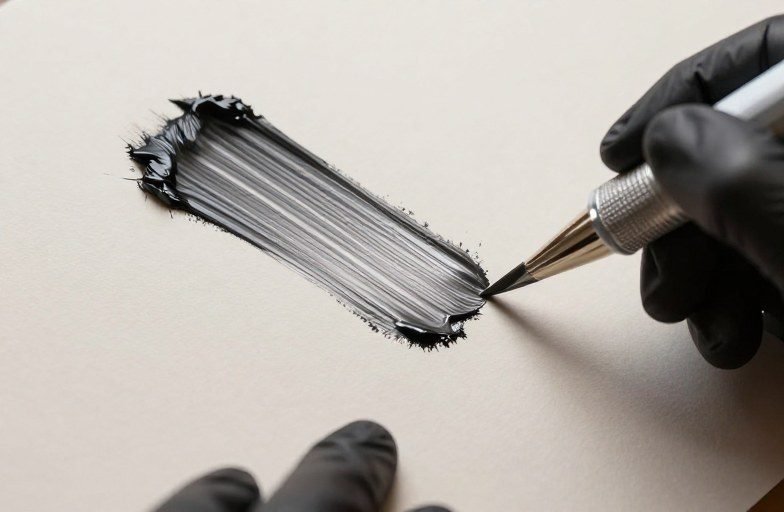
A paint stroke tattoo mimics the loose, gestural marks of a loaded brush dragged across canvas, think visible bristle texture, pigment pooling at the edges, and that satisfying taper where pressure lifts. The style ranges from single bold slashes to full compositions built from layered color fields. Done well, it reads as spontaneous; done poorly, it looks like a smudge that won’t wash off.
The Direct Answer
Paint stroke tattoos work best when the design respects how actual paint behaves. The brush leaves the surface at an angle; pigment deposits unevenly; bristles split and create parallel tracks. Your artist needs to replicate these mechanics through needle grouping choices and deliberate hand speed variation.
What Makes the Style Convincing
Authentic paint stroke tattoos typically share these traits:
- Directional flow: Every mark has a clear origin and exit point, never floating arbitrarily
- Edge variation: One side shows crisp bristle marks; the opposite edge softens where paint thinned
- Value shifts: Darker saturation where pressure peaked, lighter where the brush lifted
- Negative space: The skin itself reads as the canvas showing through, not every gap filled
Single-needle work can render fine bristle striations. Magnum shaders build the soft, velvety gradients where colors blend wet-into-wet. The best pieces combine both.
Where This Style Lives on the Body
Forearms and calves offer flat planes that let strokes read as continuous gestures. Ribs and shoulders introduce curvature that can distort straight marks, sometimes used intentionally, sometimes a pitfall. Small paint strokes behind the ear or on the wrist work as discrete accents; large back pieces allow for full compositional drama with overlapping layers.
Black and grey paint strokes age more predictably than color. Blues and greens hold reasonably; reds and yellows fade faster and require more frequent refresh sessions. Watercolor-adjacent pieces, where paint strokes bleed into soft washes, need especially careful planning since those pale washes can disappear into skin tone within five years.
Common Mistakes
Design-Level Errors
Overcomplication kills this style. A dozen competing strokes with no hierarchy looks muddy, not dynamic. The eye needs a dominant mark and supporting elements. Another frequent error: choosing “paint stroke” as a cover-up strategy. The style’s transparency and deliberate thin edges make it terrible for hiding existing ink unless the old tattoo is extremely faded.
Color selection trips people too. Neon or highly saturated tones that look striking on day one often heal to something harsher than intended. Muted, slightly greyed pigments, like actual tube paint mixed with a touch of white, settle more gracefully.
Technical Execution Pitfalls
- Uniform opacity: Real paint varies in density; tattooing every stroke at identical saturation reads flat
- Symmetrical placement: Perfectly mirrored strokes look designed, not painted, introduce slight variation
- Ignoring skin undertone: Cool pink skin shifts blues purple; warm golden skin can push greens muddy
- Scaling too small: Fine bristle detail below two inches wide often heals to indistinguishable texture
Some artists default to their standard whip-shading technique without adjusting for the specific look of loaded-brush behavior. Ask to see healed examples specifically, not fresh photos where saturation reads artificially high.
What to Expect Step by Step
Consultation and Design
Bring reference images of actual paint strokes, not other tattoos. Photographs of oil paint, acrylic drag, or even ink wash on rice paper communicate more than Pinterest screenshots. Discuss whether you want the “wet paint” look (glossy, saturated, edges slightly bleeding) or “dry brush” (scratchy, broken, textured). These require different technical approaches.
Stenciling for paint stroke pieces often uses multiple transfer layers, one for the main gesture, another for secondary marks, since the composition relies on spatial relationships between elements.
The Tattoo Session
Expect longer sessions than comparable-sized traditional work. Building soft gradients that read as pigment pooling takes passes at varying depths and speeds. A palm-sized paint stroke might take two hours where a solid black graphic of the same size takes forty minutes. The artist works wet wipes frequently to check value relationships as pale tones disappear against blood and vaseline.
Pain varies by placement but tends toward moderate. The repeated wiping and multiple passes over soft gradients can make areas feel more irritated than single-pass line work.
Aftercare Essentials
Paint stroke tattoos with significant soft shading or color fields require disciplined aftercare. The palest areas, where the design reads as thin paint or canvas showing through, are most vulnerable to healing unevenly.
- First 48 hours: Keep the bandage on as directed, typically 2-6 hours. Wash gently with unscented soap, pat dry with clean paper towel, never rub.
- Days 3-7: Thin layer of recommended aftercare product, 2-3 times daily. Over-moisturizing traps plasma and can lift pigment from soft gradients.
- Week 2 onward: Peeling begins; color fields often shed in larger flakes than linework. Do not pick. Let skin exfoliate naturally.
Clothing matters more than with line-heavy pieces. Tight fabrics that rub across a fresh paint stroke tattoo on the thigh or ribs can pull scabs from soft-edged areas. Loose, breathable layers for the first ten days.
Healing Timeline
Week by Week
Week 1: Redness and swelling subside. The tattoo looks darker and more saturated than intended, this is normal. Pale washes may seem to disappear entirely beneath scabbing.
Weeks 2-3: Peaking and flaking. The design looks terrible: patchy, dull, possibly scabbed in areas. This is the standard “ugly phase.” Resist panic and resist picking.
Weeks 4-6: Surface healing complete. The tattoo settles to its true values. Soft gradients re-emerge; the contrast between bold strokes and pale washes becomes readable again. This is when you can actually assess the piece.
Months 3-6: Full dermal settlement. Slight continued fading in the lightest passages. By month six, you know what your long-term relationship with this tattoo looks like.
Touch-Up Reality
Paint stroke tattoos with watercolor-style elements frequently need touch-ups at 6-12 months. The palest washes are simply technically difficult to implant permanently. Budget for this possibility; many artists include one touch-up in their initial pricing, but confirm explicitly.
Cost Factors
Pricing reflects the technical complexity. Single bold black strokes in a small size might fall within a shop’s minimum ($80-150 in most US markets). Full color compositions with layered transparency run hourly.
- Artist specialization: Those known for painterly work command premium rates, often $150-250/hour in major cities
- Session length: Complex pieces rarely complete in one sitting; factor travel and time costs
- Color count: Each additional pigment requires setup, cap space, and needle changes
- Size-to-detail ratio: Tiny, highly detailed paint strokes paradoxically take longer than larger simple ones
Be wary of unusually low quotes. Convincing paint texture requires experience; bargain pricing often means the artist is learning this specific style on your skin.
What to Remember
Paint stroke tattoos occupy a tricky space between representation and abstraction. They succeed when the gesture feels intentional and the technique invisible, when viewers see paint first, tattoo second. Choose an artist with demonstrated healed results in this specific style, not just general “watercolor” or “abstract” work. Commit to the aftercare that pale gradients demand. And embrace the possibility that this style, more than most, may need future refinement to maintain its intended effect.
Frequently Asked Questions
Do paint stroke tattoos fade faster than other styles?
The boldest strokes hold similarly to solid blackwork, but pale washes and soft color fields fade noticeably faster. Plan for potential touch-ups, especially in pieces with significant “canvas showing through” negative space.
Can a paint stroke tattoo be purely black and grey?
Absolutely. Sumi-e ink wash traditions translate beautifully to tattooing, and black grey paint strokes often age more gracefully than color. The key is still capturing pressure variation and bristle texture.
How do I find an artist who actually specializes in this?
Request healed photos specifically, fresh paint stroke tattoos look dramatically different. Look for consistent directional flow in their portfolio, not just random splatters. Ask how they approach needle grouping for bristle texture.
Will the soft edges blur over time?
Some spreading is inevitable with any soft-edged tattoo, but proper depth control during application minimizes this. Well-executed paint stroke tattoos maintain readable edge variation for years; poorly executed ones can indeed become indistinct blobs.
Related Tattoo Guides
- How to Draw Tattoo Flash: A Practical Guide for Artists
- How to Print Tattoo Stencils: A Practical Guide
- Is Hustle Butter Good for Tattoo Aftercare?
- Explore more