American traditional animal tattoos are the backbone of every shop I’ve worked in. Walk into any reputable place from Portland to Philly, flip through the flash sheets on the wall, and you’ll see them, snakes coiled around daggers, roaring tigers, swallows in flight, bears standing on hind legs. This style, born in the early 1900s among sailors and soldiers, has rules that keep it readable and bold for decades. I’ve tattooed these designs on biceps, chests, thighs, and forearms for fifteen years, and the same principles apply every time: thick black outlines, limited color saturation, and imagery that reads instantly from across a room. No fine-line whispering. No watercolor bleeding. Just solid, honest tattooing that holds.
Origins & History
The style didn’t emerge from a vacuum. Sailor Jerry, Bert Grimm, Cap Coleman, these were working artists in Honolulu and Norfolk who needed to tattoo fast, heal fast, and create something a guy could show his grandkids without embarrassment. Animals carried specific meanings in that culture. A swallow meant 5,000 nautical miles traveled. A pig and rooster on your feet supposedly kept you from drowning. A shark meant you’d survived a shipwreck or attack. The imagery was functional, not decorative.
From Sailors to Civilians
By the 1950s and 60s, the style migrated inland. I tell clients that the same eagle their grandfather might have gotten at a dockside shop in ’52 is spiritually identical to what we do today. The machines improved, coils to rotaries, now often cartridges, but the visual language stayed locked. That’s the point. American traditional is conservative by design. It resists trendiness because it works.
Shop Culture & Flash Sheets
In my chair, I keep a binder of classic flash. When someone says “traditional animal,” I pull it out. We see this a lot: clients pointing at a 40-year-old sheet, asking for “something like that but mine.” The flash sheet isn’t a limitation. It’s a foundation. Good artists riff on it. Great artists honor it while making it breathe for the specific body in front of them.
Key Characteristics & Motifs
You can spot American traditional animals from across a convention floor. Here’s what defines them:
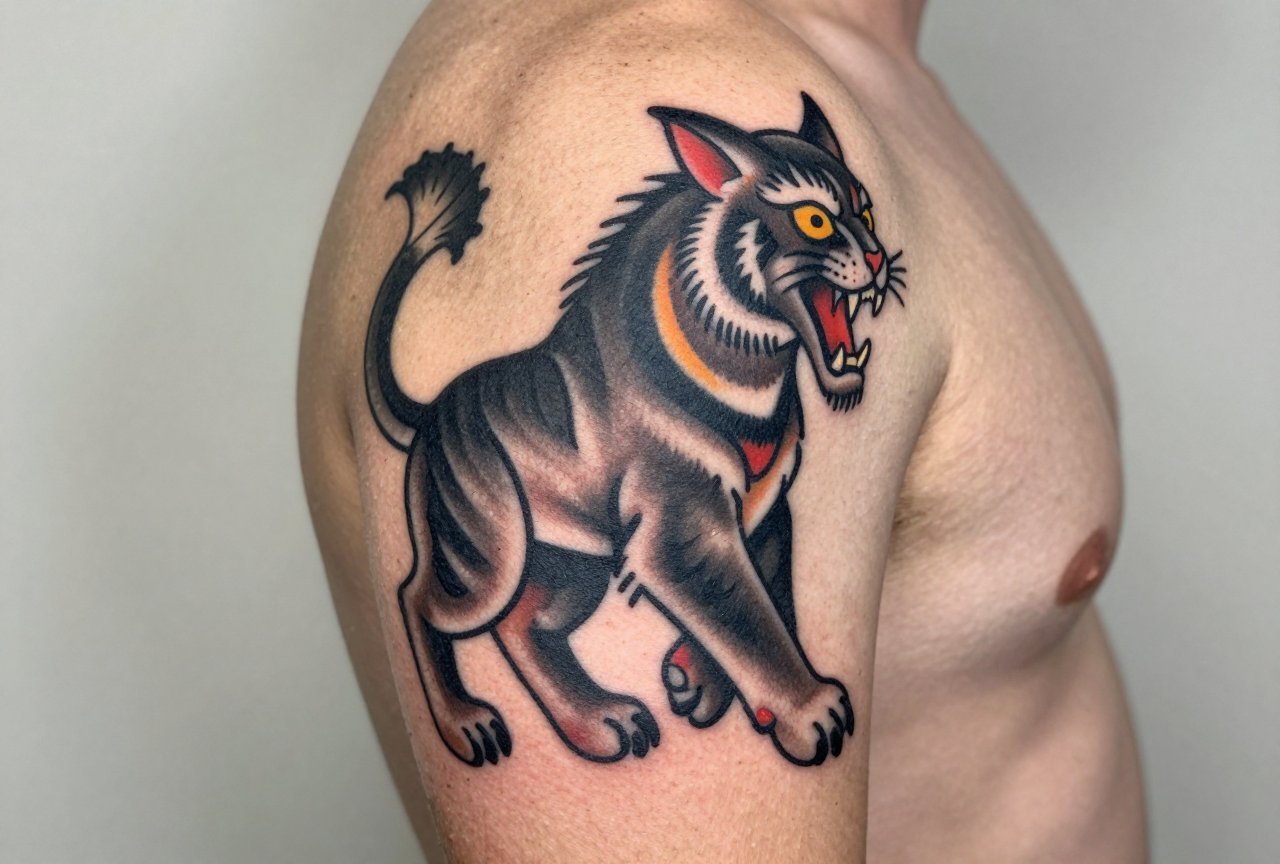
- Line weight: Thick, confident black outlines. Usually a 7 or 9 round liner, sometimes a 14 flat for bold areas. The line carries the design even if color fades.
- Color palette: Red, green, yellow, black. Sometimes navy blue or brown. No pastels, no gradients, no soft transitions.
- Shading: Sparse. “Whip shading” with loose, textured grays rather than smooth black-and-gray blends. The skin shows through.
- Subject matter: Animals in aggressive or symbolic poses, snakes striking, eagles descending, wolves howling, panthers crawling.
- Composition: Often framed with banners, roses, daggers, or geometric elements. The animal interacts with its surroundings rather than floating isolated.
I’ve done panthers crawling down forearms where every claw is a single bold line, no detail overworked. The magic is in the restraint. The eye fills in what the needle doesn’t.
Popular Animals & Their Meanings
Some animals dominate for good reason. They’ve been tested across thousands of skins and decades of fading:
- Snakes: Rebirth, danger, temptation. Often paired with skulls or apples.
- Tigers: Strength, ferocity. The striped pattern reads beautifully even with limited color.
- Swallows/Sparrows: Travel, loyalty, return home. Small enough for hands, bold enough for chests.
- Bears: Raw power, protection. The standing pose is iconic and fills large areas effectively.
- Sharks: Survival, fearlessness. The open mouth with rows of teeth is a classic composition.
- Wolves: Loyalty, wildness. Howling at moons or paired with feminine faces in the “wolf girl” tradition.
Color vs Black and Grey
This debate comes up weekly in my shop. American traditional is historically a color style. Those Sailor Jerry reds and greens weren’t optional, they were the point. But black and grey traditional has become legitimate, especially in the last twenty years.
Here’s my honest take: color traditional ages better if done right. The red stays readable longer than gray wash, which can muddy into blue-gray tones over time. But black and grey suits certain clients, darker skin tones where color saturation struggles, or people in professions where bright ink draws unwanted attention. I’ve done solid black and grey tigers that held beautifully for ten years because the line work was aggressive and the shading was minimal.
The trap is “soft” black and grey. Traditional needs bold. If you’re going monochrome, push the blacks darker, keep the grays sparse and textured. Otherwise you’re just doing a bad illustration tattoo.
Best Placements
American traditional animals demand real estate. These designs don’t shrink well. A two-inch swallow on a wrist loses its impact; the lines blur together, the color patches become indistinct. I steer clients toward placements that let the design breathe:
- Upper arm/shoulder: The classic. Room for a bear, eagle, or large snake to wrap. Heals well, ages slowly.
- Thigh: Underrated for animals. The flat muscle plane keeps lines straight, and you can go big, a full crawling panther, a coiled python.
- Chest: Centerpieces or symmetrical pairs. Two swallows facing each other, or a single eagle with spread wings.
- Forearm: Good for medium pieces. The visibility is high, which suits the bold style. But warn clients: forearms sun-fade faster.
- Back of calf: My sleeper pick. The skin is dense, holds saturation, and a crawling animal, panther, snake, tiger, follows the muscle flow naturally.
Hands and fingers? I do them, but I warn: traditional animals need to be simplified to the point of almost being symbols. A tiny wolf face on a finger becomes a blur in five years. Better to do a traditional dagger or simple rose there, save the animal for more canvas.
Who It Suits
American traditional animals aren’t for everyone, and I say that as someone who loves the style. The person who wants photorealistic fur texture or a delicate watercolor hummingbird will be disappointed. This is graphic design on skin. It suits people who want their tattoo to read immediately, who value longevity over trend, who aren’t afraid of boldness.
I tell first-timers: this is the safest style for your first tattoo. It heals predictably, it ages gracefully, and if you want to build a collection, traditional pieces talk to each other. A tiger on your arm and a snake on your leg share a visual language. They look intentional together in a way that random styles don’t.
It also suits collectors. The person with twenty traditional pieces has a coherent body. I’ve seen full sleeves built over decades, each animal telling part of a story, and the overall effect is stunning because the rules never changed.
Modern Variations
Purists will argue that any deviation kills the style. I disagree, but cautiously. The best modern traditional artists, think Rose Hardy, Bert Krak, Bryan Burk, push color palettes slightly, exaggerate proportions, or incorporate Japanese composition influences. But the skeleton stays intact: bold line, limited color, readable silhouette.
What I won’t do: blend traditional animals with realism, add geometric framing that fights the organic flow, or use neon colors that have no historical basis. I’ve had clients request “traditional but with purple and teal.” I explain: that’s not traditional, that’s something else, and it won’t age like the real thing. Sometimes they listen. Sometimes they find another artist. Both outcomes are fine.
Neo-Traditional vs True Traditional
Neo-traditional is the cousin who studied abroad. More colors, more detail, softer lines, often illustrative rather than graphic. It’s beautiful work. But when a client asks for “traditional,” I clarify which continent they mean. True American traditional animals are simpler, harder-edged, more permanent in their visual impact. Neo-traditional fades into something else; traditional fades into softer traditional. There’s a difference.
Choosing an Artist
This matters more than any other decision. A mediocre artist can ruin a traditional design by overworking it, too many lines in the fur, too many colors in the snake’s scales, shading that tries to be realistic rather than graphic. Look for artists whose portfolios show:
- Consistent, thick line work. No wobbles, no tapering into hairlines.
- Limited palettes used confidently. If they use twelve colors on a small piece, question it.
- Healed photos, not just fresh. Every tattoo looks bold at day three. The test is year three.
- Experience with the specific animal. A wolf specialist might struggle with the fluid curves of a traditional snake.
Ask in the shop. “Who here does the most traditional animals?” The answer reveals shop culture. In a good shop, artists will direct you honestly. I’ve passed clients to coworkers whose tiger game was stronger than mine. The client gets a better tattoo, the shop keeps its reputation, everyone wins.
Don’t bargain hunt. Traditional work requires time to build those solid lines and saturated color patches. A cheap traditional tattoo is a faded traditional tattoo in five years. I’ve covered enough botched bold work to know: the money you save upfront doubles in cover-up costs.
Final Thoughts
American traditional animal tattoos are the honest workhorse of our industry. They don’t pretend to be fine art, though they can achieve it. They’re meant to be seen, recognized, and endured. After fifteen years of putting snakes on biceps and eagles on chests, I still respect the discipline. The rules aren’t limitations. They’re what make the style outlast every trend that tries to replace it. If you’re considering your first traditional animal, find the right artist, pick a placement with room to breathe, and trust the process. The result will still look like a tattoo in thirty years. That’s more than most styles can promise.
Frequently Asked Questions
How long does an American traditional animal tattoo take to heal?
Most clients are through the worst of it in two weeks, with full settling around four to six weeks. The bold lines and solid color patches actually heal more predictably than fine work because there’s less skin trauma overall. Keep it clean, don’t pick, and trust the process.
Can I get a custom animal design in traditional style, or do I have to pick from flash?
Custom work is absolutely possible and common. The flash sheets are starting points, not prisons. A good artist will draw your specific animal, your dog, your spirit animal, using traditional proportions, line weights, and color rules. The style governs the execution, not the subject.
Why do traditional animal tattoos use so little shading compared to other styles?
Sparse shading keeps the design readable as it ages. Heavy black and gray blending can muddy over time, especially on skin that sees sun. Traditional whip shading creates texture without density, so the tattoo still pops at ten years when bolder work is essential.
Do American traditional animal tattoos hurt more than other styles?
The bold outlining can feel more intense moment-to-moment because the artist is running thicker needle groupings with more saturation. But traditional work is often faster than realism or heavy black and gray, so you’re out of the chair sooner. Pain is temporary; the line work is forever.
Related Style Guides
- Cowboy Traditional Tattoos: Complete Style Guide
- Japanese Black and Gray Tattoos: Complete Style Guide
- Korean Traditional Tattoos: Style Guide
- Explore more