
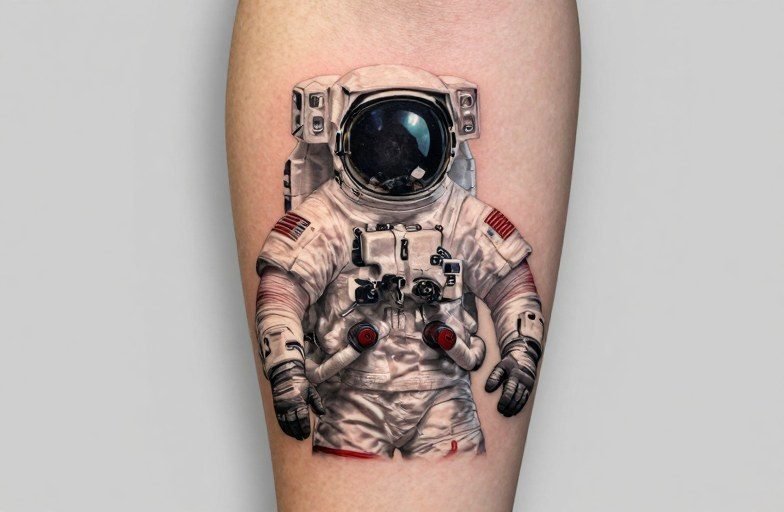
An astronaut tattoo most directly represents someone venturing into the unknown, often alone, with limited resources and no guarantee of return. The imagery carries weight because space itself is hostile: no air, no sound, no familiar ground. That figure in the suit becomes a stand-in for anyone pushing past comfort into uncertainty, career changes, recovery, creative risk, or literal travel. The meaning tightens or loosens depending on what’s shown: a floating body suggests isolation, a planting flag suggests conquest, a cracked helmet suggests vulnerability.
How It Ages on Skin
These designs live and die on detail. The astronaut suit has seams, joints, visor reflections, and life-support packs, elements that blur faster than you’d expect.
Line Weight and Helmet Clarity
Thin lines defining the suit’s edges soften within three to five years. A visor drawn with single-needle precision often becomes a grey smudge on the upper arm or calf, where fabric rubs and sun hits. Bold outer contours, think 9RL or heavier, hold the silhouette longer. Inside the helmet, keep it simple. A reflection of Earth, a skull, or a single star reads better at ten years than a full galaxy scene crammed behind glass.
Shading and White Ink
Soft grey-wash on the suit fabric creates depth but fades to flat tone. Solid black negative space (the void around the figure) stays readable decades out if packed properly. White ink for stars or suit highlights? It yellows or disappears entirely on most skin tones. Use it sparingly, and never as the only defining element in a small piece.
- Large designs with open black backgrounds age cleaner than busy, all-grey compositions
- Helmet visors work best as dark shapes with one or two sharp highlights, not gradients
- Tether lines, if included, need consistent thickness; wobbly cables ruin the technical feel
Design Tips & Pairings
The astronaut pairs naturally with imagery that contrasts scale or context. A tiny figure against a massive planet emphasizes insignificance. A skull inside the helmet turns exploration into memento mori. The suit itself is faceless, which makes it adaptable, you’re projecting onto blankness.
Popular Combinations That Actually Work
Geometric frames containing the figure give structure without clutter. Broken spacecraft or floating tools suggest failure or abandonment. Animals in suits (cats, dogs, octopuses) trend hard but date faster; they read as whimsical now, potentially cringeworthy later. More enduring: the astronaut reaching toward something just out of frame, a flower, a door, another person’s hand.
What to Avoid
Overloading the suit with real NASA logos or mission patches creates copyright issues and visual noise. American traditional versions with bold limited palettes hold up stylistically but lose the realistic loneliness that makes the image resonate. Photorealistic portraits of specific astronauts require enormous skin real estate and an artist who specializes in that tight, smooth grey-wash.
Best Placements
Vertical compositions suit the human figure naturally. Forearms, ribs, and outer calves give the height needed for a standing or floating astronaut without compressing proportions. Thighs and backs work for larger scenes with environmental context, planetary surfaces, station interiors, nebulae.
Hands and feet present problems. The suit’s cylindrical limbs distort across knuckles and ankle bones. A helmet alone on the kneecap or elbow can work as a small icon, but the full figure needs flat, stable skin. Chest pieces often split the figure awkwardly at the sternum; offset to one side if you want the torso.
- Upper arm to elbow: classic, easy to expand into a full sleeve later
- Side of thigh: flat plane, good for floating compositions with negative space
- Upper back, between shoulder blades: suits a solitary figure facing away, looking upward
Personal & Modern Meanings
Beyond the obvious explorer narrative, people choose this image for specific, private reasons. Someone who moved cities alone, started a business, or survived a period of disconnection recognizes themselves in the isolated suit. The figure is always enclosed, always dependent on technology, always one failure from death, yet still choosing to be there.
Mental Health and Burnout
The “empty suit” variation, figure intact, visor dark, no visible person inside, has become a quiet symbol for dissociation, depression, or the feeling of performing normalcy while disconnected. It’s less common than the triumphant flag-planting version, but more personally specific. Artists report this request increasing, often placed somewhere concealable.
Gender and the Suit
The astronaut figure is inherently androgynous. The suit erases body markers, which appeals to people who want symbolic imagery without gendered expectations. Some add subtle cues, flowing hair outside the helmet, specific body proportions, but the default neutrality is part of the draw.
Religious & Spiritual Angles
Space imagery overlaps with spiritual seeking in ways that aren’t always explicit. The astronaut as pilgrim, the void as the unknown divine, the return to Earth as rebirth, these readings don’t require religious iconography to function.
Cosmic Christianity and Beyond
Some trace the astronaut’s spiritual resonance to mid-century space-age theology, where the heavens were literal and exploration was framed as fulfilling dominion. More commonly today, the figure represents existential confrontation: facing infinity without fixed answers. Crosses, halos, or prayer hands inside the helmet happen, but they’re specific to the wearer’s framework rather than universal symbolism.
Eastern interpretations sometimes cast the floating figure as meditative, untethered, breath-controlled, suspended in non-action. The suit’s life support becomes a metaphor for prana or chi, sustained by unseen systems.
Color vs Black and Grey
This choice changes the emotional temperature completely.
Black and Grey
The default for serious, melancholic, or documentary-style pieces. The moonscape reads as harsh, unforgiving. Earth tones in the suit fabric (olive drab, rust, dust) can be suggested through warm grey washes. Photorealistic black and grey demands a large scale; at smaller sizes, go illustrative with stronger blacks.
Color
Teal and orange nebulae behind a dark suit create immediate visual pop. The NASA palette, red, white, blue, silver, reads patriotic or nostalgic depending on context. Full color suits rarely look realistic; they lean comic or retro-futuristic. One effective compromise: black and grey figure with a single color element (a red rose, blue Earth, gold visor reflection) that becomes the focal point.
- Watercolor backgrounds: trendy, but the loose style fights the technical precision of the suit
- Biomechanical color (exposed tubes, organic matter): shifts the meaning toward body horror or transhumanism
- UV-reactive ink for stars: gimmicky, unreliable long-term, most artists discourage it
Final Thoughts
The astronaut endures because it’s flexible without being empty. The suit is protection and prison. The void is possibility and annihilation. The figure is anonymous yet specific, anyone can see themselves there, but the choice to be there matters. If you’re considering this design, interrogate what version you want: the triumphant pioneer, the lost wanderer, the empty shell, the hopeful reach. That decision shapes placement, scale, color, and whether the image still resonates when the trend passes. Good tattooing starts with honest answers to those questions.
Frequently Asked Questions
Does an astronaut tattoo always mean someone wants to go to space?
Not at all. Most people who choose this imagery have no aerospace connection. The astronaut functions as a metaphor for isolation, ambition, or navigating unfamiliar territory, experiences that apply far beyond literal space travel.
Why do so many astronaut tattoos show a dark or empty visor?
The dark visor removes identity, making the figure universal. It also creates unease, you can’t see if anyone’s inside, which resonates with feelings of dissociation, anonymity, or the unknown aspects of oneself.
How big does an astronaut tattoo need to be to hold detail?
For a full figure with readable suit elements, plan on at least five to six inches in height. Smaller than that, and you’re looking at a helmet icon or simplified silhouette rather than a detailed composition.
Is the astronaut tattoo trend going to age poorly?
The imagery has been steady since the 1960s and resurges with each space milestone. Avoid overly trendy additions like specific meme references or excessive geometric framing, and the core symbol remains durable.
Related Tattoo Meanings
- 10Th Planet Tattoo Meaning: Jiu-Jitsu Loyalty Rebellion
- Avocado Tattoo Meaning: Growth, Health Modern Wit
- Axe Tattoo Meaning: Symbolism, Design Placement Guide
- Explore more









