
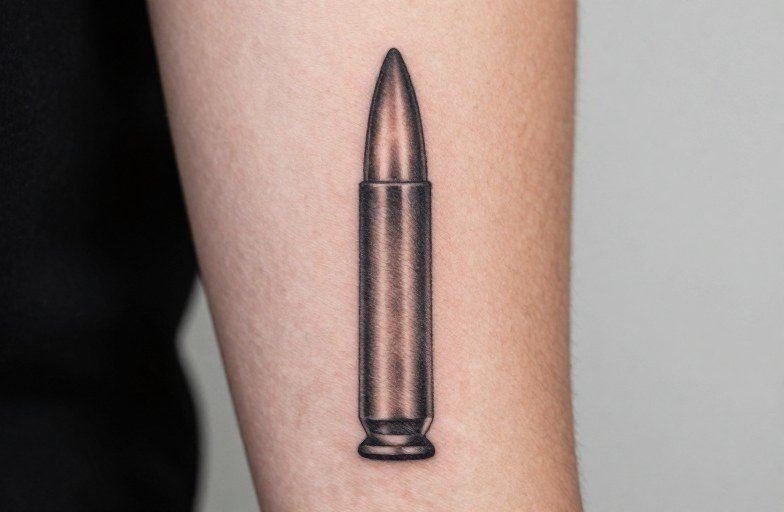
A bullet tattoo most commonly signals force, finality, and the unstoppable momentum of a single moment. Depending on context, it can speak to survival, military service, a brush with mortality, or simply an affinity for the mechanical aesthetics of ammunition. The meaning sharpens or softens dramatically based on whether the bullet is depicted intact, spent, embedded in flesh, or paired with other imagery.
Symbolism & Core Meaning
The bullet compresses several potent ideas into a small, recognizable form. Its symbolism operates on multiple registers, from the literal to the philosophical.
Kinetic Energy and Irreversibility
A bullet in flight represents something that cannot be called back. This makes it a frequent choice for memorial pieces marking a point of no return, a death, a deployment, a life-altering decision. The casing left behind carries a different weight: the spent shell suggests aftermath, residue, the hollow cost of action. Artists often render the shell with visible firing-pin impressions to emphasize this spent quality.
Protection and Aggression
The same object reads as defensive or predatory depending on presentation. A single bullet worn on the forearm or ribs can function as talismanic armor. Clustered ammunition, magazines, or bandoliers tilt toward aggression or military identity. The line between these readings is placement and quantity: one bullet whispers, a loaded magazine shouts.
Design Tips & Pairings
Effective bullet tattoos leverage the object’s natural geometry, cylindrical body, tapered tip, rimmed base, against the curves of human anatomy.
Placements That Work
- Outer forearm: The bullet’s length follows the bone structure; easy to read at a glance.
- Ribcage: Vertical placement between ribs echoes the body’s own architecture; painful but dramatic.
- Behind the ear: Small-caliber rounds work here; the location’s intimacy suits personal memorials.
- Hand or finger: Demands simplicity; best as black silhouette or minimal linework due to ink migration in high-wear zones.
- Chest over heart: Classic for military or protective symbolism; pairs naturally with dog tags, names, or dates.
Common Pairings and Their Shifts in Meaning
Bullets combined with roses or clocks soften toward “time running out” or “beauty and violence.” Crossed with a dagger, the tone turns militant. A bullet piercing a skull or heart is straightforward memento mori. Some clients request a bullet with a specific caliber marking visible.45, 7.62.50 BMG, which grounds the piece in personal history rather than generic toughness.
Line weight matters. Heavy black outlines read graphic and bold; fine single-needle work approaches technical illustration. Shading along the casing’s cylindrical body creates metallic roundness, while flat black treatment reduces the object to symbol rather than replica.
Color vs Black and Grey
The bullet’s metallic nature makes it a natural fit for black and grey, but color opens specific avenues.
Black and Grey Realism
Most bullet tattoos live in this territory. Smooth gradients on the casing suggest brass, nickel, or steel. White ink highlights for reflections can pop dramatically on medium skin tones, though they tend to yellow or disappear within 5-8 years. Artists typically use whip shading or soft mag work for the body, with tighter lines for engraved text or caliber stamps.
Color Applications
- Copper/brass tones: Ground the piece in specific ammunition types; adds warmth without cartoonishness.
- Red: Usually reserved for blood, roses, or trailing motion lines; use sparingly or it overwhelms the metallic subject.
- Patina greens: Suggest age, corrosion, something buried or recovered, effective for “survivor” narratives.
- Flag colors: Wrapping the casing in thin stripes or placing it against a flag background; common for veteran pieces but risks cliché if overdone.
Color saturation in bullet tattoos faces accelerated fading on sun-exposed placements. The forearm, in particular, will need touch-up attention to maintain brass tones or crisp red accents.
Mythology & Folklore
Projectiles carry supernatural weight across cultures, though direct “bullet folklore” is relatively modern given the object’s recent invention.
Silver Bullets and the Supernatural
The silver bullet is often linked to European werewolf lore, though this association crystallized largely in 20th-century film rather than deep folk tradition. Earlier folklore favored silver generally, coins, blades, as protective against dark forces. The bullet form became dominant with the gun’s cultural ascendancy. Some trace the silver bullet’s specific werewolf connection to Curt Siodmak’s 1941 screenplay for The Wolf Man, not ancient belief.
Protective Ammunition in Folk Practice
In parts of the American South and Caribbean, spent bullets or casings have been carried as protective objects, sometimes inscribed with prayers or soaked in specific waters. This practice blurs into broader hoodoo and conjure traditions where metal objects generally hold power. A tattooed bullet can channel this resonance without explicit religious framing.
The “magic bullet” concept, something that strikes precisely, leaving surrounding tissue untouched, has medical origins (Paul Ehrlich’s theoretical cure) but has seeped into popular language as any perfect solution. Tattooed bullets occasionally reference this: the one thing that finally worked, the answer that hit its mark.
Similar & Related Symbols
Clients considering bullets often drift toward adjacent imagery; understanding the distinctions helps clarify intent.
- Arrow: Older, more romantic; suggests direction and Cupid’s wound rather than modern violence. Better for “moving forward” narratives.
- Dagger: Intimate, hand-wielded; the bullet’s opposite in terms of distance and immediacy. Daggers pair with snakes and roses; bullets pair with brass and bone.
- Skull: Shared mortality territory, but the skull is universal while the bullet is specific, particular death, particular instrument.
- Feather: Lightness against the bullet’s weight; sometimes used in anti-violence pieces where the bullet transforms or is pierced by something delicate.
- Dog tags: Direct military association; the bullet names the cause, the tag names the casualty.
A bullet transforming into something else, birds, flowers, smoke, has become a recognizable anti-gun-violence motif in tattooing, though the reading depends heavily on viewer familiarity with the symbolism.
How It Ages on Skin
Bullet tattoos age predictably based on design choices and placement, with specific vulnerabilities worth planning around.
Line Integrity and Detail Loss
Engraved text on casings, caliber markings, manufacturer stamps, personal dates, blurs faster than the bold outline of the bullet itself. Plan for this: either accept the fade as atmospheric or keep text large and simple. Single-needle engraved details that look stunning fresh often become illegible mush within a decade.
The bullet’s tapered tip holds ink well; the cylindrical body, if over-shaded, can muddy into a grey blob. Artists often preserve a “highlight” stripe along the casing’s length to maintain the illusion of roundness even as surrounding tones soften.
Placement-Specific Wear
- Fingers and hands: Bullet tattoos here require commitment to maintenance; the object’s small details suffer first from constant abrasion and sun exposure.
- Inner bicep: Protected from sun, good longevity, but the bullet’s vertical orientation fights the muscle’s natural curve unless angled deliberately.
- Shin or calf: Excellent for larger pieces; the flat plane suits the bullet’s geometry, and leg skin typically ages tattoos gracefully.
- Neck: The bullet’s phallic shape can read unintentionally depending on angle and accompanying imagery; careful consultation advised.
White highlight ink, popular for metallic gleam, deserves special mention: it rarely lasts more than a few years and can heal to a yellowish tone on some skin types. Experienced artists sometimes skip it entirely, relying on negative space and contrast for shine.
What to Remember
A bullet tattoo carries immediate visual impact that outpaces most small-scale designs, but that power cuts both ways. The symbol can read as survival, service, aggression, or loss depending on context you control through placement, pairing, and rendering style. Before committing, test how the design reads to someone unfamiliar with your intentions, its bluntness leaves little room for ambiguity. Work with an artist who understands metal rendering specifically; the difference between a convincing casing and a generic cylinder is in the subtle gradations of reflected light and the precision of the rim and primer. Finally, plan for the long term: the details that make a bullet tattoo striking fresh are often the first to soften, so build the design around what will remain legible at ten years, not ten weeks.
Frequently Asked Questions
Does a bullet tattoo automatically mean someone is violent or pro-gun?
Not necessarily. Context matters enormously. A single bullet with a name and date typically reads as memorial; a spent casing suggests aftermath rather than intent. The surrounding imagery and placement shape interpretation more than the object itself.
What’s the best size for a bullet tattoo to keep detail sharp?
At minimum, two inches in length for basic shape and shading. If you want readable text or engraved markings, three inches or larger. Anything smaller sacrifices longevity for immediate impact.
Can a bullet tattoo be covered up or modified later?
The bullet’s simple cylindrical shape makes it adaptable. It can be extended into a larger firearm piece, surrounded by new imagery, or incorporated into a sleeve. Dark, solid areas on the casing limit cover-up options somewhat, so plan ahead if uncertain.
Is there a stigma against bullet tattoos in professional tattooing?
Most reputable artists will tattoo bullets without issue, though some decline designs they read as explicitly gang-related or hate-symbol adjacent. Military and memorial bullets are commonplace and uncontroversial. Communication about your specific intent prevents misunderstanding.
Related Tattoo Meanings
- Pistol Tattoo Meaning: Power, Protection, and Rebellion
- Lipstick Neck Tattoo Meaning: Symbolism, Styles Placement
- Three Dot Hand Tattoo Meaning: Symbolism, Styles Placement
- Explore more









