
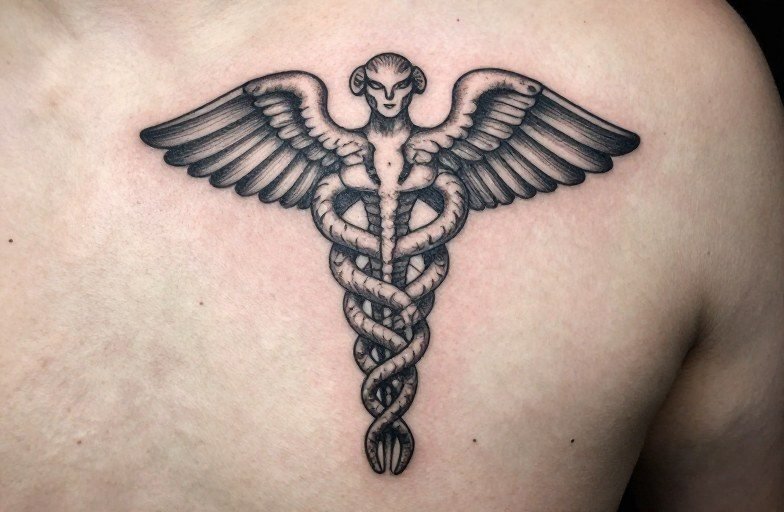
The caduceus tattoo most commonly signals medicine, healthcare, or healing professions, though this association stems from a historical mix-up with the Rod of Asclepius. Originally, the caduceus belonged to Hermes (Greek) and Mercury (Roman), representing commerce, travel, diplomacy, and the crossing between worlds. Today, most people who choose this design intend the medical connection, making meaning a negotiation between personal intent and the symbol’s layered past.
Symbolism & History
The Classical Roots
In Greek mythology, Hermes carried a staff entwined by two serpents, topped with wings. The serpents symbolized duality, life and death, earth and sky, conflict and resolution. The wings spoke to speed and divine messenger duties. Hermes guided souls to the underworld, protected travelers, and oversaw trade and negotiation. The caduceus was never a healing symbol in antiquity; that role belonged to the single-serpent Rod of Asclepius, carried by the god of medicine.
The confusion between the two symbols began in earnest during the early 20th century. The U.S. Army Medical Corps adopted the caduceus in 1902, likely because the symbol was already associated with neutrality and diplomatic protection under the Geneva Conventions. The mistake stuck. Now the caduceus appears on ambulances, pharmacy signs, and hospital logos across America, while the Rod of Asclepius remains more common in professional medical associations that know the difference.
Modern Interpretations
Contemporary wearers often blend both traditions knowingly. Some embrace the “mistake” as itself meaningful, medicine as commerce, the complexity of healthcare systems, or the tension between ideal and reality. Others choose the caduceus specifically for its classical attributes: negotiation, boundary-crossing, communication between unlike things. The twin serpents can represent partnership, chemistry, or the integration of opposites.
- Medical profession: nursing, medicine, EMT, pharmacy, physical therapy
- Classical studies: mythology, history, literature
- Personal duality: balancing opposing forces or identities
- Commerce and communication: sales, diplomacy, writing
- Transformation: snakes as shedding and renewal
Common Variations & Styles
The Staff and Serpents
Line work dominates most caduceus designs. The staff itself reads best as clean, unshaded black lines, too much shading and it becomes a muddy pole. The serpents require careful attention to head placement and body flow. Crossed or parallel, the snakes should mirror each other without becoming identical; slight asymmetry creates movement. Heads typically face each other or outward, with tongues flicked or mouths closed depending on whether you want tension or calm.
Wings at the top range from detailed feather studies to simplified geometric shapes. Full realism demands significant space, wing tattoos need room for individual feather definition. Smaller designs benefit from stylized wings, perhaps as negative space or single-outline forms. Some artists replace wings with other elements: a medical cross, a heart rhythm line, or personal symbols that modify the core image.
Style Adaptations
- Traditional/Americana: Bold lines, limited color palette, serpents in green or red, gold staff
- Blackwork: Heavy black fill on serpents, high contrast, no color needed
- Fine line: Delicate staff, minimal shading, suited for smaller placements
- Biomechanical: Staff as metal rod, serpents as cables or veins, wings as mechanical structures
- Minimalist: Single continuous line forming both serpents and staff, no wings
Color choices carry weight. Green serpents connect to medicine and pharmacy; red suggests danger, blood, or vitality. Gold or yellow staffs evoke classical authority. Blue tones feel clinical, institutional. Black and grey ages most reliably, especially on smaller pieces where color saturation can blur over time.
Best Placements
The caduceus works vertically, which shapes placement options. The forearm outer face suits medium sizes, staff running from wrist toward elbow, wings near the crook. This location shows easily, relevant for medical professionals who want visible identification. Inner forearm offers more privacy and flatter skin, better for fine detail.
The upper arm and calf both accommodate larger versions with full wing spread. Thigh pieces allow for serpents to wrap slightly, following muscle contour. The back, centered along the spine, creates a strong vertical statement but requires significant size to avoid looking like a stick-on decal.
Smaller placements, wrist, ankle, behind the ear, demand simplification. A single serpent coiled around a minimal staff, wings implied rather than drawn, prevents mushy results. Finger tattoos rarely succeed with this much detail; the staff becomes a line, the serpents become squiggles, and five years later it’s unrecognizable.
Consider professional context. Visible medical tattoos can reassure patients or raise eyebrows depending on workplace culture. The forearm caduceus reads as proud identification; the neck version reads differently in a hospital setting.
Who Chooses This Tattoo / Personal Meanings
Medical professionals form the largest group, nurses marking graduation or survival through difficult training, doctors honoring mentors, EMTs processing trauma through permanent symbol. The tattoo often commemorates specific moments: passing boards, surviving a code, losing a patient, choosing the profession after another life failed.
Some wearers have no medical background but carry caretaking roles: parents of chronically ill children, hospice volunteers, therapists. The caduceus becomes a private acknowledgment of emotional labor that lacks professional credentialing. Others use it to mark personal healing, addiction recovery, mental health management, surviving illness, though they risk misreading as medical professionals.
The classical meaning attracts a smaller but dedicated group. Writers, travelers, merchants, people who move between worlds or translate between communities. For them, the medical association is irrelevant or actively annoying. They may pair the caduceus with other Hermetic symbols: the tortoise shell, the winged sandals, the lyre.
Military medical personnel have particular claim to this version, given the Army’s historical adoption. Their tattoos often incorporate unit insignia, deployment dates, or specific campaign elements. The symbol carries institutional weight that civilian medical workers don’t share.
Similar Symbols
The Rod of Asclepius, single serpent, no wings, remains the technically correct medical symbol. It appears in professional medical association logos worldwide. Some wearers choose this deliberately to signal knowledge and precision, rejecting the confused caduceus. Others find it visually plainer, lacking the dynamic tension of twin serpents.
The Bowl of Hygieia, a serpent coiled around a cup or bowl, represents pharmacy specifically. Less recognized by general public, it offers insider identification for pharmacists and pharmaceutical researchers. The serpent-entwined tree of knowledge appears in some nursing traditions.
Cross variants (Red Cross, Star of Life) serve similar identification purposes but lack mythological depth. The DNA helix offers a modern scientific alternative for those who find classical symbols dated. The ouroboros, serpent eating its tail, shares snake imagery but carries cyclical, eternal meanings rather than medical or mercantile ones.
Some designs merge symbols intentionally: caduceus staff with Asclepian serpent, or medical cross between the wings. These hybrid approaches acknowledge the historical confusion rather than pretending it doesn’t exist.
Final Thoughts
The caduceus tattoo sits at a crossroads of error and intention, ancient and modern, personal and institutional. Its meaning depends heavily on what the wearer knows and what they want others to assume. The design demands technical precision, serpents are notoriously easy to draw poorly, and a wobbly staff undermines the whole piece. Choose an artist comfortable with line consistency and snake anatomy, or simplify to a style where those matter less. Consider whether you want to correct the historical confusion or inhabit it. Either choice is valid, but unconscious choice reads as ignorance rather than statement. The best caduceus tattoos know their own history, even when they choose to ignore it.
Frequently Asked Questions
What’s the difference between the caduceus and the Rod of Asclepius?
The Rod of Asclepius has one serpent and no wings, and it’s the authentic symbol of medicine from Greek mythology. The caduceus has two serpents and wings, belonged to Hermes the messenger god, and was mistakenly adopted by some medical organizations in the early 1900s.
Will people assume I’m a doctor or nurse if I get a caduceus tattoo?
Most people will, yes. The symbol is so widely used on medical signage that the association is automatic. If you’re not in healthcare, be prepared to explain your personal meaning, or consider placement where it’s not immediately visible.
How well does a caduceus tattoo age over time?
The staff and serpents hold up reasonably well if done with clean lines and adequate spacing. Fine detail in wings and scales tends to blur after 10-15 years, especially on smaller pieces or areas with frequent sun exposure. Bold lines age better than delicate shading.
Can I customize the caduceus without losing recognition?
Moderate customization works well, adding a medical cross, initials, or color coding for a specific profession. Heavy modification risks making the symbol unrecognizable. Keep the core elements (staff, two serpents, wings) intact if you want the meaning to communicate clearly.
Related Tattoo Meanings
- Roses and Thorns Tattoo Meaning: Beauty, Pain, and Protection
- Serpent Tattoo Meaning
- Dagger Tattoo Meaning: Protection, Betrayal, Courage and Traditional F
- Explore more









