
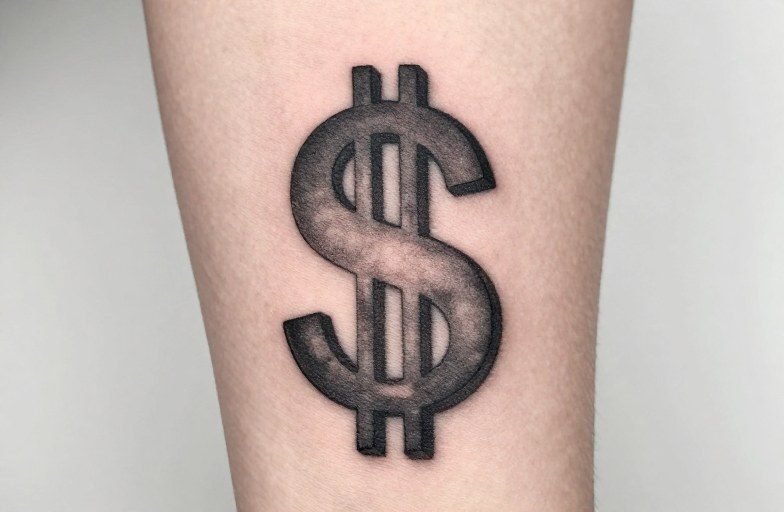
The dollar sign tattoo most commonly signals money as a primary motivation, wealth sought, wealth achieved, or the relentless pursuit of both. Beyond pure capitalism, it often represents hustle culture, survival instincts, and the transformation of poverty into power. For others, it carries darker associations: greed, risk, or the transactional nature of certain lifestyles.
Symbolism & Core Meaning
Wealth and Ambition
At its simplest, the dollar sign declares financial intent. Some wear it after climbing out of hardship, the mark of a completed journey. Others get it as a talisman, a visual commitment to future success. The symbol functions as both trophy and promise, depending on where you stand when the needle touches skin.
The Hustle Ethic
In street culture and hip-hop iconography, the dollar sign tattoo frequently celebrates grinding, legal or otherwise. It honors the 16-hour days, the side hustles, the refusal to accept circumstances. This meaning often pairs with imagery of cash stacks, dice, or cards, creating a narrative of risk and reward without needing words. See also: Depressed Tattoo Meaning: Symbolism, Design & Aging.
Warning and Critique
Not every dollar sign celebrates money. Some use it ironically or critically, commenting on capitalism’s grip, the cost of selling out, or the emptiness of chasing paper. Context matters: a single dollar sign behind the ear reads differently than a chest piece surrounded by chains and skulls.
Common Variations & Styles
Classic American Traditional
Think bold black outlines, limited color palette, green fill, maybe gold highlights. The traditional dollar sign sits well in flash sheets, readable from across a room. These age cleanly because the design relies on strong line weight rather than delicate shading. Over decades, the green may soften to a muted teal, but the symbol remains unmistakable. See also: Dogwood Flower Tattoo Meaning: Resilience, Faith & Renewal.
Minimalist and Fine Line
Single-needle dollar signs, often placed on fingers, wrists, or behind ears, trade impact for subtlety. The risk: fine lines blur faster, especially on high-movement areas like fingers. What starts crisp can feather into a soft gray shadow within five to seven years. Artists compensate by keeping the design slightly bolder than the client initially wants.
3D and Realistic Renderings
Crumpled bills, chrome-finish symbols, or dollar signs emerging from torn skin require serious technical skill. These pieces demand large scale, at least palm-sized, to read properly. Shading-heavy designs also face aging challenges: smooth gradients can muddle over time, requiring touch-ups to maintain dimension.
- Script pairings: “Get Money,” “Stay Paid,” birth years of financial breakthroughs
- Symbolic additions: crowns (dominance), roses (beauty bought through struggle), clocks (time is money)
- Negative space techniques: dollar sign carved from solid black backgrounds
Negative Space and Blackwork Approaches
One of the stronger technical options for this symbol is negative space blackwork: a heavily saturated black field with the dollar sign left untattooed, the symbol defined by what surrounds it rather than what fills it. This approach sidesteps color aging entirely. Black ink holds longer and packs more visual contrast than any green or gold fill, and the graphic tension between void and saturation makes the piece read from distance with real force.
The trade-off is commitment. Blackwork requires complete coverage with no room for partial fills or gradual additions later. Many artists note that clients underestimate how dark the surrounding field needs to be for the negative space to remain crisp as the tattoo settles. If the black softens even slightly over the years, the symbol’s edges lose their definition. Go in expecting to touch up the fill within five to eight years, not the dollar sign itself.
How This Design Ages on Different Skin Tones
Skin tone affects every tattoo, but this symbol’s reliance on either color fill or fine line makes that interaction especially significant here. On lighter skin, green pigment tends to stay readable for years before fading toward a softer, slightly yellow-toned teal. Fine-line versions on fair skin show the sharpest initial contrast, which also means the eventual blurring is more noticeable when it happens.
On medium to olive skin, traditional green fill can read muddier from the start if the artist undersaturates. You want a green with enough depth, closer to forest than lime, so the contrast against the skin holds. Black outlines become especially important here as the anchor that keeps the symbol legible once color inevitably migrates.
On darker skin tones, saturation is everything. Lighter greens disappear fast, and fine-line work frequently becomes invisible within a few years. Many artists who specialize in darker skin recommend skipping the green fill entirely and going black-and-gray or full blackwork. A bold, well-packed dollar sign in black ink on darker skin outlasts any color version and carries more visual impact at every stage of the aging process. If color matters to you, yellow gold tends to hold better than green on deeper complexions, though it still requires heavier saturation than you might expect from the reference image.
Whatever your skin tone, ask your artist directly how they handle this specific design on your complexion. A portfolio with healed photos, not just fresh shots, tells you more than any consultation promise.
Mythology & Folklore
The dollar sign itself carries disputed origins, often linked to the Spanish peso or the pillars of Hercules wrapped in ribbon. Some trace it to early American shorthand, others to Masonic symbolism. Tattoo culture borrows less from historical accuracy and more from accumulated meaning, what the symbol has come to represent through decades of wear.
Prison and Street Associations
Inside certain institutions, the dollar sign marked loyalty to financial gain over gang affiliation, or indicated a player in underground economies. Outside, these associations sometimes persist, sometimes shed. The same tattoo that signaled time served might now decorate a startup founder’s forearm, stripped of its original context through mainstream adoption.
Pop Culture Permanence
Rappers, athletes, and celebrities have normalized the dollar sign as personal branding. This visibility shifted perception: what once read as criminal or desperate now frequently scans as aspirational. The tattoo didn’t change; the audience interpreting it did.
Cultural Geography: Beyond the American Dollar
In Latin American tattoo culture, the dollar sign carries an additional layer tied to migration, remittance, and the specific dream of sending money home. In certain communities across Mexico, El Salvador, and the Dominican Republic, the symbol often marks not just personal ambition but collective obligation, the person who made it out and keeps others afloat. This context adds weight that purely aesthetic interpretations miss.
In the UK and parts of Europe, some collectors substitute the pound sterling symbol or the euro sign, carrying the same conceptual freight but localized to place. British tattoo artists often note that the pound version reads more personal than the dollar, rooted in a specific national economic identity rather than borrowed American iconography. If you want the symbol to mean something about your actual financial reality rather than a cultural export, the currency you actually use is worth considering.
Who Chooses This Tattoo
Entrepreneurs and Traders
Stock traders, real estate investors, and self-made business owners sometimes choose the dollar sign as a professional marker, less common in corporate settings, more frequent among independent operators. Placement tends toward concealment: ribs, upper arms, areas covered by standard business attire.
Artists and Musicians
For creatives, the dollar sign often acknowledges the tension between art and commerce. Getting paid for passion remains a fraught negotiation, and the tattoo can serve as permission, even provocation, refusing the starving artist narrative while acknowledging its persistence.
Younger recipients increasingly treat the symbol as aesthetic rather than ideological, drawn to its graphic simplicity and cultural recognition. This detachment frustrates some old-school collectors but reflects broader tattoo democratization: not every piece needs profound personal narrative.
Choosing the Right Artist
The dollar sign looks deceptively simple, which is exactly why it exposes weak technical execution. A sloppy curve on the S, uneven line weight, or poorly packed fill will be obvious on a symbol this widely recognized. You want an artist whose portfolio shows consistency on geometric and typographic work, clean circles, steady curves, letters that hold their shape at small and medium scale.
For traditional versions, look for someone whose flash work demonstrates confident line weight and solid color packing. For fine-line or single-needle interpretations, find an artist with healed photos of small symbolic work, not just fresh shots. Healed photos are the honest test. For blackwork or negative space, you want an artist who specializes in solid fill and can show you pieces where the black has settled evenly without patchiness.
Ask whether they have experience working with your skin tone and with this specific type of design. A good artist will tell you honestly if they think a particular approach won’t age well on your skin. If they just take your money and book the session without any pushback on a technically risky request, that’s a signal worth heeding.
Design Tips & Pairings
Line weight determines longevity. A dollar sign built from consistent, medium-thick lines outlasts one relying on hairline details. For color, green dominates for obvious reasons, but black-and-gray versions age more gracefully and avoid the “dated” look that specific color choices sometimes acquire.
Complementary Imagery
- Playing cards or dice: reinforces gambling/risk themes
- Broken chains: money as liberation from constraints
- Religious iconography: complicated tension between spiritual and material values
- Geometric frames: modernizes the symbol, distances from traditional associations
Typography Integration
Script surrounding the dollar sign should be sized to match, too small, and it becomes illegible; too ornate, and it competes with the symbol’s immediate readability. Simple block letters or clean cursive generally outperform elaborate calligraphy.
Best Placements
High-Visibility Spots
Fingers, hands, and neck placements broadcast the meaning without negotiation. These locations carry social consequences, employment limitations, assumptions about character, that wearers should weigh against the desire for visibility. Hand tattoos also heal more complexly, subject to constant movement and sun exposure.
Concealed and Semi-Concealed
The chest over the heart suggests money as life’s driving force. Ribs offer privacy and pain, this placement hurts, and the commitment itself becomes part of the statement. Upper arms and thighs provide easy coverage with option for display, the flexible choice for those navigating professional environments.
Behind the ear has emerged as a popular minimalist placement, small enough to dismiss as playful, visible enough to register. The skin there holds ink reasonably well, though hairline proximity requires careful afterthought.
Before You Book
A few specific questions worth settling before you commit to this particular symbol:
- What does money mean to you right now, and will that meaning hold in ten years? The dollar sign is readable to everyone. You’ll be explaining or deflecting for life.
- Have you seen your chosen artist’s healed work on your skin tone with this type of design?
- Have you decided between color and black-and-gray based on aging, not just aesthetics?
- Is the placement genuinely yours, or are you borrowing it from someone else’s photo?
- If the design includes fine lines or color, are you prepared to touch it up in five to seven years to keep it sharp?
- Does the size you’re considering allow the symbol to remain legible as it ages, or are you going too small for the style?
None of these are meant to talk you out of it. They’re the questions a good artist will ask you anyway, so arriving with answers puts the consultation in your hands.
Final Word
The dollar sign tattoo endures because money remains inescapable, desired, resented, worshipped, or transcended. Its meaning compresses and expands with each wearer, sometimes reduced to pure aesthetics, sometimes loaded with lived experience. What separates a compelling piece from a regrettable one usually isn’t the symbol itself but the thought behind placement, scale, and accompanying imagery. Get it because you earned something, because you’re chasing something, or because you want to interrogate the chase itself. Just don’t get it because it looked cool on someone else, wealth, real or symbolic, demands more personal investment than that.
Frequently Asked Questions
Does a dollar sign tattoo always mean someone is materialistic?
Not necessarily. The tattoo can represent hustle, survival, or even critique of capitalism. Context and accompanying imagery reveal more than the symbol alone.
How well does a fine-line dollar sign tattoo hold up over time?
Fine-line work on fingers or high-movement areas tends to blur within five to seven years. Slightly bolder lines and less detailed designs age more gracefully.
Are there placement concerns for professional settings?
Yes. Hand, neck, and face placements remain visible in most workplaces and can limit employment options. Chest, ribs, or upper arms offer easier concealment.
What colors work best for a dollar sign tattoo?
Black-and-gray ages most reliably. Green is traditional but can fade to muted tones. Gold highlights in traditional styles hold reasonably well with proper aftercare.
Related Tattoo Meanings
- Dragon Man Tattoo Meaning: Power, Protection Rebellion
- Bkc Tattoo Meaning: Symbolism, History Design Guide
- Clock with Roses Tattoo Meaning: Time, Love Mortality
- Explore more









