
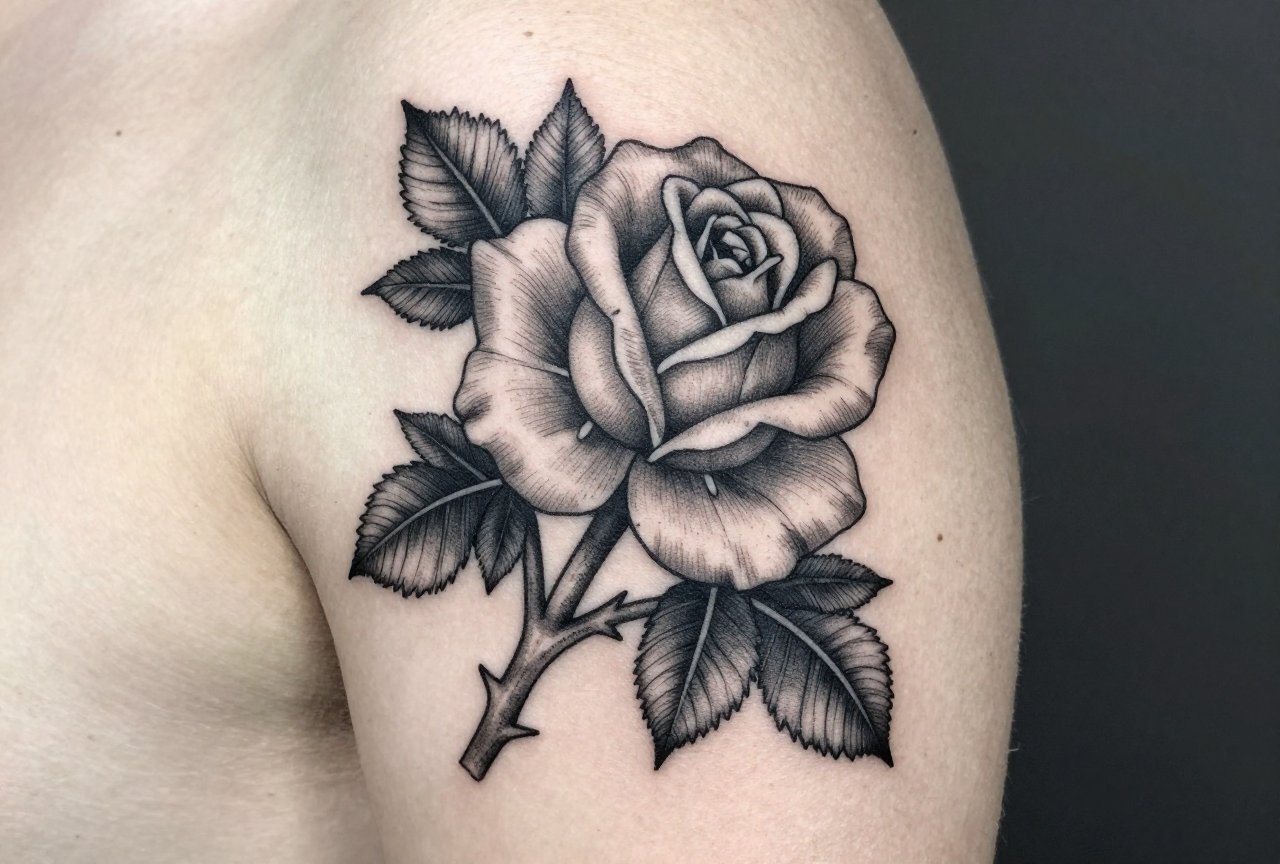
A rose and thorns tattoo carries one of the oldest visual paradoxes in Western tattooing: the beautiful flower cannot exist without the sharp defense beneath it. The meaning centers on duality, love that stings, growth that hurts, protection wrapped in attraction. Unlike a rose alone, which reads as romance or memorial, adding thorns introduces conflict, struggle, or the warning that something precious requires guarding.
Symbolism & History
The Religious Roots
The pairing predates modern tattooing by centuries. Medieval Christian iconography used the crowned rose, beauty ringed by thorns, as a symbol of the Virgin Mary, simultaneously pure and sorrowful. The “rosa mystica” imagery carried into early European folk tattoos, where sailors and soldiers wore thorned roses as memento mori: life is brief, beauty is defended, pain is inseparable from worth. This isn’t a recent Instagram trend. The visual logic has been embedded in Western culture since illuminated manuscripts.
Modern Tattoo Interpretations
Contemporary meanings cluster around several specific ideas rather than vague “personal significance.” The thorns can represent:
- Protection of vulnerability: the soft center guarded by sharp edges, often chosen after betrayal or hardship
- Love’s cost: romantic or familial bonds that required sacrifice or caused pain
- Survival and blooming anyway: thriving despite hostile conditions, the thorns as evidence of what was survived
- Warning: “beautiful but dangerous,” a boundary-setting piece, sometimes placed visibly as social signal
The thorns’ direction matters symbolically. Inward-curving thorns suggest self-protection, pain turned inward. Outward-facing thorns read as aggression, a warning to others. Straight, evenly spaced thorns feel more architectural, almost decorative; irregular, gnarled thorns suggest organic struggle, something grown wild through adversity.
Common Variations & Styles
Classic Americana
Traditional rose-and-thorn designs use bold black outlines, limited red and green color palettes, and thorns rendered as simple black triangles or curved spines along a stem. The thorns are often oversized relative to the flower, graphic, readable, meant to last decades as the ink spreads slightly. This style ages predictably: the black lines hold, the red may soften to pink or rust depending on skin undertone and sun exposure. Thorn detail in traditional work stays minimal because fine lines blur faster on high-traffic areas like forearms.
Realism and Neo-Traditional
Realistic thorned roses require different technical decisions. Individual thorns get rendered with highlight and shadow, sometimes catching light differently from the velvet petals. This creates visual tension, the organic softness of the rose against the dry, woody sharpness of the thorns. Neo-traditional work allows more color variation: purple-black thorns, blood drops at puncture points, snakes or daggers weaving through the stems. The thorns become narrative elements rather than simple botanical accuracy.
Minimal and Single-Needle
Recent years have seen fine-line thorned roses gain popularity, though this comes with aging trade-offs. Single-needle thorns can look exquisite fresh, hair-thin, delicate, almost illustrative, but they’re prone to fading into soft gray within five to seven years on most skin types. The thorns specifically suffer because they’re often the thinnest lines in the composition. Artists working in this style typically compensate by making thorns slightly heavier than the surrounding petal linework, or by stippling shadow around them to create density without fragile detail.
Best Placements
Where this design sits on the body changes how it’s read and how it holds up.
- Forearm: Highly visible, the thorns read as warning or boundary. The cylindrical shape wraps naturally around the muscle, stem following the arm’s length. Moderate sun exposure here; expect color fading over time.
- Upper arm/shoulder: Classic placement with room for larger composition. The deltoid’s curve suits a rose in profile, thorns trailing toward the elbow. Protected from sun, ink lasts longer here.
- Ribcage: Painful placement that suits the theme literally. The thorns wrapping around the torso’s edge create a cage-like effect, “protection of the heart” made physical. Healing is slower due to movement and friction from clothing.
- Thigh: Ample space for detailed thorn rendering, less daily sun damage. The muscle’s flat planes suit symmetrical compositions. Popular for larger, more private pieces.
- Hand or fingers: Thorned roses here read as defiance, visible confrontation. Ink fades fastest on hands due to cellular turnover and washing; thorns blur into soft gray within a few years. Most artists will warn about this honestly.
Thorn density should scale with placement size. A two-inch tattoo cannot carry twenty individually rendered thorns; they’ll merge into a dark smudge. Small designs need simplified, spaced thorns. Large back pieces can support thorn branches, dried leaves, and the texture of bark.
Who Chooses This Tattoo / Personal Meanings
Certain life contexts reliably produce requests for thorned roses rather than plain ones. Recovery from addiction or self-harm often involves this imagery, the beauty of survival, the marks of the struggle. People leaving abusive relationships sometimes choose thorns facing outward, a permanent statement about boundaries learned. Military veterans occasionally pair dog tags or dates with thorned roses, the flower for a lost person, the thorns for the violence of the loss.
The gender association has shifted. Fifty years ago, thorned roses were heavily masculine, prison tattoos, biker imagery, aggression. The thorns dominated, the flower shrunk. Contemporary versions are more balanced, chosen across gender presentation, with the thorn-to-flower ratio adjusted to personal emphasis rather than social coding. A design with minimal thorns and a dominant bloom suggests beauty that happens to have defenses. A stem-heavy piece with small, tight rose suggests someone whose primary experience has been the struggle, the bloom a recent or hard-won development.
Similar Symbols
Related imagery that carries overlapping or contrasting meaning:
- Rose without thorns: Pure love, memorial, innocence, or sometimes religious devotion. The absence of thorns removes conflict entirely.
- Thorns without rose: Crown of thorns references, suffering without redemption, or minimalist aesthetic choice. Bleaker, more ascetic.
- Skull and rose: Death and beauty, memento mori. Less about ongoing struggle, more about finality.
- Snake and rose: Temptation, danger within beauty, or healing (caduceus echoes). The snake adds active threat rather than passive defense.
- Barbed wire: Pure aggression, imprisonment, military service. No beauty component, all boundary and pain.
The thorned rose occupies a middle space these others don’t: it insists that both elements are necessary, coexistent, equally real. It refuses to separate beauty from its cost.
Final Thoughts
A rose and thorns tattoo works because the symbolism is immediately legible without being rigid. The thorns can be emphasized or minimized, rendered realistically or stylized, wrapped around the flower or sparse along the stem. What matters is the deliberate inclusion of both elements, the acknowledgment that worth and wound aren’t opposites. In a tattoo culture that sometimes flattens imagery into pure positivity or pure toughness, this design maintains tension. It looks like what it means: something that grew despite.
Frequently Asked Questions
Do thorns in a rose tattoo always mean something negative?
Not necessarily negative, but they always introduce complexity. Thorns represent defense, cost, or struggle paired with the beauty of the rose. A rose without thorns is simple celebration; adding thorns acknowledges that love, growth, or beauty required protection or caused pain.
Which tattoo style ages best for detailed thorns?
Bold traditional or neo-traditional styles hold thorn detail longest. Fine-line and single-needle thorns look delicate fresh but tend to blur or fade within five to seven years, especially on high-traffic areas like hands or forearms.
Can a rose and thorns tattoo work as a cover-up?
Yes, the dense black of thorn shadows and stem work covers older tattoos effectively. The organic, irregular shapes of thorn branches break up underlying lines better than geometric designs. Dark, clustered thorn areas can mask previous ink that simpler flowers couldn’t.
Should the thorns face a specific direction?
Direction carries subtle meaning. Inward-curving thorns suggest self-protection or internalized pain. Outward-facing thorns read as warning to others, boundary-setting. Discuss placement with your artist, thorns following the body’s natural curves look more integrated than arbitrary direction.
Related Tattoo Meanings
- Saddest Tattoo Meanings: Grief, Loss Unspoken Pain
- Shooting Star Tattoo Meaning: Wishes, Change Fleeting Beauty
- Snowdrops Flower Tattoo Meaning: Hope, Renewal Quiet Strength
- Explore more









