
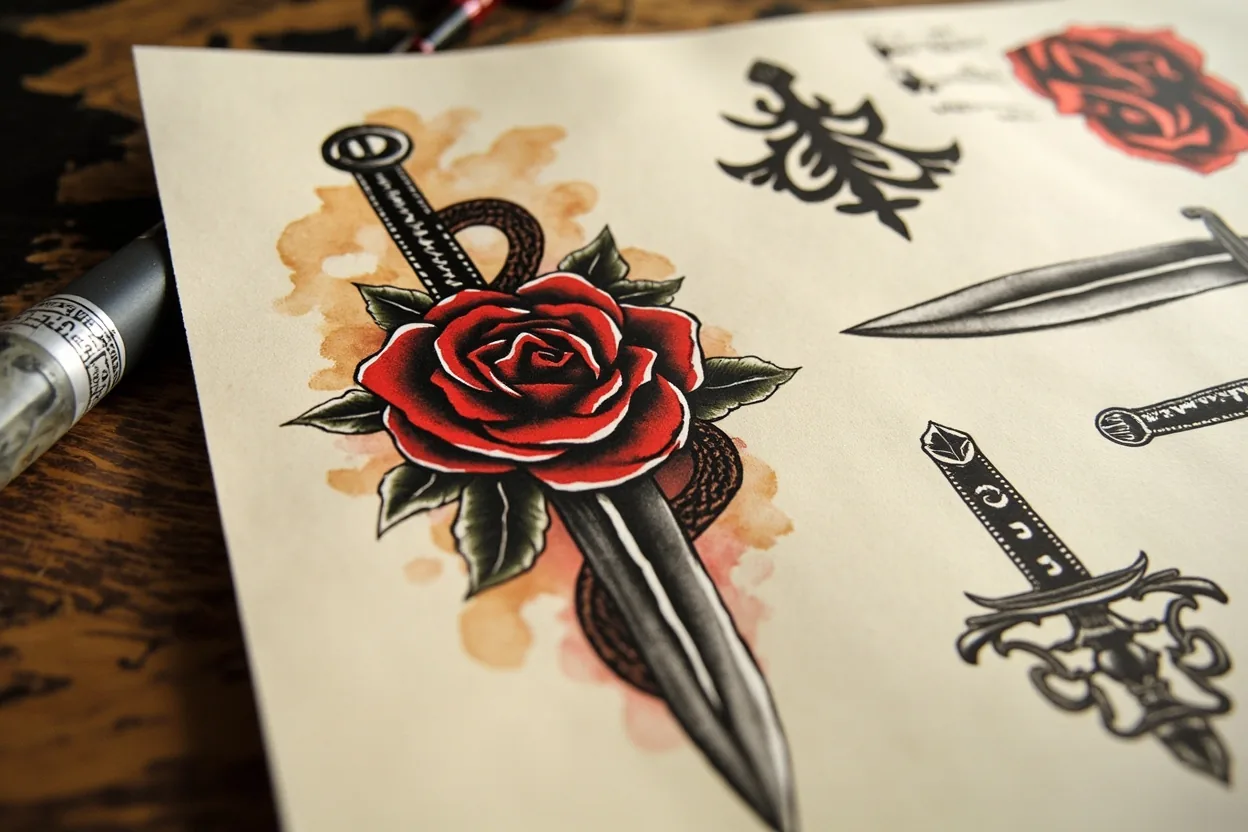
A dagger tattoo works because it is direct. It can mean protection, courage, betrayal, sacrifice, danger, survival, heartbreak, justice, or the decision to cut something out of your life. The meaning sharpens once you choose what sits beside the blade.
Quick answer: A dagger tattoo usually means protection, courage, betrayal, sacrifice, danger, or survival. Traditional dagger tattoos hold up best with bold outlines, clear blades, and one supporting symbol such as a rose, snake, heart, or banner.
What a Dagger Tattoo Means
A dagger alone is sharp. Add one symbol and the meaning changes fast. The blade is a tool of action, so your pairing tells people what kind of action you mean.
| Pairing | Common reading | Design caution |
|---|---|---|
| Dagger through rose | Love, pain, beauty and damage | Rose petals can crowd the blade |
| Dagger and snake | Danger, protection, temptation | Two long shapes need clean flow |
| Dagger through heart | Betrayal, heartbreak, sacrifice | Can feel very literal |
| Plain dagger | Courage, defense, clean break | Needs strong handle and blade shape |
| Dagger with banner | Motto, name, memorial phrase | Lettering must be readable |
Pair a dagger with a rose and you are talking love and pain in the same breath, a combination often linked to sailor-era tattoo traditions. A skull plus dagger signals mortality, confronting death rather than running from it. A snake wrapped around a dagger draws on older serpent-and-staff imagery, though artists often mix the Rod of Asclepius (one snake) with the Caduceus (two snakes on a staff) in ways that blur the medical and mythological references. A heart with a dagger through it is the classic betrayal piece, heartbreak worn permanently on the skin. A butterfly paired with a dagger flips delicate against deadly, popular right now in fine-line blackwork.
Whatever you stack it with, make sure both elements are sized to read together. They should not compete for attention at three feet away.
Why the Design Lasts
Directness without decoration
A dagger cuts, protects, threatens, or marks a wound. That directness is why the symbol has stayed useful in tattooing for generations. The meaning depends on whether the blade is active or still. A clean vertical dagger can feel like courage or defense. A dagger through a heart feels like betrayal. A dagger with a rose says beauty and pain together without needing explanation.
If you want a symbol that does not need a paragraph, a dagger is strong. The challenge is making it personal without loading it with five extra objects.
Natural fit for the body
Daggers are vertical by design, and the human body has plenty of vertical lines. That orientation makes them one of the easier motifs to place without forcing awkward angles or warping the silhouette. A well-drawn dagger follows muscle lines instead of fighting them, which is part of why the design never really disappeared from American traditional shops.
The shape also scales without losing identity. You can run a bold dagger down a full forearm or shrink it to a two-inch piece on the inner wrist and it still reads clearly. That flexibility keeps it in heavy rotation whether you want a statement sleeve anchor or a subtle first tattoo.
How Traditional Daggers Age
Bold construction, bold results
American traditional dagger tattoos use thick outlines, limited color palettes, and heavy black fill in the blade. That construction is not only aesthetic; it is structural. Bold outlines hold their edges for decades. The colors stay saturated longer because they are not competing with a dozen subtle tones. The design reads from across the room even after years of sun and skin turnover.
A thin realistic dagger can look elegant fresh, but it needs enough contrast. If the blade is all pale grey and tiny highlight, it may disappear as it heals. The handle deserves particular attention. A weak handle makes the whole tattoo look unfinished. Even a simple dagger needs a readable grip, guard, and blade.
Fine-line reality
Fine-line daggers look stunning fresh but require more care and realistic expectations. Hairline strokes in high-wear zones like the inner arm or hand will soften and spread faster than you want. If you are committed to fine line, place it somewhere lower-wear like the upper arm or calf, and budget for a touch-up around the two-year mark to keep edges crisp.
Placement and Pain
Where the shape works best
Forearm, calf, upper arm, sternum, and shin all work because a dagger is naturally vertical. The shape also fits between other sleeve elements without disrupting the overall flow. Rib and spine placements can look sharp, but pain and movement are real factors. The ribs flex with every breath, and the spine has bone close to the surface. A dagger on the sternum centers the design on the body, which suits the protective reading, though the bone makes the session harder.
Hand and finger placements are popular for visibility, but they fade fast and hurt more than most people expect. The skin on the back of the hand is thin, and the fingers are full of nerve endings. If you choose a hand dagger, plan for more frequent touch-ups and accept that the detail will soften sooner than it would on the forearm or calf.
Common placement mistakes
Another mistake is forcing a horizontal dagger where a vertical one belongs. A horizontal blade across the wrist or collarbone can work, but it fights the natural lines of the body and often reads as an afterthought. If you want horizontal, design for it from the start with a composition that fills the space intentionally, not just a rotated vertical dagger.
Before You Decide
Start with the meaning, not the image. Decide what the dagger is doing: protecting, cutting away, remembering, warning. Then choose the pairing that carries that meaning. A plain dagger is valid, but it leaves more open to interpretation than most people expect. If you want protection, consider the direction and context. If you want betrayal, the heart or a broken element belongs there. If you want transformation, the snake is the stronger choice.
Talk to your artist about line weight and aging before you commit. Show them where your skin sees sun, where it stretches, where it creases. A dagger on the inner bicep will age differently than one on the outer forearm. The best tattoo is not the one that looks perfect on paper; it is the one that looks right on your body in five years.
Finally, give the handle as much thought as the blade. The grip, guard, and pommel are where personality lives. A skull pommel, a wrapped leather grip, a simple crossguard, each changes the tone. The blade is the statement. The handle is the voice.
Frequently Asked Questions
What does a dagger tattoo mean on its own?
A plain dagger usually reads as courage, defense, or a clean break. Without a pairing, the meaning stays open, so the style and placement carry more weight. Bold and vertical tends to read protective; angled or drawn with motion can feel more aggressive.
Does a dagger through a heart always mean betrayal?
Not always, but that is the most common reading. Some people use it to mark sacrifice, devotion through pain, or a loss they survived. The meaning depends on your intent and what you tell people, though strangers will often assume heartbreak first.
How much does a dagger tattoo cost?
In the US, expect $150 to $500 depending on size, detail, and your artist’s rate. A small simple dagger might take an hour. A detailed traditional piece with color and a pairing like a rose or snake could take three to four hours.
Do dagger tattoos hurt more than other designs?
The pain depends on placement, not the design itself. Daggers go on bony areas like the sternum, ribs, and shin more often than average, which can make them feel more painful. The forearm or calf is moderate for most people.
What style lasts longest for a dagger tattoo?
American traditional with bold outlines and heavy black fill ages best. The simple color palette and strong contrast hold up for decades. Fine-line styles look delicate fresh but require more touch-ups and careful placement away from high-wear areas.









