A dove tattoo looks gentle, but it carries weight. The bird usually points to peace, faith, love, mourning, freedom or a new beginning, and the small choices around it decide which one a stranger reads first.
What a Dove Tattoo Actually Says
The dove is easy to recognize, but the emotional read shifts with what it carries, how many there are, and the symbols sitting next to it. Most animal tattoos lean one way. A lion reads as strength, a snake reads as danger. The dove is different because it has been a peace symbol, a faith symbol and a love symbol across many cultures for centuries, so it can point in several directions at once.
That range is the reason people pick it, and it is also the reason a dove tattoo can feel generic if you skip the details. A bird shape on its own says little. The olive branch, the cross, the banner, the second dove and the posture are what turn a stock outline into your tattoo.
Before you book, decide which meaning leads. Peace, faith, love, mourning and a fresh start are five different tattoos. They share a bird, but they do not share the same supporting symbols, and trying to fit all five into one small design is how the piece ends up saying nothing.
Reading the design at a glance
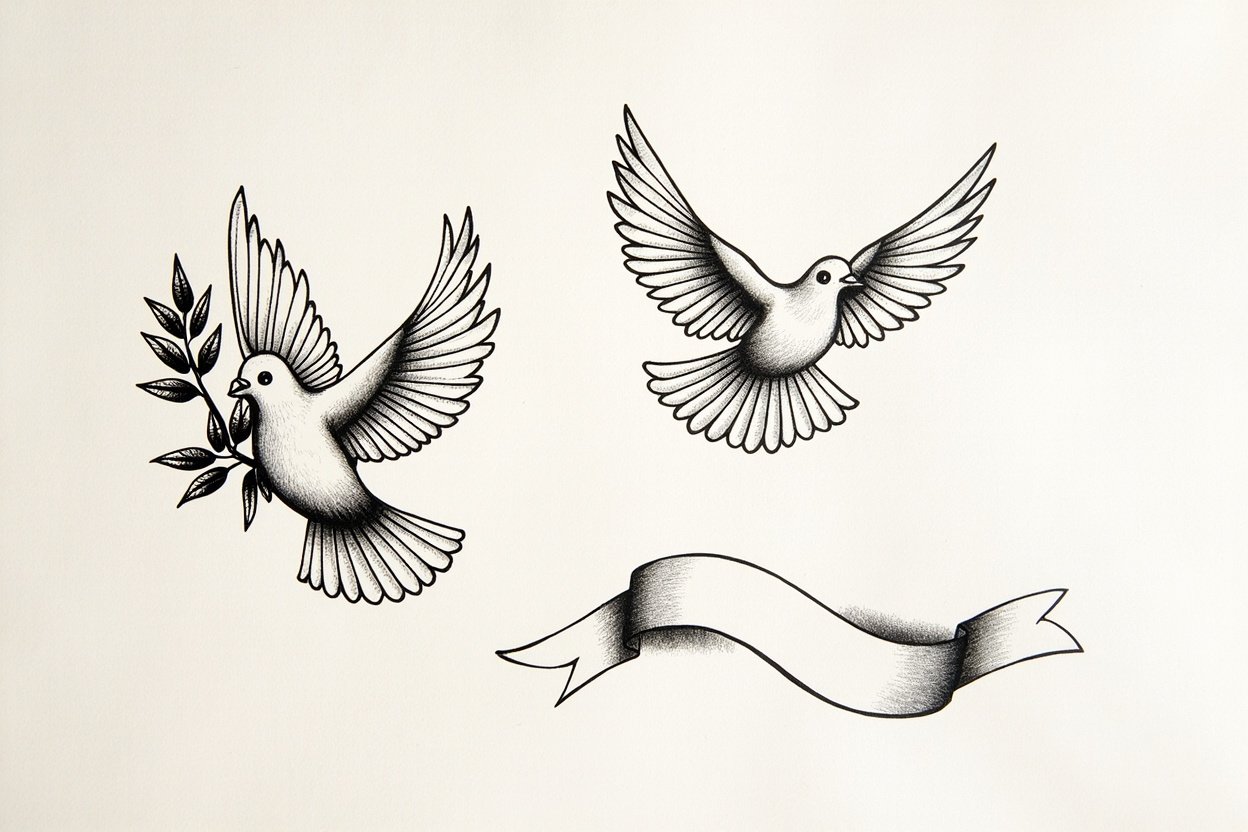
A single dove with an olive branch in its beak reads as peace. A dove near a cross, rays of light or scripture reads as faith and the Holy Spirit. Two doves facing each other read as love or partnership. A dove with a name, date or banner reads as memorial. A dove with wings spread, rising upward, reads as freedom or a new beginning. These are not rules, but they are the usual paths the eye follows.
Peace and the Olive Branch
The clearest dove meaning is peace, and the clearest way to show it is an olive branch in the beak. That pairing is old, often linked to the story of Noah, where a dove returns with an olive leaf to show the flood has dropped and dry land is near. The image reads as peace, calm and the end of conflict because of that long association.
If peace is your reason, give the olive branch enough room. A leaf or two drawn too small will read as a twig, and the whole meaning gets lost. A few clean leaves, a visible stem and an unhurried wing line do more than a busy background.
Some people use the peace dove to mark the end of a hard stretch rather than world peace in the abstract. Leaving a fight, ending a feud, or finally feeling calm after a chaotic year all fit under the same olive branch. The design does not need to announce the specifics. The posture of the bird, a settled wing, a gentle curve of the branch, these quiet cues carry the weight.
What to ask for
Tell your artist you want the olive branch readable at the final size. If the piece is small, a single detailed leaf works better than a cluster. Consider the angle of the branch in the beak. Horizontal reads calmer than diagonal. A dove descending with branch reads differently than one ascending. Most artists who have done religious or memorial work will understand the distinction without much explanation.
Faith and the Holy Spirit
In Christian art the dove is a primary symbol of the Holy Spirit, and it shows up in scenes of baptism and in church imagery across centuries. A dove tattoo in that tradition can mark baptism, a renewed faith, or the sense of being guided and protected.
When faith is the goal, one supporting symbol usually does the work. A small cross, a few rays of light or a short verse next to the dove points the meaning toward religion without turning the tattoo into a crowded scene. The dove returning with an olive leaf also carries a faith reading on its own, since it ties back to mercy and a second chance.
Resist the urge to add every religious symbol you like. Dove, cross, rosary, praying hands and scripture can each work, but stacking all of them into one piece buries the bird and weakens the message. The dove is the carrier. Let it carry one thing well.
Common placements for faith pieces
The chest, the forearm inside face, and the shoulder blade are the usual spots for faith doves. The chest keeps it near the heart, which matters to some people for reasons they do not need to explain. The forearm allows the bird to face the viewer or the wearer, a subtle choice that changes who the message is for. The shoulder blade gives space for a larger composition with rays or a cross behind.
Love, Two Doves and Devotion
Doves are tied to love, loyalty and partnership, and a pair of doves is one of the most direct ways to show it. Two birds facing each other, or flying together, read as a committed relationship, a marriage or a steady, gentle bond.
Couples sometimes split the meaning across matching tattoos, with one dove each or a pair carried by both people. If you go that route, use the same artist and the same style so the two pieces actually look related when they sit side by side. Different line weights, different eye shapes, different wing angles will make two doves look like two different birds from two different stories, which defeats the purpose.
Beyond romance, the dove can stand for a wider love, the kind aimed at family, community or a non-violent way of moving through life. That softer reading pairs well with a single dove rather than a romantic pair. A single bird with a soft posture, no aggressive spread, no sharp angles, suggests a love that is present rather than possessive.
Matching pieces that actually match
Bring reference of both doves together to both appointments, even if you are getting them on separate days. The artist needs to see the pair as a unit. Ask for the same needle grouping for line work, the same gray wash if there is shading, and the same eye detail. These technical choices matter more than the subject matter for making two tattoos feel like one story.
Mourning, Memorial and Loss
A large share of dove tattoos are memorial pieces. Because the bird is linked to peace and to the soul, many people use it to honor someone who has died, treating the dove as the spirit at rest or carried somewhere safe.
For a memorial dove, the supporting details usually do the personal work: a name, a date, a short phrase on a banner, or a small set of flowers. The risk is letting the lettering take over. A long quote in fine script can shrink the dove until the bird becomes background, so give the dove the lead and keep the words tight. One date, one name, or a single word like “peace” or “free” often holds more than a sentence.
The same design can carry comfort as well as grief. For some people the dove is less about loss and more about believing the person is finally at peace, which is why a calm, settled posture often suits a memorial piece better than a dramatic one. A bird at rest, wings folded, reads as arrival. A bird in flight reads as journey. Both are valid, but they are different stories.
Banner and lettering choices
Script under or around a dove works best when the banner has a natural curve that follows the body. Straight lines across a curved bird look forced. Ask your artist to draft the lettering first, before the dove is finalized, so the two elements negotiate for space rather than fight. Old English, typewriter fonts, and simple serif scripts are the common choices. Avoid anything too ornate at small sizes; the letters will bleed together over time.
Freedom and New Beginnings
A bird taking flight is a natural symbol of freedom, and the dove is no exception. Wings spread, lifting upward, the dove can mark release, leaving something behind, or stepping into a new chapter on purpose.
That new-start reading often connects to recovery, a major life change or a spiritual turning point. The Noah story sits underneath this meaning too, since the returning dove signaled that the worst had passed and dry land waited. A dove rising can carry that same sense: the hard part is over, something else is beginning.
The freedom reading depends heavily on posture. Wings need asymmetry to read as real movement. A mirror-image spread looks static, almost like a logo. One wing higher, feathers slightly varied, the body angled rather than flat to the viewer, these details separate a living bird from a clip art silhouette. A good artist will know this, but you should ask to see the stencil before the needle touches skin.
Color versus black and gray
Peace doves and faith doves often stay black and gray, which keeps them timeless and readable at distance. Memorial doves sometimes add a single color, a birth flower or a favorite shade, but too much color in a small piece can fracture the calm. Freedom and new beginning doves sometimes use white ink highlights or soft blue washes to suggest sky, but the effect is subtle and fades faster than solid black. Discuss how the piece will age, not just how it looks fresh.
Before You Decide
A dove tattoo works because the bird is familiar. That same familiarity is its risk. Everyone knows what a dove is, so a generic dove says nothing specific about you. The work of making it yours happens in the details you add and the details you leave out.
Choose one leading meaning. Give it one clear symbol to carry. Let the posture of the bird match the emotion: settled for peace, rising for freedom, paired for love, calm for memorial. Check that the design still reads at the size you want, that the branch or banner or cross does not disappear, that the wings look like they belong to a bird and not a stencil.
The best dove tattoos are quiet. They do not explain themselves. They let the viewer recognize the bird and feel the weight without being told what to feel. That restraint is harder than it looks, and it is worth the effort.
Frequently Asked Questions
What does a dove tattoo mean?
A dove tattoo usually means peace, faith, love, mourning or a new beginning. The specific meaning depends on what the dove carries, how it is posed, and what symbols appear with it. An olive branch points to peace, a cross or rays point to faith, two doves point to love, and a name or date points to memorial.
Does a dove tattoo always have a religious meaning?
No. While the dove is a strong symbol of the Holy Spirit in Christian tradition, it also carries secular meanings of peace, love, freedom and memorial. The surrounding design elements determine which reading comes first.
What is the best placement for a dove tattoo?
Common placements are the chest, forearm, wrist and shoulder blade. The chest suits faith and memorial pieces. The forearm works well for visibility. The shoulder blade gives space for larger compositions with banners or crosses.
How do I make sure my dove tattoo does not look generic?
Choose one leading meaning and one supporting symbol. Give the artist clear reference for posture and detail. Avoid symmetrical wings if you want movement. Make sure the olive branch, banner or cross is large enough to read at the final size.
Can a dove tattoo be a memorial piece?
Yes, many dove tattoos honor someone who has died. A name, date or short phrase on a banner, paired with a calm, settled dove, reads as the spirit at rest. Keep lettering minimal so the bird remains the focus.