
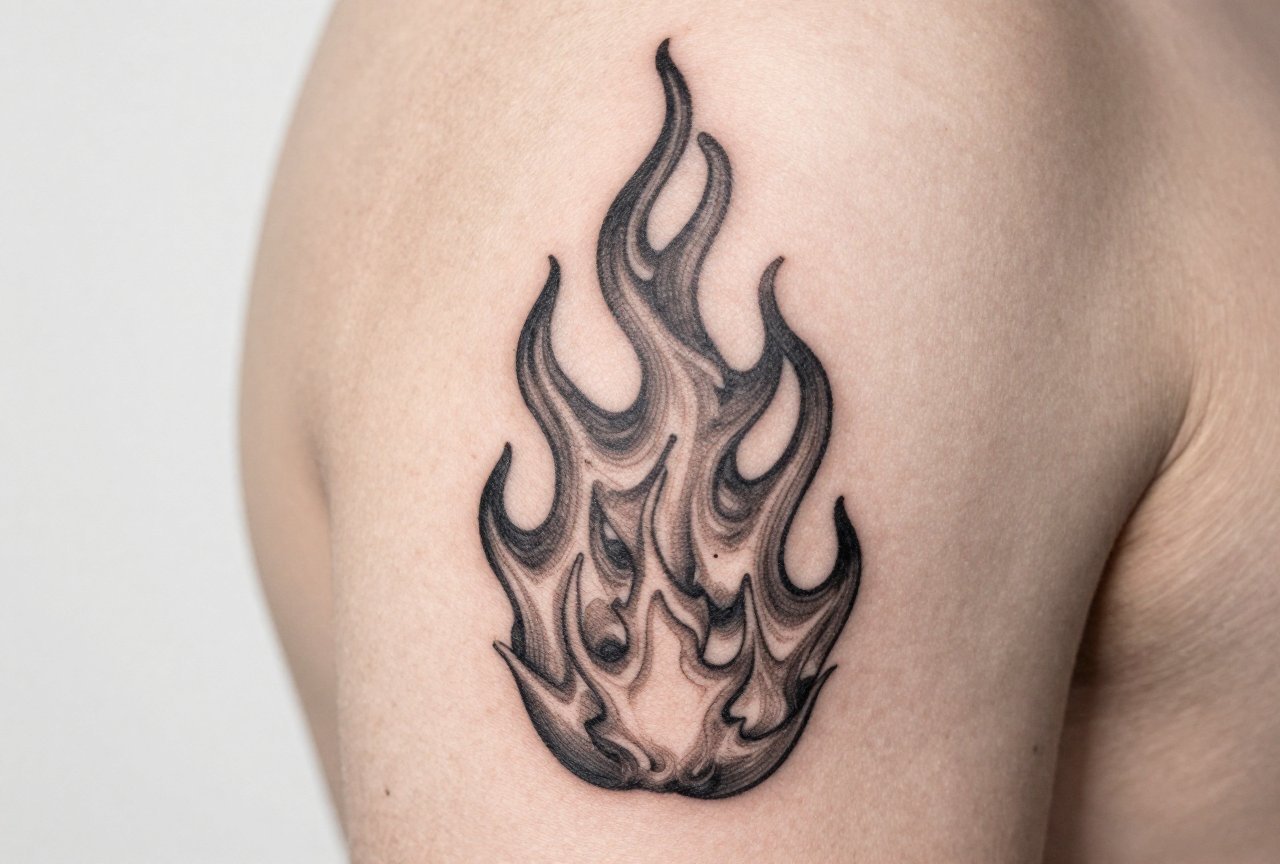
Flame tattoos carry raw, primal energy. Fire destroys, but it also warms, transforms, and lights the way forward. On skin, that duality is what makes it one of the most requested symbols I’ve worked with, people don’t just want something that looks aggressive; they want the story behind the burn.
Symbolism & History
Fire sits at the center of human mythology. Prometheus stole it. The phoenix needs it. Hell is made of it. I’ve had clients reference all three in the same consultation, and they’re not wrong, flames hold multitudes.
Transformation and Rebirth
This is the big one. The phoenix rising from ashes is the obvious reference, but plenty of people come in with quieter stories. I’ve tattooed flames wrapping a semicolon for someone five years sober. I’ve done a single matchstick flame on a wrist for a client who left a cult and rebuilt her life. The flame doesn’t have to be explosive to mean transformation. Sometimes it’s the small, stubborn burn that won’t go out.
Passion and Destruction
Fire doesn’t care about your plans. It consumes. I’ve had guys come in wanting sleeve flames after divorce, after bankruptcy, after diagnosis. The message isn’t always “I’m burning it all down.” Sometimes it’s “I survived the fire.” The visual language shifts based on placement and color, red-orange flames read passion, blue or white read something colder, more controlled.
Religious and Cultural Roots
The eternal flame shows up everywhere. Hindu agni, Zoroastrian fire temples, the burning bush, Olympic torches, Dia de los Muertos candles. I did a Sacred Heart wrapped in realistic flames for a Catholic client last year; the line work had to be razor-sharp because religious iconography ages badly if the details muddy. We kept the flame stylized, not photorealistic, so it would read clean at ten years.
Common Variations & Styles
Not all flames are created equal. The style changes the meaning as much as the imagery does.
- Traditional/Americana: Bold black outlines, limited color palette, cartoonish movement. These read nostalgic, tough, biker-adjacent. They heal like tanks because the heavy lines hold.
- Realistic/Photographic: Color gradients, no outlines, actual flame reference photos. Stunning when fresh, but I’ve seen these blur significantly after five years. The subtle yellow-to-orange transitions don’t hold without strong contrast.
- Neo-traditional: Thick lines, expanded color range, more detail. Best of both worlds for longevity and visual punch.
- Blackwork/Tribal: All black, heavy saturation. Common in Polynesian-influenced work. Reads more abstract, less “fire” and more “energy.”
- Minimalist/Single-line: One continuous line forming a flame shape. Delicate, trendy, but I’ve warned clients, these can look like a random squiggle at distance. Placement matters hugely.
- Flame as accent: Hearts, skulls, dice, motorcycles, religious figures, flames supporting another subject. This is probably 60% of what I actually tattoo.
Color Choices That Shift Meaning
Red and orange are default. Blue flames read gas fire, chemistry, something artificial or supernatural. Purple gets you into fantasy territory. Green flames, I’ve done exactly two, both for cannabis culture references. White ink flames on dark skin can be striking but fade fast; I always caveat that.
Best Placements
Fire wants to move. Straight lines kill the energy. Curved placements, forearm wraps, calf sleeves, ribs, shoulder caps, let the flame flow naturally.
- Forearm: Most common. Visible, good canvas length, easy to show or hide. Inner forearm hurts more but ages better than outer (less sun exposure).
- Calf: Great for larger pieces. Muscle movement makes the flame look alive when you walk. I’ve done full calf sleeves of climbing flames that ripple with every step.
- Ribs/Side: Painful as hell. The canvas curves, which helps the composition, but I warn everyone: this spot makes tough people tap out. The flame can follow the rib line organically.
- Hand/Neck: Job stoppers. I make people wait six months and come back if they still want it. That said, a small flame on the side of a finger, done in bold black, can read like a commitment mark.
- Chest: Sacred Heart territory. Central, symmetrical flames framing something. Heals well, plenty of flat space for detail.
One thing I tell clients: flames pointing down versus up feel different. Up is aspiration, rising, escape. Down is consuming, falling, dangerous. Most people want up. The ones who want down usually have a specific reason.
Who Chooses This Tattoo / Personal Meanings
After fifteen years in shops, I can tell you the flame attracts a specific kind of client: people in transition. Not always dramatic, but always some threshold.
The Survivors
Cancer survivors, abuse survivors, addiction survivors. The flame marks what they walked through. I did a piece for a firefighter who pulled bodies from a warehouse blaze, his flames were blue and black, no warmth in them, memorial rather than celebration. He sat for six hours without a break. Some meanings don’t need explanation in the chair.
The Transformers
New careers, new cities, new identities. College graduates getting their first visible tattoo. People who left religion and want something secular but symbolic. The flame is accessible, everyone understands it without a lecture.
The Romantics
“She’s my fire.” “He burns me up.” I hear this constantly. Couples getting matching flames (I try to talk them into complementary rather than identical, but I don’t judge). The passion reading is straightforward, maybe too straightforward, but sincerity matters more than originality in my chair.
The Aesthetics-First Crowd
Not everyone needs a story. Some people just think flames look cool. That’s valid. I have regulars who collect Japanese-inspired pieces, and flames show up in irezumi as background elements constantly. They want the look, the flow, the cultural reference. Meaning is sometimes secondary to beauty.
Similar Symbols
Clients often waver between fire and related imagery. Here’s how I break it down in consultations:
- Phoenix: The full narrative, destruction plus guaranteed rebirth. More specific than flame alone. Takes more space to read properly.
- Sun: Life-giving, less destructive. More optimistic. Circular composition versus flame’s vertical energy.
- Lightning: Sudden change, less sustained. More masculine-coded in my experience, though I hate gendering tattoos.
- Smoke: The aftermath. Ghostly, ephemeral. Harder to tattoo well, too much gray wash looks muddy fast.
- Skull with flames: Mortality plus destruction. Classic biker imagery. Reads differently now than in the 90s, more nostalgic than threatening.
I usually ask: do you want the fire itself, or what the fire does? That question separates the symbol from the story.
Final Thoughts
Flame tattoos work because fire is honest. It doesn’t pretend to be gentle. It gives light and takes everything, and that duality mirrors how people actually live, creating, destroying, surviving, starting over. I’ve watched this symbol age on hundreds of clients, and the ones that hold up best share one thing: bold choices. Heavy lines or strong contrast. Flames that know what direction they’re moving.
If you’re considering fire on your skin, know what you’re burning for. The tattoo will outlast the reason if you don’t. But when the reason is real, there’s nothing better than carrying your own light forward.
Frequently Asked Questions
Do flame tattoos age badly because of all the color gradients?
They can, especially photorealistic pieces with subtle yellow-to-orange shifts. I always push for stronger contrast and bolder outlines than the reference photo suggests. Black linework at the flame’s core gives it structure as the color softens over years.
Why do artists ask which direction I want the flames pointing?
Upward flames read as rising, escaping, aspiring. Downward flames feel consuming, dangerous, falling. It’s a compositional choice that changes the emotional tone completely. Most people default to up without realizing there’s a meaningful alternative.
Can I get a meaningful flame tattoo even if I haven’t been through trauma?
Absolutely. Fire is also warmth, community, light in darkness. I’ve tattooed campfire flames for people who grew up in scouting, candle flames for writers who work at night, hearth fires for new parents. Your reason doesn’t need to be dramatic to be valid.
Is it true that blue flames mean something different than red ones?
In tattoo culture, blue often reads as supernatural, chemical, or controlled, gas fire rather than wildfire. Some clients choose it for that colder, more intellectual energy. Others just like the color. Either way, blue requires more maintenance since lighter pigments fade faster on most skin tones.
Related Tattoo Meanings
- Heartagram Tattoo Meaning: Love, Life Rock Roots
- Hour Glass Tattoo Meaning: Time, Mortality Personal Symbolism
- Katana Tattoo Meaning: Honor, Discipline the Warrior Spirit
- Explore more









