
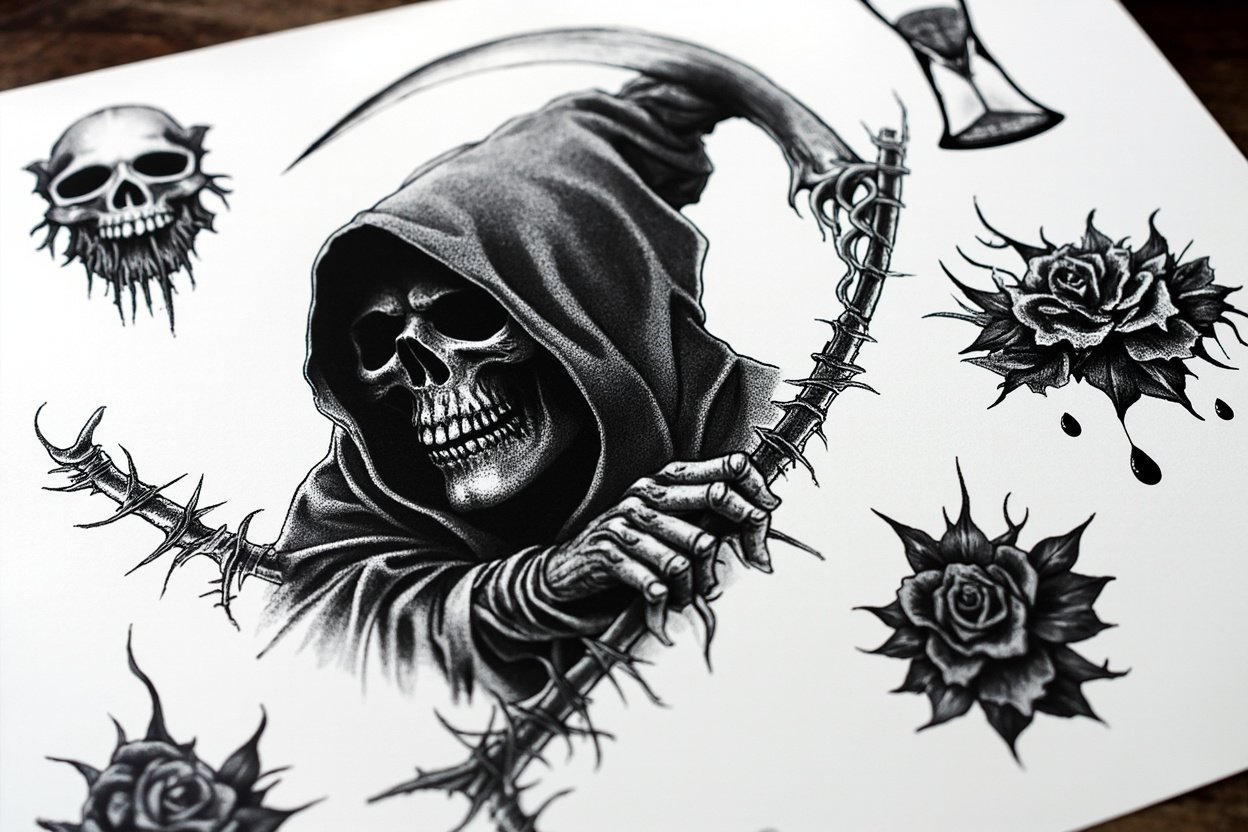
A grim reaper tattoo is rarely about wanting to die. More often it marks the moment someone accepted that death is real, or lost someone, or decided to stop wasting time. The figure carries memento mori, grief, protection, and the quiet idea that life and death sit next to each other rather than far apart.
What the reaper says first
Before any detail registers, the grim reaper reads as mortality itself. That is the whole point. It is a memento mori you wear: a reminder that the time is finite, so use it.
The meaning does not have to be dark. For many people the reaper stands for acceptance, not fear. Death is part of the cycle, and a calm reaper can mark the moment someone made peace with that. The pose sets this tone faster than any prop. A reaper mid-swing is confrontation. A reaper standing still, watching, reads as guide or guardian. The same figure can feel menacing or protective depending on angle alone, so decide which one you want before the drawing starts.
The props and what they shift
Most of the meaning comes from what you put in the reaper’s hands or at its feet. The strongest pieces usually commit to one or two symbols rather than stacking everything.
The scythe
The harvest tool. It cuts crops at season’s end, so on the reaper it stands for cutting the thread of life, for ending what has run its course. An oversized or very sharp blade can also read as a decisive break with the past. Be careful with scale: too small, and the blade loses its edge in a few years of sun and wear, turning into an unreadable smear.
The hourglass
The clearest time symbol on the body. It says the sand is running, the message usually being use what you have. A shattered hourglass shifts the meaning toward transformation, a moment when time as you knew it stopped. Intact, it reads as patience or warning.
The hood and cloak
The hidden face reinforces mystery, what comes after. Deep shadow with no features reads as impersonal, inevitable. A hood that opens just enough to show a skull or gaunt features feels more like a character, sometimes a companion rather than a threat. Negative space in the hood and robe helps create depth without over-packing black ink, which keeps the figure readable as the tattoo ages.
The skull
Under the hood, this is mortality in its oldest visual form. A pile of skulls or skulls in the background pushes the idea that everyone shares the same end. It can flatten the image into generic darkness if overdone, so consider whether one well-rendered skull says more than five.
Roses
The counterweight. Love, beauty, tenderness set next to death. That contrast is the duality many people are actually after. A reaper holding roses or standing among them often reads as memorial. A withered rose leans toward grief and decay. A red rose toward love and sacrifice. A white rose toward remembrance.
Styles that hold the figure
The reaper carries fabric folds, a skull, a long scythe. The style has to hold all of that without turning into grey soup. Black and grey realism is the most common choice for good reason: the hood’s shadows, the bone texture, and the metal of the blade all read clearly. Blackwork with strong line weight also works, especially for smaller pieces where grey wash might blur together. Traditional American can handle the reaper, but the figure tends to become more graphic and less nuanced, which suits some meanings and not others. Fine line and single needle generally struggle; the reaper needs weight to feel present, and thin lines spread or fall out over time on a figure this detailed.
Color is not common for the reaper itself, but accent color in the roses, the hourglass sand, or a background glow can direct the eye without softening the figure. Too much color and the reaper starts to look like an illustration rather than a presence on skin.
Placement and how it changes the read
The reaper is usually a standing figure, so tall placements suit it best. The outer forearm gives the scythe room to run and keeps the face at a readable angle when your arm hangs naturally. The upper arm and thigh work for larger pieces with more background. The back and chest allow full scenes: the reaper in a field, at a doorway, among stars or smoke. The calf can work but the curve of the muscle sometimes distorts the standing posture; the artist needs to design for the flow of the leg, not just paste a flat image on.
Small placements are risky. Hands, fingers, behind the ear: the reaper needs detail to be a reaper, not a hooded blob. If you want something discreet, consider a single prop instead, the scythe alone or an hourglass, and let that carry the meaning.
What the reaper means in different hands
A reaper after a parent’s death often carries roses, dates, or both. The figure becomes a psychopomp, a guide across rather than a threat. Someone who survived a near-death experience sometimes chooses the reaper mid-swing, not to celebrate violence but to mark the confrontation and the walking away. People who have done time, or lost years to addiction, sometimes use the reaper with a broken hourglass to say the old life ended and something else began.
The reaper as protection is older than people think. The figure of death watching over you can read as nothing left to fear, or as a warning to others. In either case it is a boundary, a line drawn around the wearer.
Before you decide
Know which reaper you want. The guardian and the aggressor are the same skeleton in different posture. The memorial and the warning share the same scythe. The more props you add, the more you risk a cluttered read. One or two strong symbols, rendered well, carry further than five symbols fighting for space.
Find an artist who has done the figure before. The reaper’s face is a skull, which means anatomy knowledge matters even when the anatomy is bone. The drape of the cloak has to fall correctly or the figure looks like a blanket, not a garment with weight. The scythe’s perspective has to be accurate or the blade looks broken. This is not a design to hand to someone whose portfolio is mostly lettering and small flash.
Consider how the image will age. Heavy black in the hood will soften and bloom over decades. A face that relies on subtle grey wash for its expression may lose that expression in ten years. Plan for the long version of the tattoo, not just the fresh photo.
And be honest about why you want it. The reaper is a serious figure. Worn lightly, it looks like a costume. Worn with real reason behind it, it becomes part of how you carry yourself.
Frequently Asked Questions
Does a grim reaper tattoo mean you want to die?
No. Most people who choose this figure are marking acceptance of mortality, not desire for it. The reaper often reads as a reminder to live, not a wish to end.
What does a reaper with roses mean?
Usually memorial or the duality of love and loss. The rose softens the figure and adds tenderness. Color and condition of the rose shift the meaning: fresh red for love, withered for grief, white for remembrance.
Is the grim reaper a religious symbol?
Not specifically. The figure draws on European personifications of death and has been used across many cultures and belief systems. It is often linked to memento mori traditions in art, but wears no single religious affiliation.
Where does a grim reaper tattoo work best?
Tall placements that suit a standing figure: forearm, upper arm, thigh, back, chest. Small or highly curved areas tend to distort the posture or lose the detail that makes the figure readable.
What style works best for a grim reaper?
Black and grey realism and blackwork with strong line weight hold the detail best. Traditional American can work but becomes more graphic. Fine line generally struggles with the weight and complexity the figure needs.









