
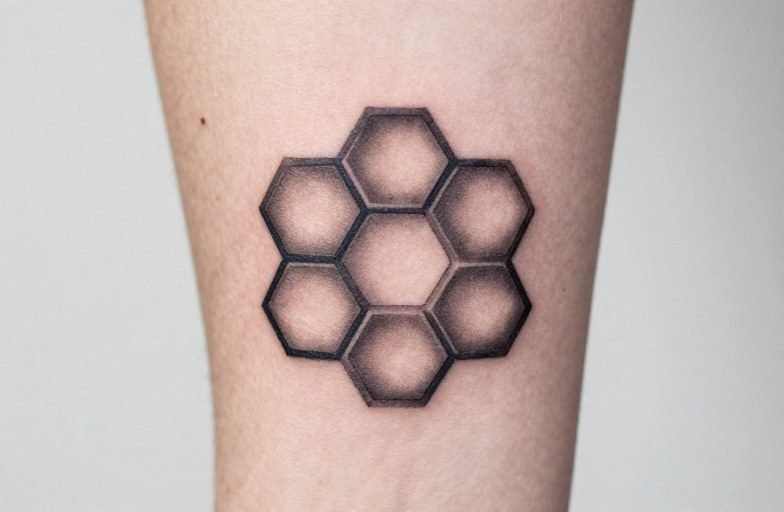
A hexagon tattoo most commonly represents structure, balance, and the intelligent efficiency found in nature. The six-sided shape appears in honeycombs, snowflakes, and molecular structures, making it a symbol of natural order, cooperation, and the interconnectedness of systems. For many people, it serves as a visual reminder of finding strength in pattern and purpose in design.
Similar & Related Symbols
Geometric tattoos cluster in families, and the hexagon sits among shapes with overlapping but distinct associations. Understanding these neighbors helps clarify what makes the hexagon its own specific statement.
Hexagram vs. Hexagon
The six-pointed star (hexagram) often carries spiritual or protective meaning across Jewish, Hindu, and occult traditions. A hexagon, by contrast, is a polygon, flat-sided, enclosing space rather than radiating outward. The hexagon emphasizes containment and foundation; the hexagram, intersection and ascent. Choose the hexagon when you want groundedness rather than transcendence.
The Flower of Life and Tessellation
Hexagons tile perfectly without gaps, a property shared only with squares and equilateral triangles. This tessellation quality links hexagons to the Flower of Life pattern and Islamic geometric art. Where circles in the Flower of Life suggest cyclical potential, hexagons suggest realized structure, potential made stable and usable.
- Triangle: tension, direction, aspiration
- Square: human order, the built world
- Circle: wholeness, cycles, the infinite
- Hexagon: natural efficiency, collective labor, molecular reality
Symbolism & Core Meaning
The hexagon’s symbolic weight comes from three main sources: mathematics, biology, and chemistry. Each offers a different angle on why this shape resonates.
Natural Engineering
Honeybees build hexagonal cells because the shape holds maximum volume with minimum wax. No other polygon achieves this efficiency. A hexagon tattoo can quietly reference doing more with less, resourcefulness as virtue, or finding the elegant solution. Dragonfly eyes, snowflake crystals, and basalt column formations (like Giant’s Causeway) all repeat this pattern, suggesting the hexagon isn’t arbitrary but emergent from physical law.
Molecular and Material Reality
Carbon atoms arrange in hexagonal sheets to form graphite and graphene. Benzene rings, the foundation of organic chemistry, are hexagonal. For people in science, engineering, or environmental fields, the hexagon can signal engagement with material reality at its most fundamental level, neither mystical nor purely abstract, but the actual geometry of substance.
Mythology & Folklore
Direct mythological narratives attached specifically to the hexagon are sparse compared to the circle or triangle. Instead, the hexagon accumulates meaning through association and cultural use.
Cultural and Religious Appearances
Some trace the hexagon’s sacred significance to Islamic geometric art, where it appears in complex tiling patterns as a vehicle for contemplating divine order without figurative representation. In certain European folk traditions, hex signs painted on barns, often hexagonal stars, but sometimes six-sided frames, were commonly associated with protection and agricultural blessing, though their origins blend German folk art with later commercial reproduction. Hindu and Buddhist yantras sometimes incorporate hexagonal elements as part of larger diagrams, though these are rarely standalone symbols.
Modern Esoteric Use
Contemporary occult and neopagan practice sometimes adopts the hexagon as a symbol of the union of opposites: six sides divisible by both two and three, even and odd, representing reconciliation of dualities. This is modern interpretive practice rather than ancient doctrine, but it demonstrates how the shape’s mathematical properties generate symbolic readings.
Color vs Black and Grey
The hexagon’s clean geometry makes it especially responsive to different color approaches. Your choice significantly changes the tattoo’s visual weight and how it interacts with skin tone.
Black and Grey Approaches
Line-work hexagons, single needle or fine line, read as diagrammatic, scientific, restrained. Shaded hexagons with dotwork or stippling create depth and texture, suggesting stone, metal, or organic material. Black and grey ages predictably; the contrast between ink and skin remains readable even as lines soften slightly. For maximum longevity, avoid extremely fine interior details that will blur together over five to ten years.
Color Applications
Gradient fills inside hexagons produce a stained-glass or digital aesthetic. Amber and gold reference honey directly; blues and whites evoke snowflakes or ice crystals. Saturated color requires more frequent touch-ups, especially on high-movement areas. Consider how color choice affects the symbolic reading: warm tones emphasize organic/natural associations, while cool or neon tones push toward technology, gaming, or futuristic themes.
Best Placements
Hexagons adapt to flat planes and curved surfaces differently. The shape’s angularity creates specific challenges and opportunities.
- Forearm (inner or outer): Flat surface preserves geometric integrity; visible but concealable; scales well from two to four inches
- Chest/sternum: Central placement suits hexagons as framing devices or mandala centers; expect significant pain on bone
- Thigh: Large, flat canvas allows tessellated patterns or single large hexagon with interior detail
- Calf: Muscle curvature can distort straight lines if the hexagon is large; smaller designs hold shape better
- Behind ear/side of neck: Small hexagons work as subtle markers; avoid intricate interior work due to limited space and skin movement
Hexagons composed of multiple interlocking units (honeycomb patterns) flow around curved anatomy better than single isolated hexagons, which can look artificially stamped if placed on a highly contoured area.
How It Ages on Skin
Geometric tattoos age according to the precision of their lines and the simplicity of their design. The hexagon’s advantage is structural clarity, even with slight blur, six sides remain identifiable as six sides, unlike complex knotwork where threads merge into indistinct texture.
Line Weight and Spacing
Interior hexagon lines (dividing the shape into smaller sections) should maintain at least 2-3mm spacing to prevent blurring into solid fill over time. Single-needle hexagons look crisp initially but require touch-ups within five to seven years. Bold outlines at 7-9RL or equivalent hold definition for a decade or more. Shading inside hexagons ages more gracefully than solid black fill, which can look blotchy as ink settles unevenly.
Skin Type Considerations
On darker skin tones, white ink highlights inside hexagons fade to translucent or yellowish within two to four years; plan for this or avoid white as a primary element. Keloid-prone skin may react to the repeated straight lines of geometric work, though hexagons are less problematic than designs with many intersecting acute angles. Always consult with your artist about how your specific skin holds fine lines.
Final Thoughts
The hexagon offers something rarer in tattoo symbolism than it first appears: a shape that is simultaneously ancient and modern, natural and mathematical, personal and universal. It does not demand narrative explanation. A hexagon can mark a career in science, a love of beekeeping, an appreciation for efficient design, or simply an attraction to its visual balance. The meaning holds because the shape itself is real, pressed into wax by insects, frozen into ice, baked into rock, and now inked into skin with the same deliberate precision that has made it endure across scales and species.
Frequently Asked Questions
Does a hexagon tattoo always mean something about bees or nature?
No. While the honeycomb connection is common, many people choose hexagons for mathematical, geometric, or purely aesthetic reasons. The meaning depends on your personal context and what the shape represents to you.
How painful is a hexagon tattoo compared to other geometric designs?
Pain depends on placement and size, not the shape itself. However, hexagons often require long, straight lines that demand steady hand pressure, which can make the tattooing process feel more intense than scattered, organic shapes.
Can a hexagon tattoo be easily covered up or modified later?
Hexagons adapt well to cover-ups because their straight edges can frame or incorporate older work. Tessellated patterns can expand to absorb smaller existing tattoos, though very dark solid fills limit your options.
What’s the difference between a hexagon and a honeycomb tattoo?
A single hexagon is one six-sided shape, often symbolic or minimalist. A honeycomb tattoo shows multiple interconnected hexagons, usually referencing community, productivity, or natural engineering more directly.
Related Tattoo Meanings
- Snow Leopard Tattoo Meaning: Solitude, Stealth, and Mountain Strength
- Thunder Tattoo Meaning: Power, Chaos, and Raw Energy
- Wasp Tattoo Meaning: Symbolism, Styles What It Says About You
- Explore more









