
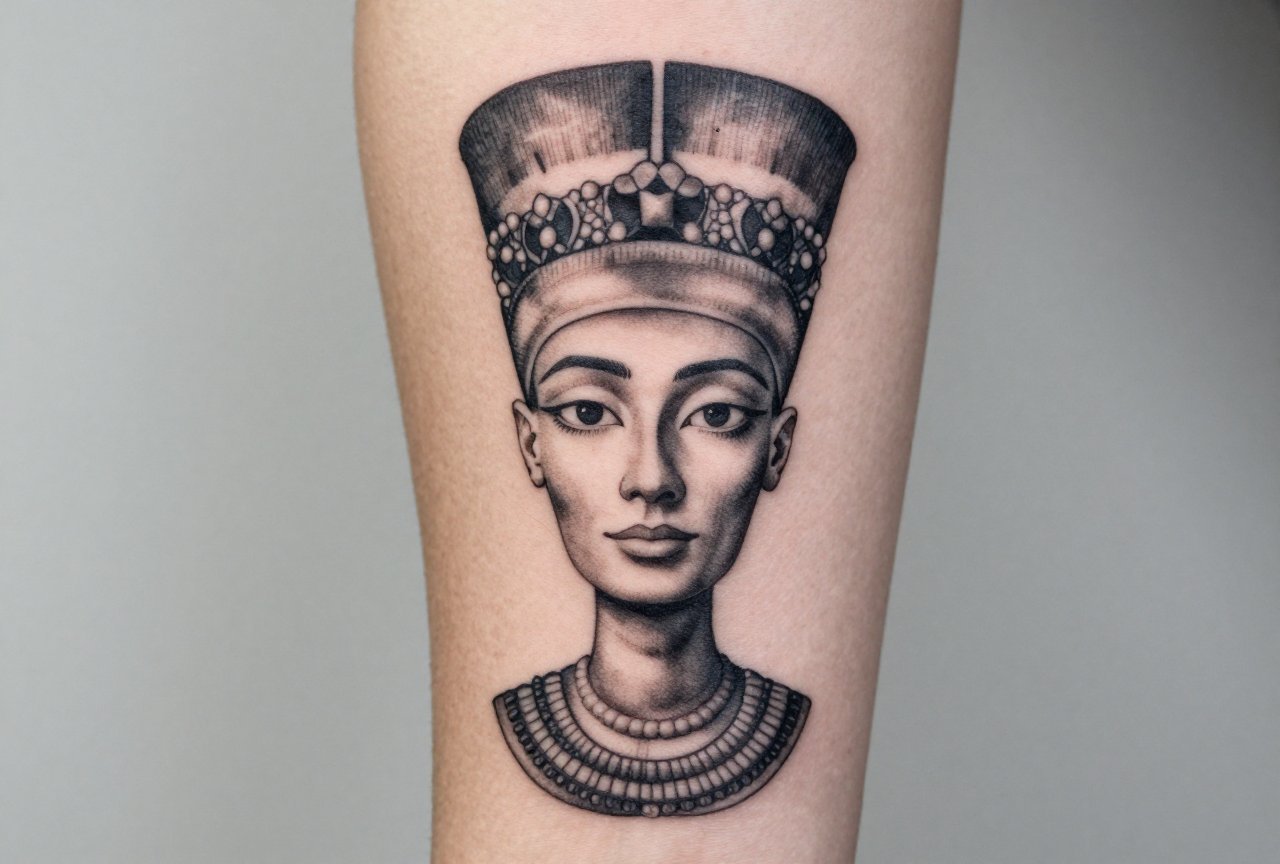
A Nefertiti tattoo carries weight. It’s not just a pretty face from a history book, this design speaks to feminine authority, resilience, and the kind of beauty that outlasts empires. Most people who sit in my chair asking for her want something deeper than aesthetics; they want a symbol of strength that doesn’t apologize.
Symbolism & History
Queen Nefertiti ruled alongside Akhenaten in the 18th Dynasty, roughly 3,300 years ago. Her name means “the beautiful one has come,” but her bust, discovered in 1912, shows something harder than beauty. That elongated neck. The sharp jaw. Eyes that don’t flinch. I’ve had clients trace her profile with their finger and say, “That’s the energy I need every morning.”
The historical Nefertiti redefined power in her time. She appeared in art equal in size to her husband, something unprecedented for Egyptian queens. Some scholars believe she may have ruled alone after his death. That ambiguity, that possibility of hidden strength, draws people in. You don’t choose Nefertiti because you want to look delicate. You choose her because you want to look unbreakable.
What She Represents Today
Modern wearers layer their own meanings onto her. I’ve heard dozens:
- Survival through transformation. Nefertiti’s era upended traditional Egyptian religion; she lived through radical change.
- Black identity and heritage. For many clients, she connects to African history before colonial interruption.
- Maternal authority. She had six daughters and shaped the next generation of rulers.
- Self-possession. That famous bust captures a woman who knew exactly who she was.
One client, a prosecutor in her fifties, got Nefertiti on her forearm after winning a case that took three years. “She waited three thousand years to be found,” the client told me. “I can wait three years for justice.” That’s the kind of personal mythology this image carries.
Common Variations & Styles
Not every Nefertiti looks the same. I’ve tattooed her in maybe fifteen different approaches, and each reads differently on skin.
Realistic Portrait Style
The most direct interpretation copies the Berlin bust: that blue crown, the missing left eye (some artists fill it in, some leave the void), the elegant neck. This works best large, at least palm-sized, because her features are subtle. Small realistic portraits blur fast. I always warn clients: fine lines around the lips and eyes will soften within five years. Go bigger, or go stylized.
Blackwork and Silhouette
Stripping her down to pure profile, just that unmistakable outline, makes for bold, readable tattoos that age beautifully. I’ve done this on inner biceps, on calves, on the backs of necks. The negative space becomes part of the design. You recognize her instantly without any color.
Neo-Traditional and Decorative
Some artists surround her with lotus flowers, ankhs, pyramids, or geometric patterns. This can work, but I tell clients: Nefertiti herself is the statement. Too much ornamentation competes with her presence. The best decorative pieces use restraint, maybe a single lotus at the base of her neck, or a subtle geometric border.
- Color vs. black and grey: The original bust is painted limestone, so color feels authentic. But black and grey ages more forgivingly on most skin tones.
- Single needle vs. bold lines: Single needle gives that delicate, museum-quality feel. Bold lines read stronger from a distance. Your lifestyle matters here, who do you want to see this?
Best Placements
Where you put Nefertiti changes her meaning. I’ve done this design enough to see patterns.
Forearm or outer bicep: This is visibility. She faces the world with you. Good for people who want that daily reminder of their own backbone.
Back of the neck or upper back: More private, more protective. I’ve had clients say it feels like she’s watching their back. The placement suits the silhouette style especially well.
Ribcage or side: Painful, intimate. This tends to be for deeply personal meanings, grief, transformation, something you don’t explain to strangers.
Thigh: Growing in popularity. Gives room for detail, easy to cover, but yours to see. I’ve noticed younger clients gravitate here; older clients often want her where they can catch her eye during hard moments.
One thing we see a lot in shops: people want her facing forward, but the bust faces right. Some clients ask for a mirror image so she faces them. I always discuss this. The original orientation connects to her historical context. The reversed version becomes purely personal. Neither is wrong, but it’s worth choosing consciously.
Who Chooses This Tattoo / Personal Meanings
There’s no single type. I’ve tattooed Nefertiti on a nineteen-year-old art student and a sixty-two-year-old retired Marine. But I do notice threads.
Women who’ve rebuilt themselves often choose her. After divorce, after illness, after leaving jobs or religions or countries. She represents a self built from scratch, crowned and certain. The blue crown in the bust, that “Nefertiti cap crown”, wasn’t everyday wear. It was ceremonial, formal, intentional. These clients are dressing themselves in intention.
Men choose her too, usually differently. Often as tribute, to mothers, to partners, to the concept of feminine strength they want to honor or remember. I’ve had fathers get her after daughters were born, saying they want to raise girls who know their own power.
Some clients come with heritage as the driver. The Nefertiti bust spent decades in European museums while Egypt fought for repatriation. Wearing her can be a reclamation, a way of saying she belongs to us, not to glass cases. I’ve had long conversations in my chair about what it means to carry African history on skin in a country that often forgets it.
Similar Symbols
Clients sometimes hesitate between Nefertiti and related icons. Here’s how I talk them through it:
- Cleopatra: More dramatic, more sexualized in pop culture, more Roman-era. Cleopatra tattoos often play with asp imagery, drama, tragic endings. Nefertiti feels more serene, more enduring.
- Isis: Goddess, not historical queen. Wings spread, maternal, magical. Choose Isis for protection and mysticism; choose Nefertiti for human achievement and regal dignity.
- Anubis or Ra: Deity territory, masculine-coded in most Western interpretations. Nefertiti offers feminine divinity without leaving the human world.
- Generic Egyptian eye (Wedjat): Common, sometimes overdone. Nefertiti is specific. She has a story. The eye is a symbol; she is a person.
I had a client switch from a planned phoenix to Nefertiti mid-consultation. “A phoenix burns and rises,” she said. “Nefertiti just stayed. She kept her head up for three thousand years.” That distinction matters. Not everyone wants the drama of rebirth. Some want the quiet of endurance.
Final Thoughts
Nefertiti endures because she refuses simplification. Historians still debate her final years. The bust itself is unfinished, the left eye missing, the surface rough in places. That incompleteness invites projection. You don’t finish her story; you continue it.
In my years tattooing, I’ve learned that the best designs carry tension. Nefertiti offers plenty: ancient and immediate, foreign and deeply personal, beautiful and severe. She works in fine lines or bold black, on visible skin or hidden places, for twenty-year-olds and for grandparents.
If you’re considering her, spend time with the bust itself. Visit it if you can, or study high-resolution images. Notice the asymmetry. The tool marks. The color that remains. Then decide what you want to carry forward. Because this tattoo isn’t about Egypt. It’s about what Egypt means to you, here, now, in your particular life. That’s where meaning actually lives. Not in the symbol, but in the choice to wear it.
Frequently Asked Questions
Does a Nefertiti tattoo have to be large to look good?
Not necessarily, but realism needs space. Small Nefertiti portraits lose detail fast as skin ages. Stylized silhouettes or minimal line versions work beautifully at smaller sizes. I usually suggest at least three inches for any portrait-style work.
Is it culturally appropriate for non-Egyptian people to get this tattoo?
Most Egyptian artists and historians I’ve spoken with welcome appreciation, but context matters. If you’re drawn to her as a symbol of feminine strength or historical significance, that respect usually reads. Avoid treating her as exotic decoration or mixing her with unrelated sacred symbols.
How well does color hold in Nefertiti tattoos?
The blue crown is iconic, but blues and yellows fade faster than black on most skin tones. I often suggest black and grey with subtle blue accents, or planning for touch-ups every few years if you want bold color that stays true.
What should I ask an artist before booking this design?
Ask to see their portrait work specifically, not just Egyptian-themed tattoos. Look for clean lines in facial features and healed photos. Nefertiti’s profile is distinctive, any artist should be able to explain how they’ll handle her crown, neck proportions, and that famous missing eye.
Related Tattoo Meanings
- Cleopatra Tattoo Meaning: Power, Beauty Legacy
- Nice Meanings Tattoo Meaning: Symbolism, Styles Placement
- Nmm Tattoo Meaning: Symbolism, History What Artists See
- Explore more









