
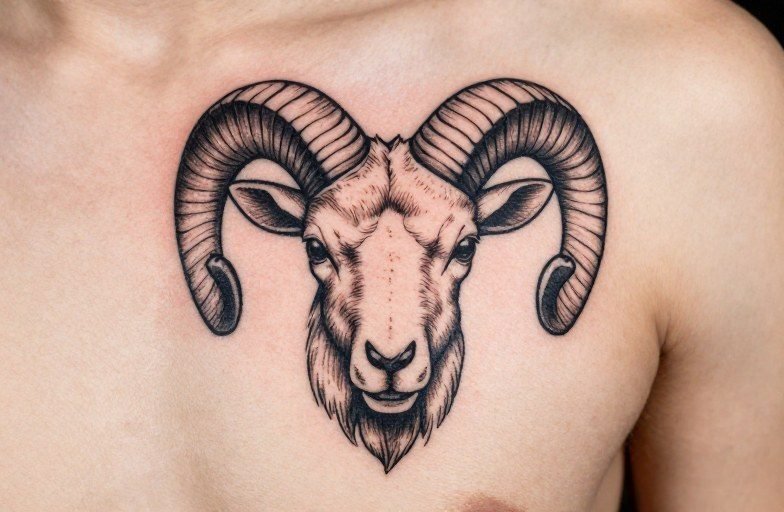
A ram head tattoo primarily signals force of will, unflinching confrontation, and the refusal to back down. The curled horns read as both weapon and crown, making the image popular among people who identify with leadership, aggression channeled into purpose, or the Aries zodiac sign. Beyond astrology, the ram carries ancient associations with sacrifice, fertility, and solar power across several Mediterranean and Near Eastern cultures.
Symbolism & History
The Horn as Weapon and Status
The spiraled horns are the visual anchor of every ram design, and they carry layered weight. In nature, horn size determines dominance within the flock; a full curl signals maturity and fighting experience. Tattoo compositions often exaggerate this curve for dynamism, sometimes wrapping the horns around a skull, clock, or floral element. The horn also functions as a shield, the ram lowers its head and charges, making the skull itself a battering ram. That physical reality translates symbolically to someone who leads with their head, sometimes literally.
Ancient and Cultural Threads
The ram appears in Egyptian iconography, often linked to the god Amun and solar rebirth. Some trace it to the worship of Khnum, the ram-headed creator deity who shaped humans on a potter’s wheel. In Greek myth, the golden fleece came from a winged ram sent by Hermes to rescue Phrixus and Helle, an origin story that ties the animal to divine intervention and heroic quest. Norse and Celtic traditions commonly associated the ram with virility and agricultural cycles, though specific symbolic overlap varies by region and period. Rather than a single unified “ancient meaning,” the ram accumulated significance through these dispersed channels, which gives modern wearers room to emphasize the thread that resonates personally.
- Aries / Mars: The astrological ram, ruled by Mars, emphasizes initiative, competitive drive, and occasional impulsivity. Aries placements often choose this tattoo to mark identity or a pivotal birthday.
- Sacrifice and renewal: The ram as sacrificial substitute in Abrahamic traditions (the binding of Isaac) adds a layer of substitution and providence that some incorporate explicitly.
- Military and team insignia: Several army regiments and sports teams have adopted the ram for obvious reasons, aggression, coordinated force, terrain dominance.
Common Variations & Styles
Not all ram heads read the same. The stylistic choice shapes meaning as much as the subject itself.
Realistic vs. Stylized
Photorealistic black-and-grey rams emphasize texture, wet nose, coarse wool, the ridged horn surface. These often read as reverence for the animal itself, or a connection to hunting, farming, or rural identity. Stylized versions, geometric, tribal, or neo-traditional, abstract the horns into patterns that can feel more aggressive or more spiritual depending on line weight and symmetry. A geometric ram with perfect mirror halves suggests control and order; a fractured or asymmetrical version hints at struggle or transformation.
Graphic and Neo-Traditional
Bold-line neo-traditional rams with limited color palettes (red, black, gold) channel vintage military insignia and biker aesthetics. The high contrast ages well on skin, and the simplified shapes hold up better over decades than fine detail. Graphic single-needle work has emerged more recently, using delicate lines to render the horn curl as almost calligraphic, less aggressive, more contemplative.
- Skull variants: Ram skulls remove the living animal and emphasize mortality, memento mori, or the passage through hardship. The empty eye socket becomes a focal point for negative space or embedded imagery.
- Floral integration: Roses or wildflowers woven through horns soften the martial edge, often chosen to balance masculine-coded aggression with growth, memory, or specific relationships.
- Celestial additions: Stars, moons, or constellation lines explicitly mark Aries identity or timing, birth, death, or a decision made under a specific sky.
Best Placements
The ram head’s natural triangle shape, broad at the horns, narrowing to the muzzle, suits several body locations better than others.
Thigh and calf: The curved horns follow the muscle contour naturally. Outer thigh placement allows for larger scale and fuller detail; the calf’s narrower canvas often demands a more compressed, graphic treatment. Both locations heal relatively predictably and allow the wearer to control visibility.
Chest and sternum: Centered placement makes the horns spread across the pectorals like a natural breastplate. This reads as protective and confrontational, visible in a tank top, impossible to miss. Sternum pieces between the pecs work for smaller, more vertical compositions but require committed sitting; the bone proximity makes the session sharp.
Upper arm / shoulder: The classic “badge” location. A ram here functions like a pauldron, historically associated with armor and regiment insignia. The deltoid curve lets the horns wrap slightly, adding dimension. Inner bicep offers concealment and a more private intensity.
Hand and neck: Aggressive placements for an aggressive image. The visibility stakes are high; this is not a first tattoo choice for most. The small canvas forces simplification, which can actually strengthen the icon’s immediate impact.
Skin aging considerations: horn curls with fine interior detail (shading between the ridges, wood-grain texture) will soften and blur over fifteen to twenty years on high-movement areas like the inner arm or calf. Simpler line-based horns hold their structure longer. Sun exposure accelerates fading on the outer arm and thigh; plan for touch-ups if you work outdoors.
Who Chooses This Tattoo / Personal Meanings
There’s no monolithic ram-head wearer, but patterns emerge in consultation.
Aries-identified clients often arrive with specific dates, planetary positions, or matching sibling pieces. The ram becomes shorthand for self-recognition rather than performance. Others come after a period of sustained opposition, legal battles, competitive sports careers, military service, or recovery from significant physical injury. The charging animal validates a mindset they needed to survive.
Some agricultural backgrounds inform the choice: actual sheep and goat farmers, 4-H alumni, people who grew up with the animal’s smell and behavior and want to carry that origin forward. The tattoo then functions as heritage marker rather than borrowed symbolism.
Less commonly, the ram appears as a sober or memorial piece. The sacrificial associations, or the animal’s role in specific family farming histories, create space for grief and gratitude that the more common deer or dove imagery doesn’t accommodate. A ram skull with a specific date or coordinates can carry this weight without explaining itself to strangers.
Similar Symbols
People considering ram heads often cross-shop related imagery. Understanding the distinction helps clarify the choice.
- Bull / Taurus: Earthier, more grounded, associated with fertility and stubbornness without the martial charge. The bull stands its ground; the ram charges. Taurus energy reads patient where Aries reads impulsive.
- Stag: Regenerative (antlers shed and regrow), more forest and solitude than flock and confrontation. The stag leans noble; the ram leans scrappy.
- Goat: Close cousin visually, but the goat carries more chaotic or occult associations, Capricorn’s ambition, Baphomet’s deliberate provocation, the mountain goat’s impossible terrain mastery. The ram is more direct, less ironic.
- Lion: Apex predator, royalty, solar power. The lion announces; the ram insists. Lions are given their status; rams fight for it every breeding season.
Some designs hybridize, ram horns on a human skull, a ram emerging from flames, the Aries symbol integrated into abstract geometry. These work when the combination resolves a specific personal tension rather than accumulating symbols for coverage.
Final Thoughts
The ram head tattoo works because the animal’s behavior is legible even to people who’ve never seen one in person. Head down, horns forward, momentum over caution. That physical grammar translates across styles and cultures without requiring explanation. Whether the connection is astrological, agricultural, or simply temperamental, the image carries enough historical density to feel grounded and enough visual punch to hold its own against more common tattoo subjects. Choose the horn curl you want to live with, place it where the shape fits your body, and let the line work do the talking.
Frequently Asked Questions
Does a ram head tattoo always mean I’m an Aries?
Not at all. While Aries identification is a common reason, many people choose the ram for its qualities of determination, leadership, or personal history with farming and livestock. The meaning depends on your own context, not just astrological alignment.
Will a detailed realistic ram head age well on my forearm?
Fine detail in the wool texture and horn ridges will soften over time, especially on high-movement, sun-exposed areas. A simpler graphic version or bolder line work holds its structure longer; plan for a touch-up after several years if you want crisp detail preserved.
What’s the difference between a ram skull and a living ram head tattoo?
A living ram emphasizes vitality, confrontation, and ongoing force of will. The skull shifts toward mortality, sacrifice, and what you’ve survived. The skull also allows for more negative space and embedded imagery like flowers or celestial elements.
Is the ram head considered a masculine tattoo?
The imagery is traditionally coded masculine due to military and sports associations, but the symbol itself isn’t gendered. Many women and non-binary people choose ram heads for the same reasons of resilience and leadership, often integrating floral or abstract elements that complicate the stereotype.
Related Tattoo Meanings
- Rare Meanings Tattoo: Symbolism of Obscure Ink
- Razor Blade Tattoo Meaning: Sharp Edges and Deeper Symbolism
- Riley Reid Back Tattoo Meaning: Symbolism and Design
- Explore more









