A rattlesnake tattoo carries layered meaning rooted in actual danger, not fantasy. It represents protection, transformation, and the power of warning before striking. For many people, it becomes a personal symbol of surviving something that could have killed them, or of choosing when to fight and when to stand down.
Symbolism & History
I’ve tattooed rattlesnakes on bikers, veterans, recovering addicts, and quiet suburban dads who never explain the full story. The thread connecting them is always some version of “I made it through.” The snake itself is a loaded symbol across cultures, but the rattlesnake adds something specific: the rattle. It gives warning. That’s the whole point.
Native American Roots
In Southwest Indigenous traditions, the rattlesnake commands respect as a guardian figure. Pueblo and Hopi imagery often shows the snake protecting sacred spaces. The Hopi snake dance isn’t about worshipping danger; it’s about acknowledging the balance between life and death, rain and drought. When someone asks for a rattlesnake with geometric Pueblo patterns, I know they’ve done real research. The diamondback’s patterning already echoes basket-weave designs, so the visual marriage works naturally.
American Frontier & Military Connection
The Gadsden flag, “Don’t Tread on Me” with a coiled rattlesnake, dates to 1775 and never really went away. I’ve had Marines request that exact coiled pose, sometimes with the text, sometimes without. The military connection runs deep: the snake as defender of territory, striking only when provoked. One client, an Army Ranger, told me the rattle was the equivalent of escalation of force protocol. Warning first. That stuck with me.
- Warning and discernment, the rattle as voice before violence
- Rebirth and shedding, the literal skin-shedding process
- Primal survival, venomous but not aggressive without cause
- Boundaries and territory, the coiled stance as “this far, no further”
Common Variations & Styles
The style changes the meaning more than people expect. A photorealistic diamondback reads as documentary, almost scientific. A traditional American coiled snake with roses reads as classic tough-guy sentimentality. I’ve done both, and the conversation in the chair is totally different.
Traditional & Neo-Traditional
Traditional American rattlesnake tattoos usually show the snake coiled, ready to strike, often paired with daggers, roses, or skulls. The bold lines hold up for decades. I’ve watched thirty-year-old traditional snake tattoos age beautifully because the black outlines carry the design even as color fades. The meaning here leans into warning and defiance, the classic “don’t mess with me” energy that traditional tattooing was built on.
Realistic & Black-and-Grey
Photorealistic rattlesnakes require serious technical skill. The scales, the rattle’s segmented texture, the eye’s vertical pupil, every detail matters. These clients usually want the snake itself respected, not stylized. The meaning shifts toward reverence, sometimes fear confronted. One guy had me do a huge black-and-grey diamondback across his ribs after a snakebite that nearly killed him during a desert hike. He wanted to see it daily. The realism was non-negotiable.
- Coiled strike pose, aggression, readiness, warning
- Shedding skin, transformation, leaving the past behind
- Snake and dagger, betrayal survived, or danger defeated
- Skull and snake, mortality, the cycle of life and death
- Ouroboros variant, self-creation, eternal return
Best Placements
Placement changes how the tattoo moves and how others read it. I always ask clients to consider whether they want the snake to appear defensive or active.
The forearm coiled strike is probably the most common request. It’s visible, the muscle movement makes the snake seem alive, and it carries that classic “watch yourself” energy. I’ve done dozens. The inner bicep works well for a snake wrapping upward, head near the shoulder, protective, almost guardian-like. Thigh pieces allow for full body length with the rattle near the knee, which creates interesting movement when walking.
Back pieces let you do the full spread, sometimes with the snake’s body forming a frame or surrounding another image. The ribs hurt like hell but give that side-wrapping natural curve. I’ve tattooed throats twice, both times on people who’d survived violence and wanted the warning visible at speaking distance. That’s heavy. I made sure they were sure.
Hand and finger snakes are trendy but problematic. The small scale loses detail, the rattle becomes a blob, and finger tattoos fade fast. I warn people honestly. If they insist, I do it, but I want them knowing what year three looks like.
Who Chooses This Tattoo / Personal Meanings
After fifteen years in shops, I can tell you the stereotype is wrong. It’s not all bikers and rebels. The rattlesnake attracts people who’ve had to become dangerous to survive, or who’ve learned to set hard boundaries after failing to protect themselves.
Survivors and Boundary-Setters
I’ve tattooed this on people leaving abusive relationships, getting sober, coming out of prison, or surviving illness. The common thread is transformation through necessity. The snake didn’t choose to be venomous; it evolved that way. The rattle isn’t aggression; it’s communication. These nuances matter to people who feel misunderstood as “angry” when they’re actually careful.
Regional Identity
Texans, Arizonans, New Mexicans, the Southwest connection is real. Some people just grew up watching for diamondbacks on hikes. The tattoo becomes hometown pride with teeth. I’ve had clients from rattlesnake-free states request it anyway, drawn to the symbolism without the lived experience. That’s fine, but the ones who’ve actually heard that buzz in dry grass carry something different in their eyes when they describe what they want.
Similar Symbols
Clients often compare rattlesnakes to other snake tattoos or protective symbols. Here’s how I talk them through it.
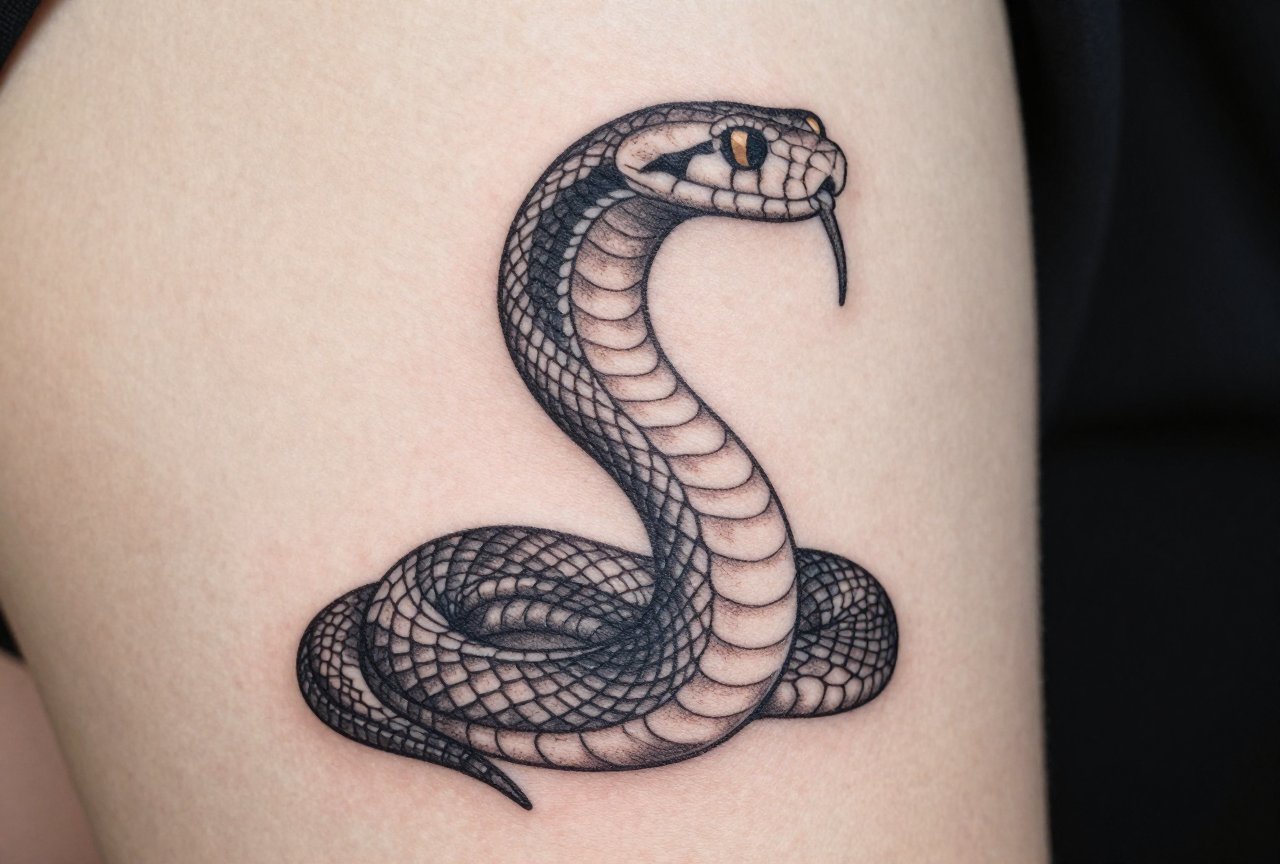
The cobra shares the danger-prestige but lacks the warning system. Cobras are more about lethal elegance, royalty, hypnotic power. The rattlesnake is rougher, more American, more about boundaries than domination. King snakes, nonvenomous, actually eating rattlesnakes, sometimes appeal to people who want the protective vibe without claiming danger they don’t feel. That’s valid too.
Scorpions share the desert-defender niche, but they’re more purely aggressive. No rattle, no warning. Wolves protect the pack; rattlesnakes protect the self. The comparison I use: wolf tattoos are about who you love, rattlesnakes about who you are when alone.
- Cobra, lethal elegance, no warning system
- King snake, protection without venom, the peaceful guardian
- Scorpion, pure aggression, desert survival
- Wolf, pack loyalty, community defense
- Panther, silent power, stalking patience
Final Thoughts
A rattlesnake tattoo isn’t decoration. It’s a statement about how you move through the world, armed but not attacking, dangerous but not indiscriminate. I’ve watched people cry in my chair explaining why they need this specific snake in this specific pose. I’ve watched others sit silently, not sharing, and that’s fine too. The image carries enough weight without the backstory.
If you’re considering one, think about the pose. Coiled and ready? Shedding? Striking? Each reads differently. Think about the rattle, do you want it emphasized, or subtle? That detail changes everything. And find an artist who understands snake anatomy. A rattlesnake with the wrong scale pattern or a generic snake head is a wasted opportunity. This creature deserves accuracy. It’s earned that respect.
Frequently Asked Questions
Does a rattlesnake tattoo always mean something aggressive?
Not at all. The rattle specifically means warning before violence, which many people interpret as healthy boundaries or measured response. I’ve tattooed this on trauma survivors who see it as finally being able to protect themselves without lashing out.
How well do detailed rattlesnake tattoos age over time?
Bold traditional styles with strong black outlines age best. Photorealistic scale detail will soften and blur over a decade, especially on high-movement areas like hands or wrists. I always tell clients to expect the rattle segments to merge slightly over time.
Is it disrespectful to get a rattlesnake with Native American design elements?
It depends on context and specificity. Broad geometric patterns inspired by Southwest art are generally acceptable, but directly copying sacred ceremonial imagery or specific tribal symbols without connection or permission crosses a line. I steer clients toward respectful collaboration or original patterning instead.
What’s the most painful placement for a rattlesnake tattoo?
Ribs and sternum hurt most due to bone proximity and thin skin. The throat is brutal but brief. Thighs and outer arms are manageable for most people. I always warn that the rattle detail near bony areas like wrists or ankles stings extra because of the needle concentration.
Related Tattoo Meanings
- Rebellion Flag Tattoo Meaning: Symbolism, History Personal Expressio
- Rock of Ages Tattoo Meaning: Faith, Strength Timeless Ink
- Ship Tattoo Meaning: Journey, Freedom Resilience
- Explore more