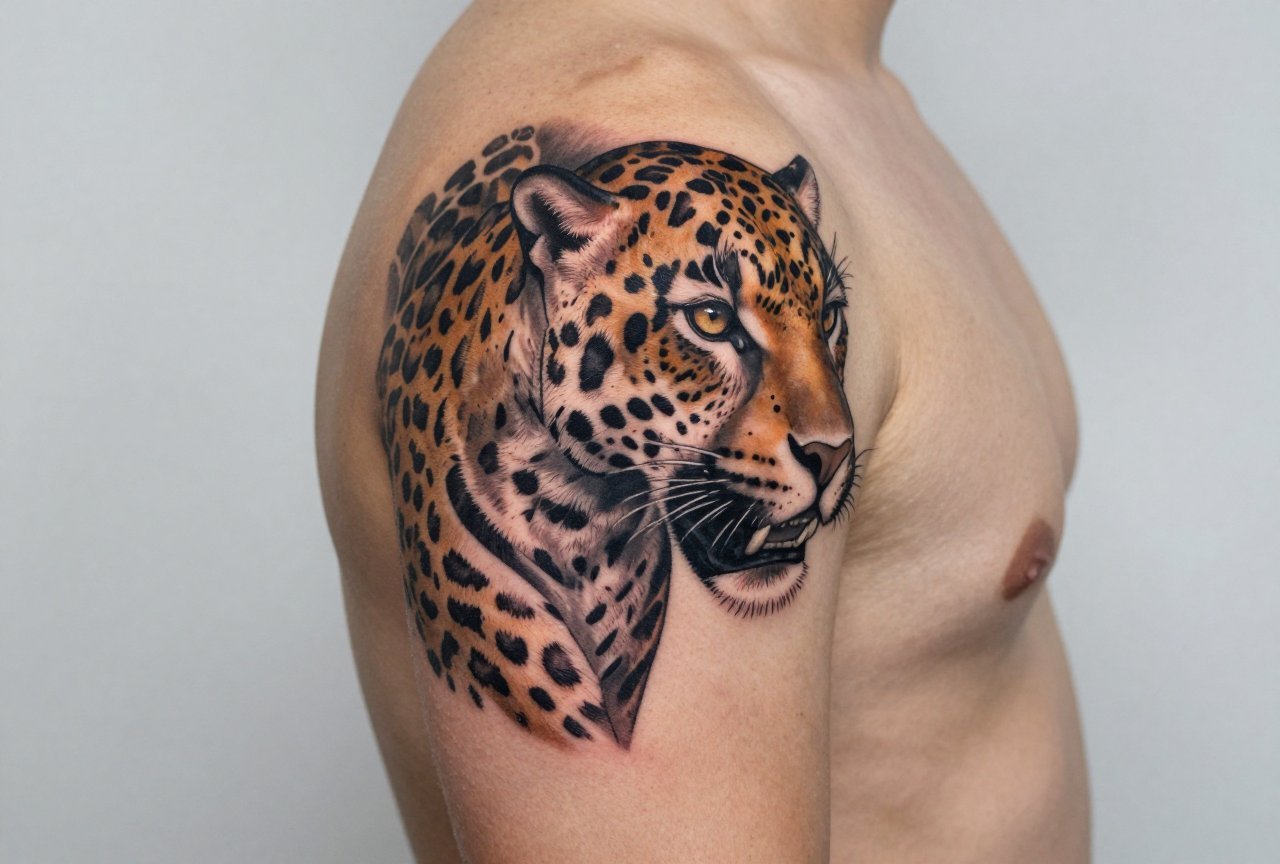
A realistic jaguar tattoo is exactly what it sounds like: a portrait of the animal rendered with photographic detail, every rosette, every whisker pore, the weight of muscle under fur captured in ink. It’s not stylized. Not tribal. Not a cartoon. The goal is to make someone do a double-take and wonder if the cat’s about to step off your skin. I’ve tattooed jaguars across shoulders, thighs, ribs, and full backs over the years, and the style demands a specific technical approach. The jaguar’s rosette pattern, those broken circles with spots in the center, creates a natural visual rhythm that translates beautifully to skin, but only if the artist understands how to build depth without turning the whole thing into mud.
Origins & History
Pre-Columbian Roots
The jaguar carries serious weight in Mesoamerican culture. Olmec, Maya, Aztec, these civilizations didn’t just respect the animal; they built entire cosmologies around it. The jaguar was a shamanic creature, a bridge between worlds, a symbol of night vision and predatory power. I’ve had clients come in with references from codices, wanting to blend that ancient iconography with photorealistic rendering. It’s a tricky balance. The traditional imagery is flat, symbolic, frontal. Realism wants dimension, light source, anatomy. When it works, though, when you get that stone-carved intensity rendered in living skin, it’s something special.
Modern Tattoo Evolution
Realistic animal portraiture really took off in the 1990s and 2000s as tattoo machines improved and artists started studying fine art fundamentals more seriously. Before that, most jaguar tattoos were either traditional Americana flash or tribal blackwork. Now you’ve got artists who can render individual guard hairs catching light, the wet gleam of a nose, the specific amber-to-green gradient of a jaguar’s eye. I’ve watched the style evolve in my own work, what I considered “realistic” fifteen years ago looks flat to me now. The bar keeps rising.
Key Characteristics & Motifs
What separates a realistic jaguar from other big cat tattoos? A few specific elements:
- Rosettes, not spots: Leopards have solid spots. Jaguars have rosettes, larger, broken circles with one or more central dots. Getting this wrong is an instant tell. I always double-check reference photos with clients because mix-ups happen constantly.
- Stockier build: Jaguars are compact, muscular, almost tank-like compared to the leaner leopard. The head is broader, the jaw heavier. An artist used to drawing cheetahs will make your jaguar look wrong without realizing.
- Eye color and intensity: That golden-green stare is iconic. In color work, the eye often becomes the focal point. In black and grey, it’s all about the reflective catchlight and the depth of the pupil.
- Environmental context: Many realistic jaguar pieces incorporate rainforest elements, dappled light through canopy, wet leaves, mist. This grounds the animal in its actual habitat rather than floating it on skin.
Texture work separates good from great. The fur direction changes across the body, short and smooth on the nose, longer and coarser on the neck and shoulders. I’ve spent hours building up layers of fur texture with single needles, and it’s tedious, but the result makes the animal feel alive.
Color vs Black and Grey
Full Color Realism
Color jaguar tattoos can be stunning. The golden-tan base, the black rosettes, the pink nose leather, those green-gold eyes. But color realism on animals is unforgiving. Fur has thousands of subtle shifts, warm undertones, cool shadows, sun-bleached tips. I tell clients that color pieces need more sessions, more saturation, and more commitment to aftercare. The yellows and oranges in particular can fade or shift toward brown over time. I’ve seen gorgeous color jaguars that needed significant refresh work after five years.
Black and Grey
This is where I personally think jaguars shine. The high contrast between dark rosettes and lighter fur translates naturally to greywash. You can push the depth further without worrying about color muddying. The technique relies on smooth transitions, soft grey backgrounds, crisp black details, white highlights for whiskers and eye reflection. Healing tends to be cleaner too; less trauma to the skin from fewer passes. Most of the jaguars I’ve done in recent years have been black and grey, often with selective use of white ink for pop.
Best Placements
Jaguars need room to breathe. The detail work demands real estate.
- Thigh: My favorite placement for a single jaguar portrait. The muscle curve gives the animal natural dimension, and there’s enough flat area for detail without distortion. I’ve done thighs where the cat appears to be crouching, muscles coiled, ready to spring.
- Upper arm/shoulder: Classic placement. The deltoid cap can carry the head and shoulders beautifully, with the body wrapping toward the chest or back. Watch for the ditch and inner arm, those areas don’t hold fine detail as well long-term.
- Back piece: For the serious collector. Full back jaguars allow for environmental storytelling, water, jungle, prey in the distance. I’ve worked on back pieces that took forty hours plus.
- Ribs: Painful, but the vertical format suits a stalking or climbing jaguar. The skin here moves a lot with breathing, so I design with some flexibility built in.
- Chest: Powerful placement, especially with the head centered over the sternum. The pectoral muscles can create a living, breathing quality to the piece.
Small placements? I generally talk clients out of anything under palm-sized for realistic work. The rosettes become blobs, the fur texture disappears, and you’re left with a cat-shaped smudge in five years.
Who It Suits
I’ve tattooed jaguars on construction workers, software engineers, grandmothers, veterans. The symbolism crosses demographics: power, stealth, connection to the wild, cultural heritage for those with Latin American roots. What matters more than “who” is the commitment level. Realistic animal work isn’t a spontaneous Friday decision. It requires patience for long sessions, disciplined aftercare, and willingness to return for touch-ups. The people who get the best results are the ones who’ve thought about it for months, who bring strong reference material, and who trust the process enough to sit still while I build layers of detail.
Modern Variations
The style keeps evolving. Lately I’ve seen more clients asking for:
- Double exposure: The jaguar’s silhouette filled with jungle canopy, Mayan calendar wheels, or starfields. Technically demanding but visually striking when executed well.
- Neo-traditional realism: Photographic rendering with bold, illustrative outlines. A hybrid that heals cleaner than pure realism but keeps the detail.
- Motion blur and action shots: Jaguars mid-leap, water splashing, prey in frame. These reference wildlife photography directly and require serious composition skills.
- Cultural fusion: Realistic jaguar combined with geometric patterns from indigenous art, or gold elements referencing Aztec metalwork. I did one recently where the cat’s eye was replaced with a polished obsidian mirror, unsettling and beautiful.
Choosing an Artist
This is where I get passionate. Not every realism artist can do animals. Not every animal artist can do jaguars specifically. Look for:
- Healed photos: Fresh tattoos look amazing. Healed work tells the truth. Ask to see pieces from one, three, five years back. I keep a folder of healed client returns for exactly this reason.
- Specific big cat experience: An artist who does wolves or eagles isn’t automatically prepared for the rosette pattern and muscle structure of a jaguar. Ask directly.
- Understanding of light source: Realism lives or dies on consistent lighting. Inconsistent shadows flatten the image. I always sketch the light direction before starting the tattoo.
- Willingness to say no: An artist who’ll talk you out of a bad placement or unrealistic size is an artist who cares about the work long-term. I’ve turned down palm-sized realistic jaguars more times than I can count.
Budget matters too. Realistic animal work is slow. A quality thigh piece might run eight to fifteen hours. Paying by the piece versus hourly affects how the artist paces themselves. I prefer hourly for complex realism because rushing serves nobody.
Final Thoughts
A realistic jaguar tattoo is a serious undertaking. It’s not flash art. It’s not something you pick off a wall. The best pieces come from collaboration, your vision, the artist’s technical knowledge, and a shared respect for the animal itself. I’ve watched clients sit through twenty hours for a back piece and emerge changed by the process. There’s something about carrying that predator’s gaze on your skin. It changes how you move through rooms.
Take your time finding the right artist. Bring references that matter to you, maybe a photo from a specific reserve, or a memory of seeing one in the wild, or an ancestral connection you want honored. The jaguar has been revered for millennia. Your tattoo joins that lineage. Make it count.
Frequently Asked Questions
How long does a realistic jaguar tattoo typically take to complete?
A palm-sized portrait might take four to six hours, but most quality realistic jaguar work runs eight to fifteen hours for a thigh or shoulder piece. Full back pieces with environment can exceed forty hours across multiple sessions. I schedule realism in three-to-four-hour blocks because detail work degrades when the artist fatigues.
Do jaguar tattoos fade faster than other realistic animal tattoos?
The rosette pattern actually holds up well because the high contrast between black and lighter tones creates visual readability even as some softening occurs. What fades first is the subtle fur texture and background environment. I always plan for a touch-up session around the one-year mark to refresh those softer elements.
Can I combine a realistic jaguar with traditional tribal or geometric patterns?
Absolutely, but it requires careful design integration. I recommend keeping the jaguar itself purely realistic and placing geometric elements in negative space around it, or using them as a background layer behind the animal. Mixing styles within the cat’s body usually looks disjointed unless handled by an artist experienced in that specific fusion.
What’s the most painful area for a realistic jaguar tattoo?
Ribs and sternum are brutal, the skin is thin over bone with lots of nerve endings. The ditch (inner elbow) and back of the knee aren’t far behind. Thighs and outer arms are most manageable. I always warn clients that the second session on a painful area often feels worse than the first because the body remembers the trauma.
Related Style Guides
- Realistic Portrait Tattoos: A Working Artist s Guide
- Traditional Lady Tattoos: A Working Artist s Guide
- Traditional Pirate Tattoos: A Working Artist s Guide
- Explore more